DRILL HOLES
49
YEARS ON MARS
14+
DESIGN LIFE EXCEEDED
7×
ORIGINAL COST
$2.5B
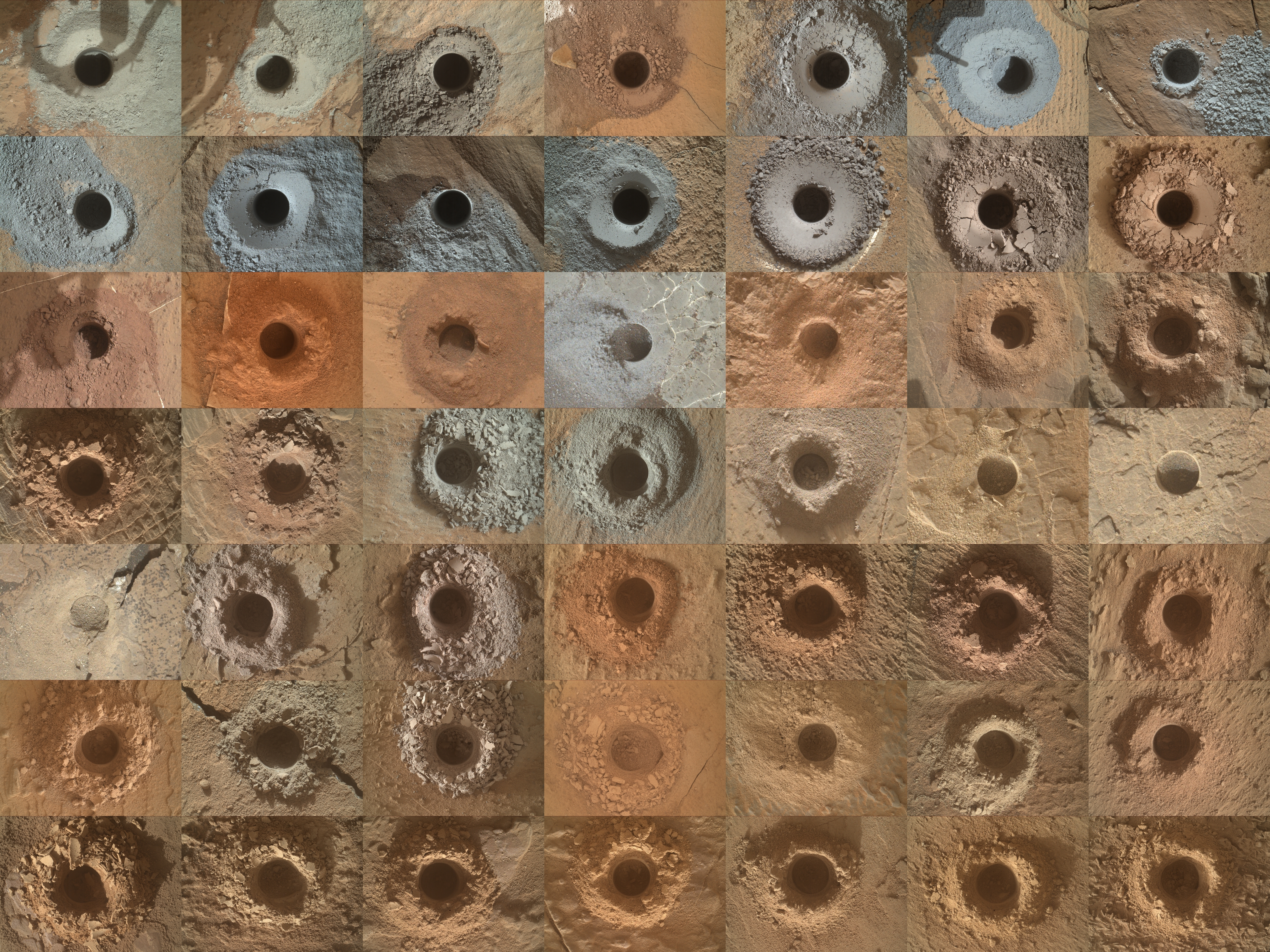
NASA released a collage on November 16 showing 49 drill holes captured by the Curiosity Mars rover as of November 2026. Each hole represents a rock sample collected from the Martian surface, drilled by the instrument on the end of Curiosity's robotic arm, pulverized, and dropped into onboard instruments for compositional analysis. It is a simple image that encodes an extraordinary operational achievement.
Extraction Map
Curiosity landed in Gale Crater in August 2012. It was designed for a two-year primary mission. It is now in its fifteenth year of operations — more than seven times its design life. The 49 drill samples represent a geochemical transect across kilometers of Martian terrain, from ancient lake beds to sulfate-bearing highland deposits, each sample a data point in reconstructing Mars's habitability history. The drill-and-analyze cycle is not glamorous. Each sample requires days of planning, execution, and data return. The rover's Chemistry and Mineralogy (CheMin) and Sample Analysis at Mars (SAM) instruments process pulverized rock to identify mineral composition and organic molecules. This is planetary science at its most incremental and most productive — a methodical accumulation of ground truth that no orbital instrument can replicate. What makes this generative rather than merely operational is the cumulative knowledge architecture. Each drill hole is not an isolated experiment but a node in a growing dataset that enables comparative mineralogy across geological time. The 49th sample is exponentially more valuable than the first because it exists in the context of the other 48. This is compound returns on sustained public investment. The resilience story is mixed. Curiosity's longevity is a testament to JPL's engineering margins — the rover has survived wheel damage, software glitches, and a drill mechanism failure that required a complete redesign of the sampling procedure in 2016. But there is no backup Curiosity. If the rover fails tomorrow, the specific in-situ analytical capability it provides at Gale Crater goes to zero until another mission arrives. From an efficiency standpoint, Curiosity represents remarkably low friction for the science returned. The marginal cost of each additional sample is effectively the operations budget — the $2.5 billion construction and launch cost was paid in 2011. Every year of extended mission is science at a fraction of the per-sample cost of a new mission. This is how public science investment is supposed to compound. The image is a quiet rebuke to the notion that space exploration requires constant novelty. Curiosity's value comes from persistence, not disruption. Forty-nine holes drilled over fourteen years on another planet, each one adding to a dataset no other instrument in human history can produce. The generative value is in the accumulation.
Worth reading?
RECOMMENDED
Score
72
/100
Generative. Public investment from 2011 continues to compound scientific returns at declining marginal cost per sample, with no extraction layer between the science and the public that funded it.
What Is GRIN?
GRIN stands for Generativity, Resilience, Innovation efficiency, and Novelty openness. These four dimensions capture the essential characteristics of any memetic intelligence — whether a nation, a corporation, a religion, or a movement.
About GRINGenerativity
4/5
Resilience
2/5
Efficiency
4/5
Novelty
3/5
Extractive
0/5
Inverted
Does this create new capability or just redistribute existing value?
Textbook compounding generativity. Each of 49 samples gains value from the other 48 — a growing geochemical dataset no other instrument can produce. Pure knowledge creation on public funding.
Verified Facts (5)
49 drill holes captured by NASA's Curiosity Mars rover as of November 2026
Collage dated Nov. 16
Curiosity's drill is located on the end of its robotic arm
Drill drops pulverized rock samples into instruments in its belly that analyze their composition
Image credit: NASA/JPL-Caltech/MSSS
More latest news
Read all