ORBIT CHANGE · DIMORPHOS
33 min
MISSION COST
~$330M
HELIOCENTRIC DEFLECTION
1st
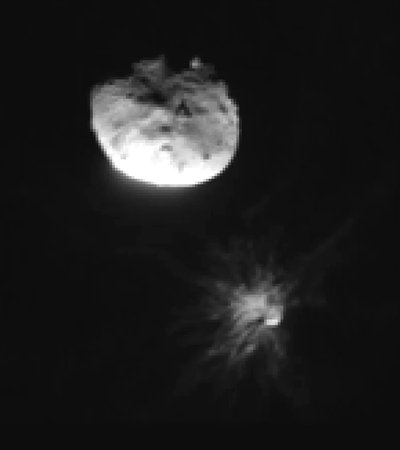
NASA has confirmed that the DART (Double Asteroid Redirection Test) spacecraft's impact on the moonlet Dimorphos in September 2022 changed not only the moonlet's orbit around the larger asteroid Didymos, but the binary system's orbit around the Sun itself. The finding confirms that a kinetic impactor — essentially ramming a spacecraft into an asteroid at high speed — can be an effective planetary defense technique for deflecting a near-Earth object.
Extraction Map
This is a significant escalation of the original result. When DART struck Dimorphos on September 26, 2022, the immediate measurement was the change in Dimorphos's orbital period around Didymos — shortened by 33 minutes, from 11 hours 55 minutes to 11 hours 22 minutes, far exceeding the minimum benchmark of 73 seconds that NASA had set for success. That was a proof of concept for moving a small body relative to its parent. The new finding goes further: the momentum transfer was sufficient to measurably alter the trajectory of the entire Didymos-Dimorphos system through the solar system. The physics are straightforward but the engineering implications are profound. For planetary defense, what matters is not whether you can change an asteroid's orbit around a companion — it's whether you can change its orbit around the Sun, because that is what determines whether it hits Earth. The heliocentric orbit change confirms that the kinetic impactor technique operates at the scale that actually matters for planetary defense. DART was always designed as a technology demonstration, not a response to an actual threat. Didymos poses no danger to Earth. But the principle it demonstrates — that a refrigerator-sized spacecraft can measurably alter the solar orbit of a binary asteroid system — is the specific capability that planetary defense requires. The institutional significance is worth noting. Planetary defense is one of the few areas where public investment in space generates a return that is unambiguously public in nature. There is no private capture mechanism for asteroid deflection — the benefit (not being struck by an asteroid) is distributed across the entire planet. DART cost approximately $330 million, making it one of the highest-leverage public investments in existential risk reduction ever undertaken, assuming the technique scales to larger objects with sufficient warning time. The caveats are important and should be stated plainly. DART struck a 160-meter moonlet in a binary system, not a standalone kilometer-scale asteroid on an Earth-intercept trajectory. The momentum transfer that works on a small body in a binary system may not scale linearly to the kinds of objects that pose civilization-threatening risks. The technique requires years to decades of warning time — the orbit change is small, and its effect on trajectory compounds over time. A kinetic impactor launched six months before impact would be far less effective than one launched ten years before. This means that the DART result is only as useful as the detection infrastructure that provides early warning. The detection side of the equation is advancing in parallel. The Vera Rubin Observatory (expected to begin its Legacy Survey of Space and Time in 2025-2026) and NASA's NEO Surveyor mission (an infrared space telescope designed specifically for near-Earth object detection) are the two instruments most likely to dramatically expand the catalog of potentially hazardous objects. DART proves the deflection works. The next question is whether we can find the threats early enough to use it.
Worth reading?
RECOMMENDED
Score
78
/100
Generative — DART creates an entirely new planetary-scale capability (asteroid deflection validated at heliocentric orbit level) with purely public benefit, zero private capture, and no extraction mechanism.
What Is GRIN?
GRIN stands for Generativity, Resilience, Innovation efficiency, and Novelty openness. These four dimensions capture the essential characteristics of any memetic intelligence — whether a nation, a corporation, a religion, or a movement.
About GRINGenerativity
5/5
Resilience
4/5
Efficiency
5/5
Novelty
5/5
Extractive
0/5
Inverted
Does this create new capability or just redistribute existing value?
New capability, full stop. Humanity had never demonstrated the ability to alter a solar system body's heliocentric orbit. DART is a first — not redistribution, but creation of a species-level defense tool.
Verified Facts (1)
The spacecraft changed the binary system's orbit, confirming that a kinetic impactor can be an effective planetary defense technique for deflecting a near-Earth object
More latest news
Read all