MARATHON · MARS
26.2 mi
SOLS TO FINISH
1,890
FASTER THAN OPPORTUNITY
2.1×
ACTIVE MARS MISSIONS
5
NASA's Perseverance rover has driven a full marathon on Mars. On sol 1,890 — June 14, 2026, five years and four months after landing — the robotic explorer crossed the 26.2-mile (42.195-kilometer) mark on the Martian surface. The previous record holder, NASA's Opportunity rover, took 11 years and two months to cover the same distance. Perseverance did it in less than half the time.
Extraction Map
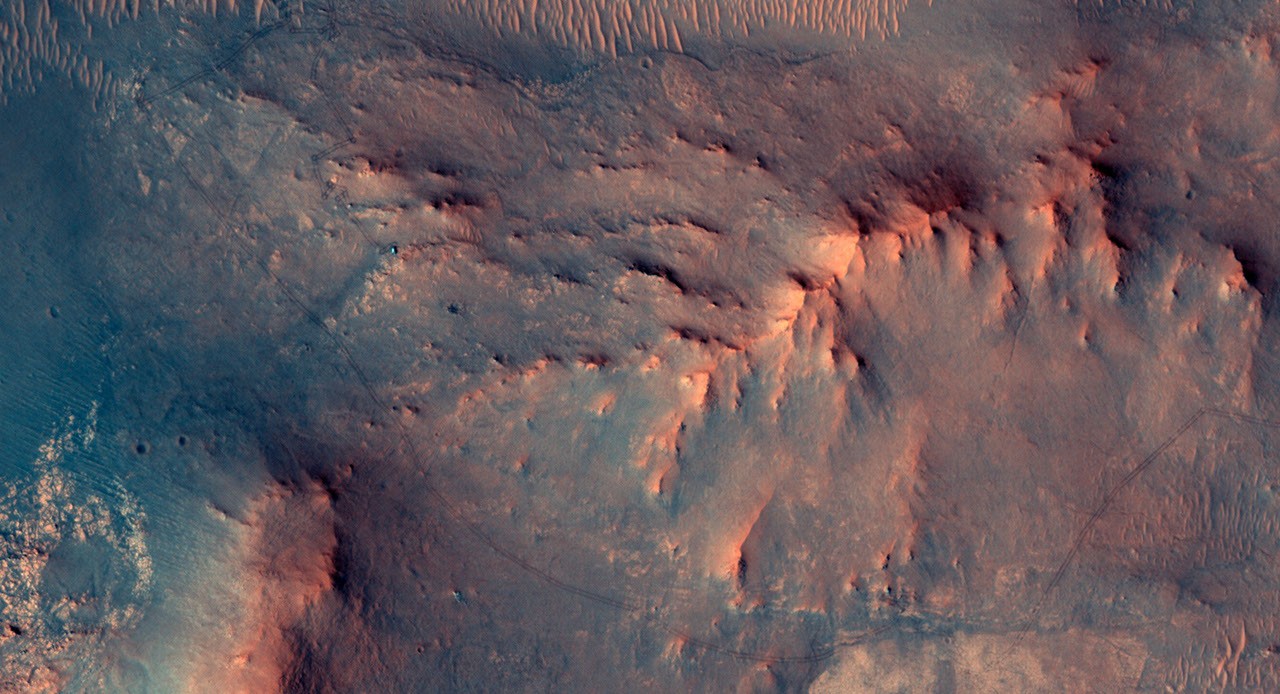
The milestone was captured from orbit the day before, on June 13, by NASA's Mars Reconnaissance Orbiter using its High-Resolution Imaging Science Experiment (HiRISE) camera. In the image, Perseverance appears as a green speck on the surface, its tracks tracing the terrain behind it. The rover is operating in an area west of Jezero Crater that the science team has named "Arbot." The speed improvement over Opportunity is not accidental. Perseverance carries an autonomous navigation system that lets it drive faster and farther per sol, and a recent demonstration on December 8 and 10 used generative AI to create waypoints — a task traditionally performed by human rover planners who analyze terrain and sketch routes to avoid hazards. The vast Earth-Mars communication lag makes real-time driving impossible, so autonomy is not a luxury but a mission multiplier. Perseverance is one of five active NASA missions at Mars. It launched July 30, 2020, landed February 18, 2021, and serves as the first step of a proposed roundtrip to return Mars samples to Earth. Curiosity, its older sibling, has been operating since August 2012. Together the two rovers are exploring terrain separated by roughly 2,300 miles (3,700 kilometers), covering billions of years of Martian geological history. The broader Mars infrastructure is in transition. NASA's MAVEN orbiter ended its mission after more than 11 years following an unrecoverable signal loss on December 6. Meanwhile, the Psyche spacecraft executed a Mars gravity assist on May 15, calibrating instruments en route to a metal-rich asteroid encounter in 2029. Mars Reconnaissance Orbiter, which took the milestone image, has been in orbit since March 2006 — over 20 years of continuous operation. Managed by Caltech's Jet Propulsion Laboratory in Southern California, Perseverance and MRO fall under NASA's Science Mission Directorate and the Mars Exploration Program portfolio. Lockheed Martin Space in Denver built MRO and supports its operations. The University of Arizona in Tucson operates HiRISE, which was built by BAE Systems in Boulder, Colorado. The 25th Martian sample — "Sapphire Canyon," taken from a vein-filled rock named "Cheyava Falls" — contains features that may help answer whether Mars once hosted microscopic life. The marathon milestone matters less as a distance record and more as a proxy for operational efficiency. Faster driving means more science per sol, more terrain covered per dollar, and a stronger case for autonomous navigation as the default mode for future planetary missions. Every mile Perseverance drives autonomously is a mile that didn't require a team of human planners to map in advance.
Worth reading?
RECOMMENDED
Score
76
/100
Generative. Faster autonomous driving expands the science-per-dollar frontier, and the AI waypoint demonstration creates new capability that transfers to future missions.
What Is GRIN?
GRIN stands for Generativity, Resilience, Innovation efficiency, and Novelty openness. These four dimensions capture the essential characteristics of any memetic intelligence — whether a nation, a corporation, a religion, or a movement.
About GRINGenerativity
4/5
Resilience
3/5
Efficiency
4/5
Novelty
3/5
Extractive
0/5
Inverted
Does this create new capability or just redistribute existing value?
Genuinely generative. Halving marathon time signals autonomous nav improvements that expand science yield per sol. The AI waypoint demo creates transferable capability for future planetary missions.
Verified Facts (17)
Perseverance traveled a full marathon (26.2 miles, or 42.195 kilometers) on the Red Planet
Perseverance reached that distance after five years and four months of driving — on the 1,890th Martian day, or sol, of its mission
The previous record holder, NASA's Opportunity rover, took 11 years and two months to reach the same milestone
Image taken June 13, 2026, a day before the milestone
The rover is in an area west of Jezero Crater that the science team is calling 'Arbot'
Image taken by NASA's Mars Reconnaissance Orbiter (MRO) using its High-Resolution Imaging Science Experiment (HiRISE) camera
Lockheed Martin Space in Denver built MRO and supports its operations
The University of Arizona, in Tucson, operates HiRISE, which was built by BAE Systems in Boulder, Colorado
The demonstration, executed on Dec. 8 and 10, used generative AI to create waypoints for Perseverance
25th Martian sample — 'Sapphire Canyon' — taken from a vein-filled rock named 'Cheyava Falls'
MAVEN ended after more than 11 years; last heard Dec. 6; review board determined spacecraft not recoverable
Psyche spacecraft Mars flyby May 15; asteroid encounter in 2029
Perseverance launch July 30, 2020; landing Feb. 18, 2021
Curiosity launch Nov. 26, 2011; landing Aug. 6, 2012
MRO launch Aug. 12, 2005; Mars arrival Mar. 10, 2006
Mars Odyssey launch April 7, 2001; Mars arrival Oct. 24, 2001
Perseverance and Curiosity exploring about 2,300 miles apart (about 3,700 kilometers)
More latest news
Read all