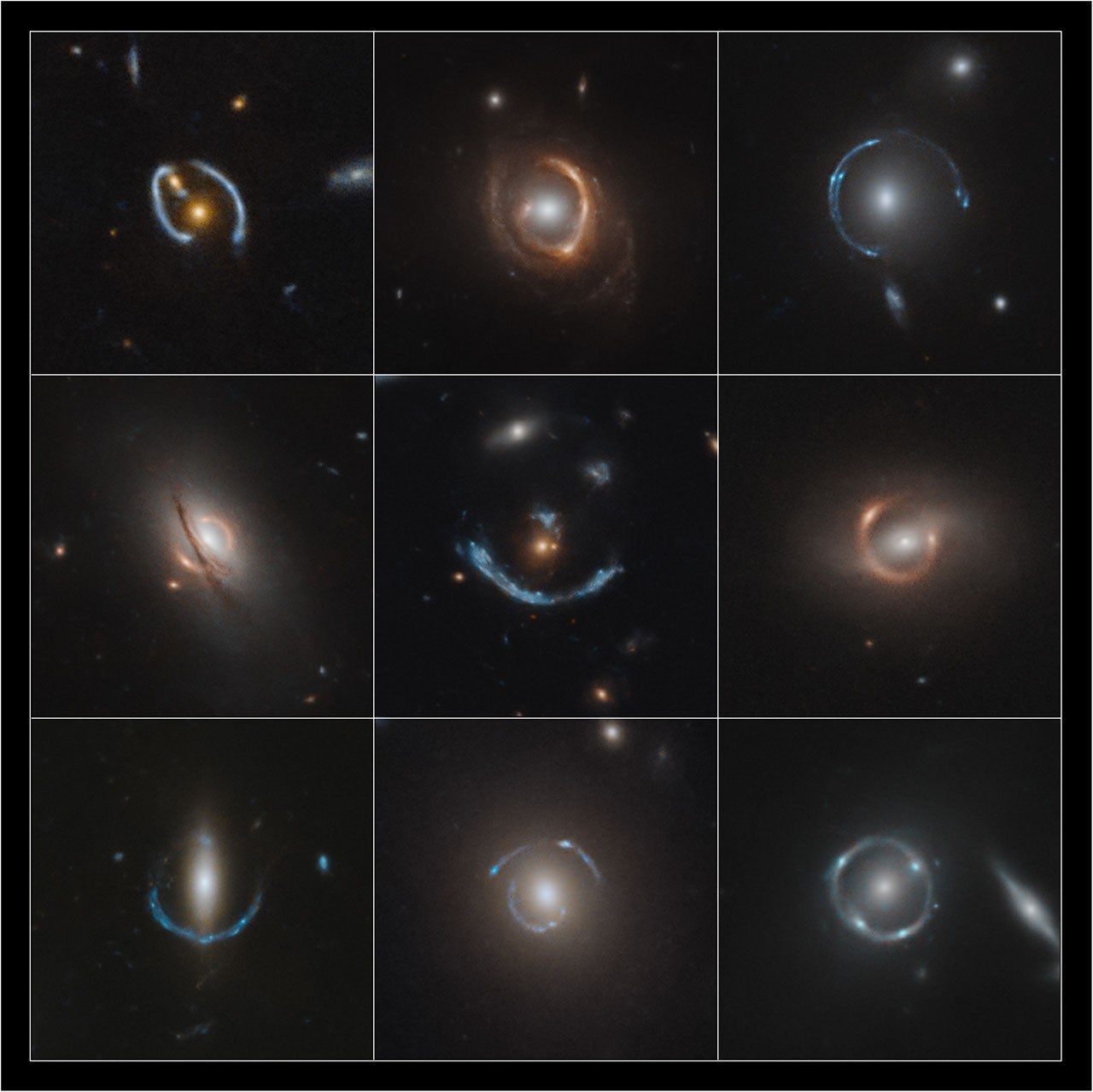
Imagine you're a locksmith trying to figure out the shape of a key you've never held. All you have is the pattern of scratches it left inside a hundred different locks. That's gravitational lensing in a sentence: the 'scratches' are the warped arcs of distant galaxies, the 'locks' are foreground galaxies, and the 'key' is the invisible dark matter distribution you're trying to reconstruct. NASA's Hubble has now delivered a diverse sampler of these locks — a catalog of strong gravitational lenses first flagged by the Dark Energy Spectroscopic Instrument (DESI) at Kitt Peak, then imaged at Hubble's sharp visible/UV resolution — to serve as the calibration and training foundation for the Nancy Grace Roman Space Telescope, which launched in August 2026. The core scientific objective is straightforward but high-stakes: use the precise distortion patterns in lensed galaxy arcs to map the mass distribution of foreground galaxies, including their invisible dark matter halos. The critical test is whether small imperfections in lensed arcs reveal clumps of dark matter in the million-to-billion solar mass range. Cold dark matter theory predicts many such clumps should exist. If Hubble and Roman find them, cold dark matter survives its most granular test yet. If the arcs are smooth where clumps should appear, the theory has a serious problem. The operational architecture is a relay: DESI identifies candidate lenses from ground-based spectroscopy, Hubble resolves them at high angular resolution in visible and ultraviolet light, and Roman captures far more lenses across its much wider infrared field of view. The telescopes are complementary by design — Hubble excels at individual-object detail (visible/UV), while Roman trades resolution for panoramic coverage (infrared). When Roman flags something interesting, Hubble can drill down. The researchers explicitly intend to build what they call a 'super-intelligence tool' — essentially a machine learning pipeline trained on Hubble's detailed lens images to automate arc detection across Roman's vastly larger datasets. The lens catalog itself is scientifically rich in its diversity. The panels range from arc-counterarc configurations (Panel A, where a pair of foreground galaxies splits a background galaxy into duplicate arcs) to near-perfect Einstein Rings (Panel F, requiring almost exact alignment and a roughly spherical mass distribution) to quadruple lensing (Panels C and I, where background galaxies are replicated four times). Color differences in the arcs — blue indicating young stars, red indicating older populations — provide a bonus channel for studying galaxy evolution across cosmic time. Most foreground lensing galaxies are dense ellipticals, but some show spiral arms or dust lanes (Panel D), which is rare and diagnostically valuable. The dust-lane case in Panel D is a neat illustration of the Hubble-Roman relay. Hubble's visible-light sharpness reveals the dust lane 'breaking' what might be a complete Einstein Ring, but dust is more transparent at infrared wavelengths. Roman's infrared eyes could see whether the ring completes behind the dust, resolving an ambiguity Hubble alone cannot. What makes this more than a pretty image release is the dark matter stakes. The Milky Way's dark matter halo is roughly 1.3 trillion solar masses. Cold dark matter theory predicts a hierarchy of much smaller subhalos — a million to a billion solar masses — orbiting within larger halos. These subhalos have never been directly detected. If the Hubble-trained lens models can pick up their gravitational signatures as tiny perturbations in lensed arcs, it would be the first observational confirmation of this predicted substructure. That's a genuine milestone in cosmology, not incremental refinement. This catalog positions Roman's dark matter program with a concrete observational pipeline rather than a vague research direction. The limiting factor is now Roman's operational performance and whether the ML models trained on Hubble's relatively small sample generalize to Roman's flood of wider-field data. The 20-year trajectory here is a complete census of dark matter substructure across cosmic time — or, if the subhalos aren't found, a forced revision of the dominant cosmological model.
The analogy
Imagine you're a locksmith trying to figure out the shape of a key you've never held. All you have is the pattern of scratches it left inside a hundred different locks. The scratches are warped galaxy arcs, the locks are foreground galaxies, and the key is the invisible dark matter distribution. Hubble is cataloging scratches so Roman can test thousands of locks at once.
Locksmith
Infer key shape from scratch patterns left inside many different locks
Lens modeling
Infer dark matter distribution from distortion patterns in many gravitationally lensed arcs
Honest assessment
This is infrastructure, not a result. The Hubble lens catalog is genuinely useful — diverse morphologies, multi-band coverage, and a clear scientific target in cold dark matter substructure. But no quantitative validation exists yet for the ML pipeline that's supposed to bridge Hubble's small sample to Roman's flood. The real test comes when Roman data arrives and someone measures whether arc perturbation detection actually works at the sensitivity needed to see million-solar-mass clumps. Worth tracking for the dark matter stakes; premature to celebrate.
What Is CLAIMS?
50
/ 100
BedrockNews applies a structured analytical framework called CLAIMS to academic papers and technical research releases.
How CLAIMS worksClaim
3/5
Ladder
1/5
Architecture
3/5
Integrity
2/5
Milestone
3/5
Successor
3/5
What is this paper actually committing to?
Infrastructure claim, not a result. The real bet is that Hubble's lens sample is diverse enough to train models that generalize to Roman's wider, infrared dataset. Promising pipeline, no proof yet.
The field fight
Does dark matter form small-scale substructure (cold dark matter) or smooth distributions (warm/fuzzy dark matter)?
Side A
Cold dark matter predicts abundant subhalos from million to billion solar masses that should perturb lensed arcs
Held by: ΛCDM, most cosmological simulations, this program
Side B
Warm or fuzzy dark matter suppresses small-scale structure; smooth arcs would favor alternative models
Held by: Warm dark matter proponents, axion/fuzzy DM theorists
Milestone tracker
Unlocks: Statistical power to detect or rule out cold dark matter subhalos in the million-to-billion solar mass range
Current
~dozen
diverse lenses
Hubble catalog
Next
1000+
lenses
Roman wide-field survey
~2-5 years of Roman operations
Verified Facts (10)
Gravitational lensing first predicted by Albert Einstein
Roman launched in August 2026
Dark matter halo of the Milky Way is around 1.3 trillion solar masses
Cold dark matter theory predicts many small dark matter clumps of between a million to a billion solar masses
Strong lenses first detected with The Dark Energy Spectroscopic Instrument at Kitt Peak
Panel A is an arc-counterarc configuration with a pair of foreground galaxies
Panel F is an Einstein Ring
Panel I shows a quadruply lensed galaxy
Panel D's foreground galaxy has a visible dust lane
Credit: NASA, ESA, and X. Huang (University of San Francisco); Processing: Gladys Kober (NASA/Catholic University of America)
Practical Implications (4)
Gravitational lens modelers now have a publicly available, morphologically diverse Hubble reference set for training and benchmarking
The DESI-Hubble-Roman relay establishes an operational template for multi-observatory ML pipelines in astronomy
Cold dark matter substructure remains untested at the critical million-to-billion solar mass scale — this program is the most concrete path to that test
Dust-lane lenses like Panel D demonstrate the value of multi-wavelength follow-up and could yield clean tests of infrared vs visible mass reconstruction
More latest news
Read all