GALAXY MASS · BULGE
~25%
STARS · SWEEPS LEGACY
180K
OBSERVING PROGRAM
#17776
TELESCOPES LINKED
2
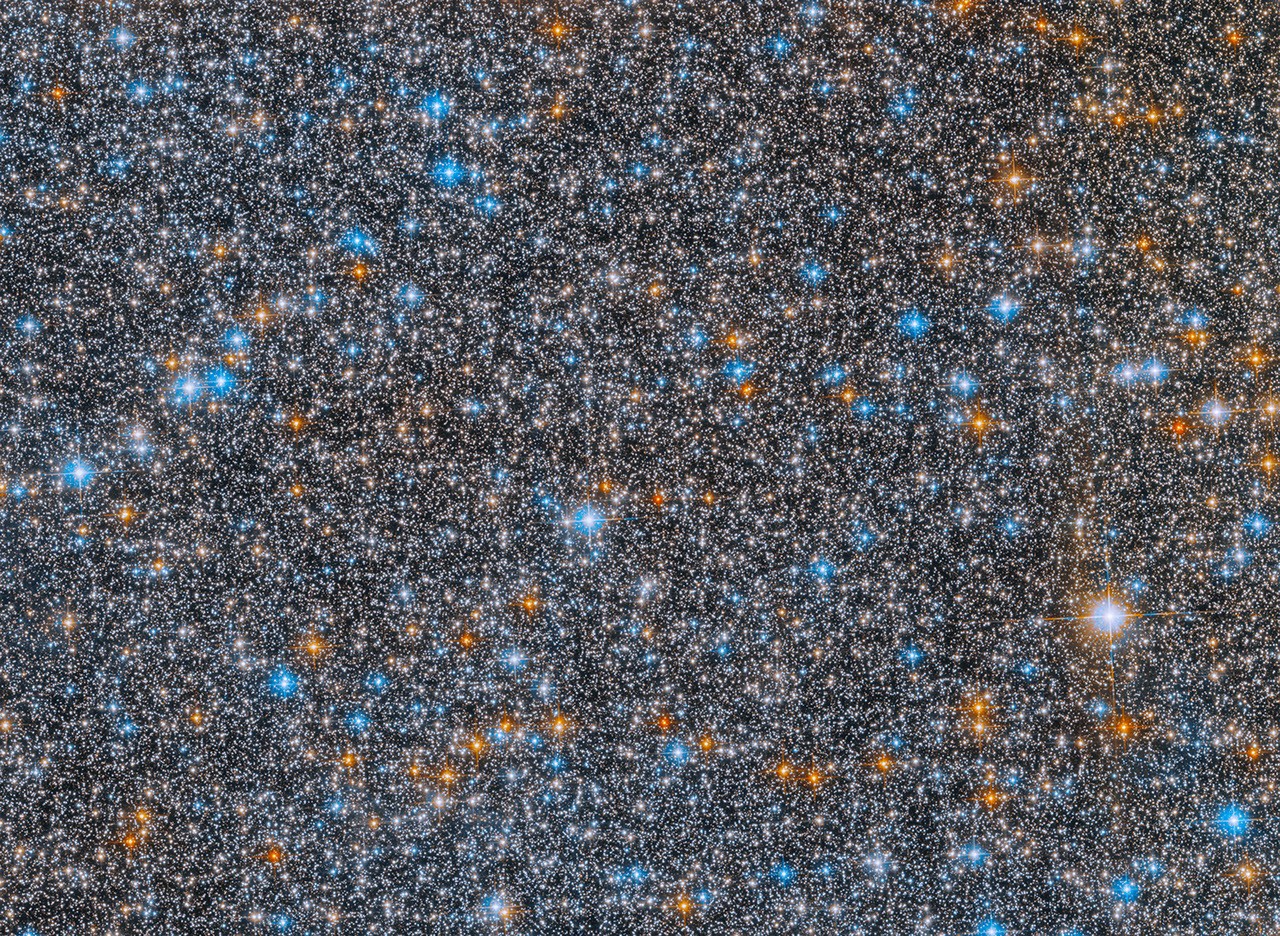
NASA's Hubble Space Telescope is surveying stars in the Milky Way's galactic bulge — the dense, spherical region of stars surrounding our galaxy's center that holds nearly a quarter of the galaxy's total stellar mass. The images, released November 25, 2026, are not simply pretty pictures. They are infrastructure: a detailed reference catalog that the Nancy Grace Roman Space Telescope will rely on when it begins operations.
Extraction Map
The galactic bulge is the only place where astronomers can study this type of dense stellar environment at single-star resolution. Other galaxies have bulges, but they are too distant and crowded to resolve individual stars. The Milky Way's proximity makes it the only laboratory available for this science, which is why Hubble keeps returning to it. The core scientific payoff is microlensing. When a foreground star passes between Earth and a more distant star, gravity bends and magnifies the distant star's light. The distortion pattern reveals properties of the foreground star and any planets orbiting it. Roman will capture these fleeting events at scale, but interpreting them requires knowing what the stars looked like before the lensing occurred. That is Hubble's job: build the before picture. Hubble observed this region in wavelengths that overlap with Roman's sensitivity range — the red end of visible light and near-infrared — specifically so the two datasets will be directly comparable. This is not a general survey; it is calibration work designed around Roman's instrument specifications. The observing program (#17776, led by S. Terry at the University of Maryland) targets brightness, age, composition, and motion data for stars in the field. This survey builds on a substantial legacy. Hubble's WFC3 Galactic Bulge Treasury Program previously mapped stellar positions and motions in this region. The SWEEPS program used Hubble's Advanced Camera for Surveys to examine 180,000 bulge stars. The new observations extend and update this dataset with Roman-specific requirements in mind. The broader science case extends beyond exoplanets. Characterizing bulge stars at this resolution supports research into black hole locations, dark matter distribution, and the formation history of the Milky Way itself. The galactic bulge is an archaeological site — its stars are among the oldest in the galaxy, and their properties encode billions of years of galactic evolution. What makes this worth watching is the deliberate infrastructure logic. NASA is investing expensive Hubble time not for standalone discoveries but to maximize the return on a telescope that has not launched yet. Roman's microlensing survey will cover far more sky far faster than Hubble ever could, but Hubble's resolution provides the ground truth that makes Roman's data interpretable. This is generative investment in future capability, not science theater.
Worth reading?
RECOMMENDED
Score
76
/100
Generative. Public funds building open-access reference datasets that multiply the scientific return of a future public instrument. No private capture, no extraction — pure capability expansion.
What Is GRIN?
GRIN stands for Generativity, Resilience, Innovation efficiency, and Novelty openness. These four dimensions capture the essential characteristics of any memetic intelligence — whether a nation, a corporation, a religion, or a movement.
About GRINGenerativity
4/5
Resilience
4/5
Efficiency
4/5
Novelty
2/5
Extractive
0/5
Inverted
Does this create new capability or just redistribute existing value?
Textbook generativity. Hubble time invested now multiplies Roman's future science output. The reference catalog is a public good that enables exoplanet detection, dark matter mapping, and galactic archaeology at scale.
Verified Facts (8)
The galactic bulge holds nearly a quarter of the galaxy's stellar mass.
The Sagittarius Window Eclipsing Extrasolar Planet Search (SWEEPS) used Hubble's Advanced Camera for Surveys to look at 180,000 stars in the bulge.
The new observations come from observing program #17776, led by S. Terry at the University of Maryland.
Hubble observed in wavelengths that overlap with Roman's areas of sensitivity: the red end of the visible spectrum and near-infrared wavelengths.
The WFC3 Galactic Bulge Treasury Program used Hubble's Wide Field Camera 3 to study brightness, precise positions, and motions of stars.
Image processing by G. Kober (NASA/Catholic University of America).
Media contact: Claire Andreoli, NASA's Goddard Space Flight Center.
Last updated November 25, 2026.
More latest news
Read all