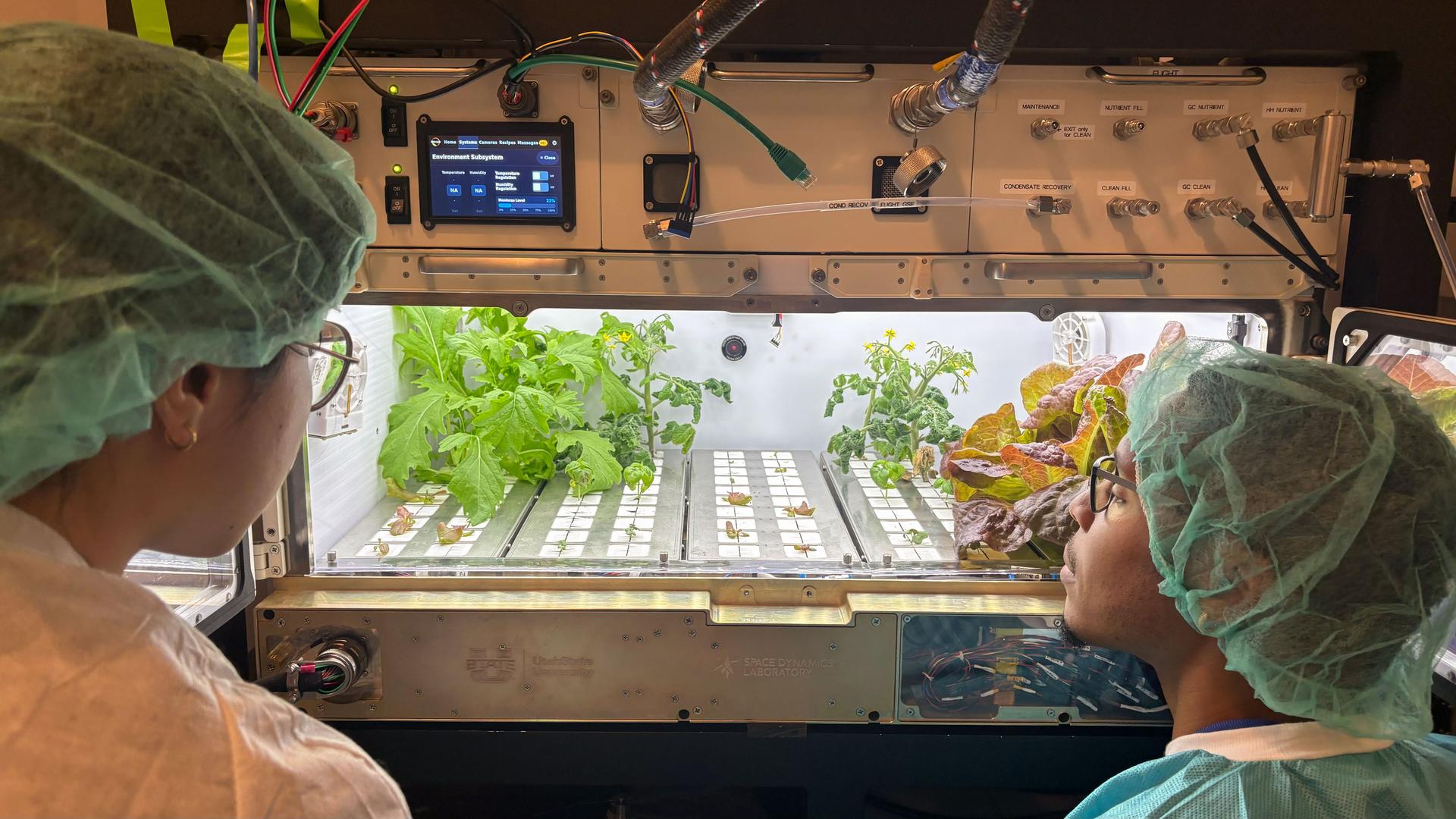
Imagine you're watering a houseplant, but someone has turned off gravity. The water doesn't fall into the soil — it forms a blob and floats away. Every drop you add has to be mechanically pushed to the roots through capillary channels, and if the delivery rate is even slightly off, your plant either drowns or desiccates. That's the core engineering problem NASA's new Ohalo III growth chamber is trying to solve on the International Space Station. The committed claim here is straightforward: this is the first integrated crop-production prototype designed specifically to validate water-delivery mechanics and volume optimization in microgravity for long-duration missions. It's not a plant-growth experiment in the traditional ISS sense (we've grown lettuce up there since 2014 with Veggie, and the Advanced Plant Habitat has run dozens of studies). This is a systems-engineering validation — can you build plumbing that reliably feeds crops at scale in zero-g, the kind you'd need inside a Moon Base habitat or on a Mars transit vehicle? The prototype rides aboard Northrop Grumman's 25th Commercial Resupply Services mission alongside a second investigation: a miniature fluid-handling system for lab-grown human brain tissue models called miBrains. Both experiments share the same underlying engineering question — precision fluid delivery in microgravity — but applied to radically different biological payloads. The miBrain system must mix, deliver, and maintain nutrient-rich liquid to keep tiny neural tissue models alive, building on a previous ISS investigation that proved the tissues could survive launch and short-duration exposure. The ladder against prior art matters here. NASA's existing plant systems — Veggie (2014) and the Advanced Plant Habitat (2018) — are research tools, not production prototypes. They grow small batches for science. The Ohalo III chamber is explicitly framed as a step toward production-scale architecture: validated water delivery, optimized growing volume, designed with Moon and Mars habitats in mind. The gap between 'we can grow a few lettuce heads for a photo op' and 'we can feed a crew of four for 900 days' is enormous, and this experiment sits at the very beginning of closing it. On the brain-tissue side, the miBrain fluid-handling validation is a necessary precursor to long-duration neurological studies in space. The previous flight proved the tissues survive; this flight proves the life-support plumbing works. If it validates, researchers gain a platform to study how microgravity and radiation affect human neural tissue over months — directly relevant to understanding cognitive risks on a Mars mission and potentially advancing neurological disease modeling on Earth. The integrity picture is typical for NASA flight hardware validation: these are engineering demonstrations, not hypothesis-driven experiments with control groups and blinded analysis. The validation criterion is binary — does the water-delivery system maintain target flow rates and keep crops alive, yes or no? Does the fluid-handling system keep brain tissues viable? The results will be compared against ground controls, but there's no adversarial baseline or independent replication baked in. That's appropriate for this stage of technology readiness, but it means the science output is 'it works' or 'it doesn't,' not a publishable effect size. The practical trajectory is clear: if the Ohalo III water-delivery system validates on ISS, the next concrete milestone is a scaled version tested in a lunar-analog environment or aboard Artemis infrastructure. The miBrain system, if validated, enables the first long-duration neural tissue studies in space — weeks to months rather than the days achieved previously. Both feed directly into NASA's Biological and Physical Sciences Division roadmap for sustained human presence beyond low Earth orbit.
The analogy
Imagine watering a houseplant with gravity turned off. The water blobs and floats away instead of soaking into soil. You need plumbing that mechanically pushes every drop to the roots through capillary channels at exactly the right rate — too fast drowns, too slow desiccates. That's the fluid-delivery problem this mission validates for both crops and brain tissue.
Drip irrigation
Gravity pulls water downward through soil to roots at controlled rates via emitters
Microgravity fluid delivery
Capillary and mechanical systems push water to roots (or nutrients to tissue) without gravity assist
Honest assessment
This is an engineering validation mission, not a scientific breakthrough. Its importance is infrastructural: if the water-delivery plumbing works in microgravity, it unblocks the next generation of space agriculture hardware for Moon and Mars habitats. If it doesn't, the timeline for self-sustaining food production beyond Earth slips further. The miBrain fluid system is similarly foundational — a plumbing prerequisite for real neuroscience in space. Neither experiment will produce a headline result; both could quietly enable the ones that do.
What Is CLAIMS?
50
/ 100
BedrockNews applies a structured analytical framework called CLAIMS to academic papers and technical research releases.
How CLAIMS worksClaim
3/5
Ladder
2/5
Architecture
2/5
Integrity
2/5
Milestone
3/5
Successor
3/5
What is this paper actually committing to?
Genuine prototype first: not another ISS lettuce experiment but a production-system validation aimed at Moon/Mars habitats. The claim is engineering readiness, not biological discovery.
The field fight
Can closed-loop bioregenerative life support actually feed crews on multi-year missions, or will pre-packaged food always win on mass and reliability?
Side A
Pre-packaged food is lighter, more reliable, and doesn't require crew labor — bioregenerative systems add mass, complexity, and failure modes
Held by: Traditional mission planners, ISS resupply advocates
Side B
Beyond ~900 days, resupply is impossible and pre-packaged food degrades — in-situ crop production becomes the only viable option
Held by: NASA BPS Division, Ohalo, ESA MELiSSA, Mars mission architects
Milestone tracker
Unlocks: Crew-feeding crop production validated for Moon surface habitat, prerequisite for Mars transit food systems
Current
1
prototype
Ohalo III ISS validation
Next
1
scaled system
Lunar-analog or Artemis test
~3-5 years if Artemis schedule holds
Verified Facts (7)
Northrop Grumman's 25th Commercial Resupply Services mission for NASA
Novel space crops experiment with prototype growth chamber for water delivery and volume optimization
Knowledge gained could help inform agricultural practices such as vertical farming and indoor growing systems
Small lab-grown models of the human brain called miBrains previously sent to ISS
New experiment validates miniature fluid-handling system to mix, deliver, and maintain nutrient-rich liquid
Investigations from NASA's Biological and Physical Sciences Division
Design of plant production systems for future Moon Base habitats and Mars missions
Practical Implications (3)
Validated microgravity water-delivery tech could directly transfer to vertical farming and indoor agriculture on Earth, particularly for water-scarce environments
If miBrain fluid handling validates, researchers gain a platform for long-duration neurological studies relevant to both astronaut health and Earth-based disease modeling
Success accelerates NASA's timeline for bioregenerative life support on Artemis and Mars missions; failure forces redesign and delays
More latest news
Read all