LBS CARGO
~11,000
CYGNUS XL FLIGHT
3rd
SCIENCE PAYLOADS
6
WELDING METHODS
2
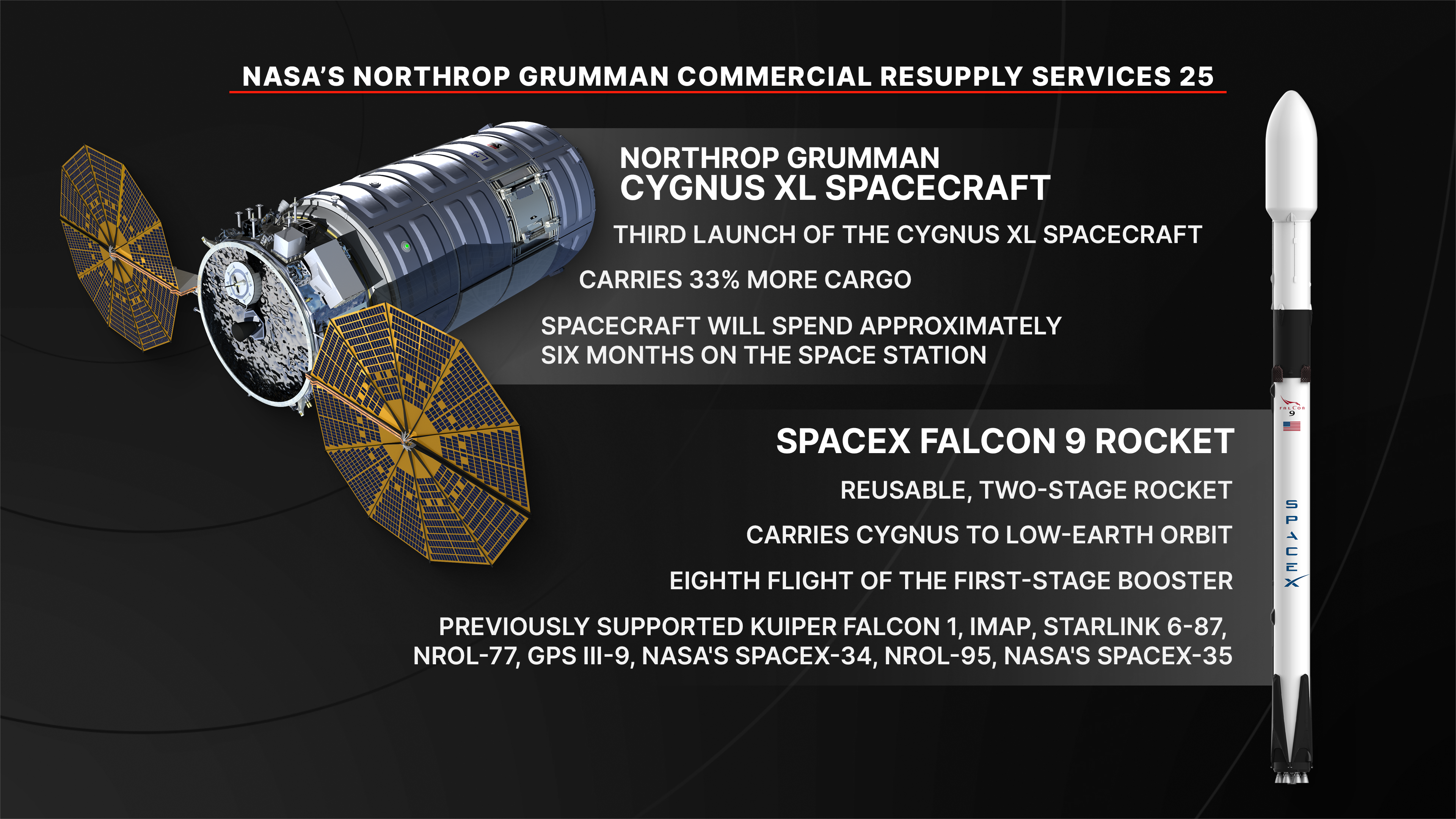
Northrop Grumman's CRS-25 mission will loft approximately 11,000 pounds of science experiments, crew supplies, and hardware to the International Space Station aboard a SpaceX Falcon 9 from Cape Canaveral. The spacecraft, the third flight of Cygnus XL — Northrop's larger cargo variant — is named after Apollo astronaut Jim Lovell. NASA astronauts Jessica Watkins and Luke Delaney will handle grapple and berthing using Canadarm2, installing the vehicle at Unity's Earth-facing port.
Extraction Map
The science manifest is unusually applied. Cardinal Muscle 2.0, developed with the Palo Alto Veterans Institute for Research, uses microgravity's accelerated muscle atrophy to screen FDA-approved drugs for repurposing against age-related muscle loss. DNA Nano B, from the University of Connecticut, manufactures DNA-inspired nanoparticles in microgravity for targeted drug delivery into dense tissues like cartilage and solid tumors — a production method that may yield more uniform particle assembly than ground-based alternatives. Two investigations target cancer directly. Encapsulate-1 grows miniature replicas of patients' actual tumors aboard the station to study how cancer cells move, invade tissue, and potentially metastasize — aiming to build a space-based diagnostic tool that could predict cancer progression months or years ahead. ARES, the Active Radiation Environment Sensor, tests a compact radiation monitor designed for integration with Artemis-era spacecraft, validating real-time crew safety monitoring for future lunar missions. OHALO III addresses a quieter but critical constraint for deep-space missions: feeding people. The mostly automated plant growth facility from Utah State University uses innovative water recovery and air exchange to grow multiple crop varieties, generating data that could shape food production systems for Mars-class missions. The technology demonstration headline is JOINS — Joining Demonstrations In-Space — a Lockheed Martin experiment performing autonomous robotic welding inside the Bishop Airlock. JOINS tests both laser beam welding and friction stir welding on aluminum and stainless steel. If in-space joining matures, it removes a fundamental constraint: structures no longer have to fit inside a launch vehicle fairing. That capability is load-bearing for any serious lunar base or large orbital infrastructure. Mundane cargo matters too. The manifest includes crew quarter blankets, hatch seal covers, a modified toilet pretreat hose for the waste management system, Alpha Magnetic Spectrometer spacewalk tools, and Anomaly Gas Analyzer batteries. Keeping the station operational is not glamorous, but it is the substrate on which all of this science depends. CRS-25 illustrates what a mature commercial resupply architecture looks like: Northrop builds and operates the spacecraft, SpaceX provides the ride, NASA curates the science and maintains the station. The model is generative — multiple private contractors competing for cargo delivery while NASA focuses on research utilization. The risk is concentration: if either SpaceX or Northrop Grumman drops out, the pipeline narrows fast.
Worth reading?
RECOMMENDED
Score
68
/100
Generative. The commercial resupply model creates real science output (cancer diagnostics, drug repurposing, in-space manufacturing) while distributing launch and cargo services across private contractors rather than concentrating them in a single government monopoly.
What Is GRIN?
GRIN stands for Generativity, Resilience, Innovation efficiency, and Novelty openness. These four dimensions capture the essential characteristics of any memetic intelligence — whether a nation, a corporation, a religion, or a movement.
About GRINGenerativity
4/5
Resilience
3/5
Efficiency
3/5
Novelty
3/5
Extractive
1/5
Inverted
Does this create new capability or just redistribute existing value?
Genuine capability creation. Cancer tumor diagnostics, drug repurposing screens, DNA nanoparticle manufacturing, and autonomous in-space welding each open new pathways with Earth applications beyond the station itself.
Verified Facts (10)
Northrop Grumman CRS-25 will deliver about 11,000 pounds of science and supplies to the International Space Station
The mission will be the third flight of the company's Cygnus XL
The Cygnus XL will launch aboard a SpaceX Falcon 9 rocket from the Cape Canaveral Space Force Station in Florida
Spacecraft is named in honor of NASA astronaut James 'Jim' A. Lovell Jr.
NASA astronauts Jessica Watkins and Luke Delaney will be on duty during the Cygnus spacecraft's approach and rendezvous
JOINS will test two distinct approaches: laser beam welding and friction stir welding on aluminum and stainless-steel
Cardinal Muscle 2.0 tests FDA-approved drugs used to treat other conditions can be repurposed to prevent or reduce muscle loss
DNA Nano B investigation uses microgravity to manufacture tiny, DNA-inspired particles designed to deliver medicine into dense tissues
Encapsulate-1 uses miniature replicas of patients' tumors to study how cancer cells move, invade surrounding tissues, and potentially spread
ARES will test a small radiation monitoring device to support future Artemis program and lunar missions
More latest news
Read all