Get it
NASA Dragonfly Mission
on NASA
SCIENCE CAMERAS
7
TITAN SURFACE TEMP
−290°F
LAUNCH DATE
Jul 2028
TITAN ARRIVAL
Late 2034
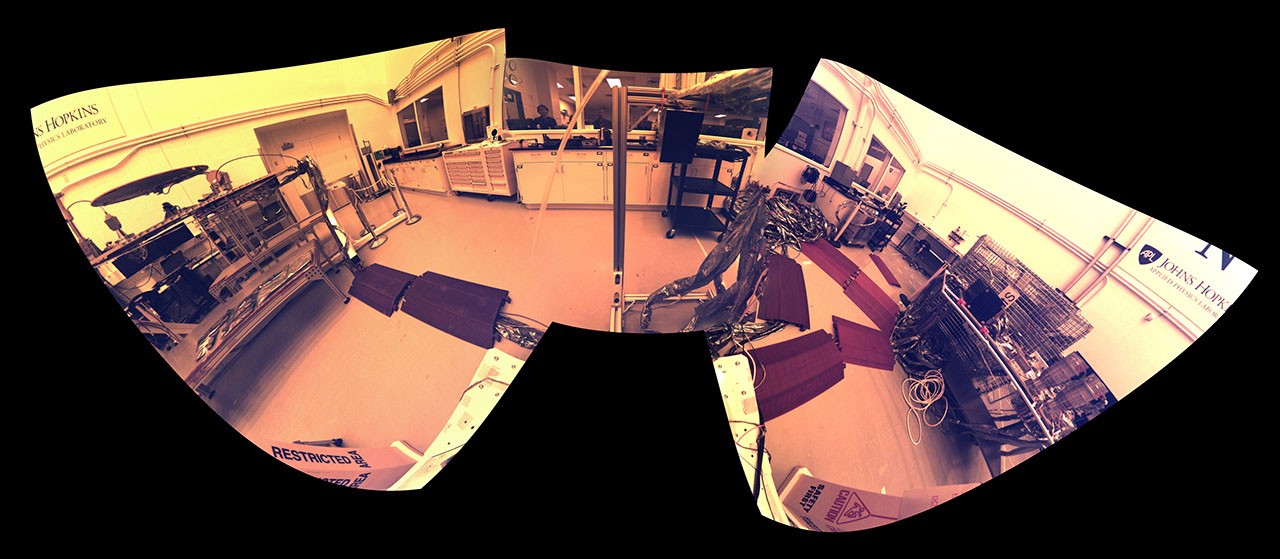
NASA's Dragonfly rotorcraft — a car-sized, nuclear-powered drone designed to hop across the surface of Saturn's moon Titan — has begun receiving its science instruments at the Johns Hopkins Applied Physics Laboratory in Laurel, Maryland. The first suite installed: DragonCam, a seven-camera imaging system built by Malin Space Science Systems, integrated by mid-November 2026.
Extraction Map
The camera system is engineered for a world profoundly hostile to electronics. Titan's surface temperature hovers around minus 290 degrees Fahrenheit, so each camera peers through a window in a foam enclosure that insulates it from cryogenic conditions. A configurable LED array spanning infrared to ultraviolet provides spectral illumination of surface materials, enabling composition inferences and the detection of organic molecules that fluoresce under UV light. During Titan's eight-Earth-day nights, these LEDs double as Dragonfly's headlights. DragonCam's seven cameras cover multiple scales and angles. Two forward-mounted cameras — a 90-degree wide-angle and a higher-resolution medium-angle — provide stereoscopic views of approaching terrain. Two side-mounted wide-angle cameras extend coverage to panoramic. Two downward-facing cameras assess landing zones for safety before deploying the sample drill. A high-resolution microscopic imager resolves details down to millimeter-sized sand grains around drill sites. Two additional navigation cameras, also built by Malin, were installed earlier in the summer. The imaging suite serves both exploration and science. DragonCam will capture the first aerial and ground-level views of Titan's landscape — a world of methane lakes, hydrocarbon dunes, and organic-rich surface chemistry that planetary scientists consider one of the solar system's most promising environments for prebiotic chemistry. The microscopic imager provides critical context for samples collected by DrACO, the Drill for Acquisition of Complex Organics. Four more instrument packages remain to be delivered and integrated over the coming months: DraGNS (Gamma-ray and Neutron Spectrometer), DraGMet (Geophysics and Meteorology), DraMS (Mass Spectrometer), and DrACO itself. Each adds a different analytical dimension — elemental composition, atmospheric profiling, molecular identification, and physical sampling. Dragonfly is scheduled to launch in July 2028 and arrive at Titan in late 2034, an eight-year transit reflecting the vast distance to the Saturnian system. The mission represents a genuinely new category of planetary exploration: a powered rotorcraft operating in an atmosphere 1.5 times denser than Earth's, with 1/7th the gravity, capable of flying kilometers between landing sites rather than crawling meters per day like a traditional rover. The instrument integration milestone marks the transition from structural assembly to science-ready spacecraft. If the remaining deliveries and testing proceed on schedule, Dragonfly will be one of the most capable and ambitious planetary science missions ever launched — a flying chemistry lab sent to the one place in the outer solar system where complex organic chemistry meets liquid on a surface.
Worth reading?
ESSENTIAL
Score
84
/100
Generative. Public investment creating entirely new scientific capability — first rotorcraft on another world, first ground-truth organic chemistry of Titan — with open-access data and broad institutional participation.
What Is GRIN?
GRIN stands for Generativity, Resilience, Innovation efficiency, and Novelty openness. These four dimensions capture the essential characteristics of any memetic intelligence — whether a nation, a corporation, a religion, or a movement.
About GRINGenerativity
5/5
Resilience
3/5
Efficiency
3/5
Novelty
5/5
Extractive
0/5
Inverted
Does this create new capability or just redistribute existing value?
New category of planetary exploration. No one has flown a powered aircraft on a moon, sampled Titan's organics in situ, or imaged its surface at ground level. This creates capability that did not exist.
Verified Facts (10)
DragonCam consists of seven cameras designed to characterize Titan's surface at multiple scales during flight and while on the ground
All seven cameras developed and built by Malin Space Science Systems had been installed by mid-November
Ambient temperatures on Titan reach minus 290 degrees Fahrenheit
A configurable LED array spanning infrared to ultraviolet provides information about color of surface materials
Forward WAC offers a 90-degree field of view
Dragonfly is scheduled to launch in July 2028 and reach Titan in late 2034
Two navigation cameras were installed this summer
Remaining instrument packages: DraGNS, DraGMet, DraMS, and DrACO
Elizabeth Turtle is Dragonfly principal investigator at APL
Michael Ravine is DragonCam development manager from Malin Space Science Systems
More latest news
Read all