Get it
Voyager Mission
on NASA
DISTANCE
16.1B mi
SIGNAL TIME
24 hrs
MISSION AGE
49 yrs
POWER LOSS
4 W/yr
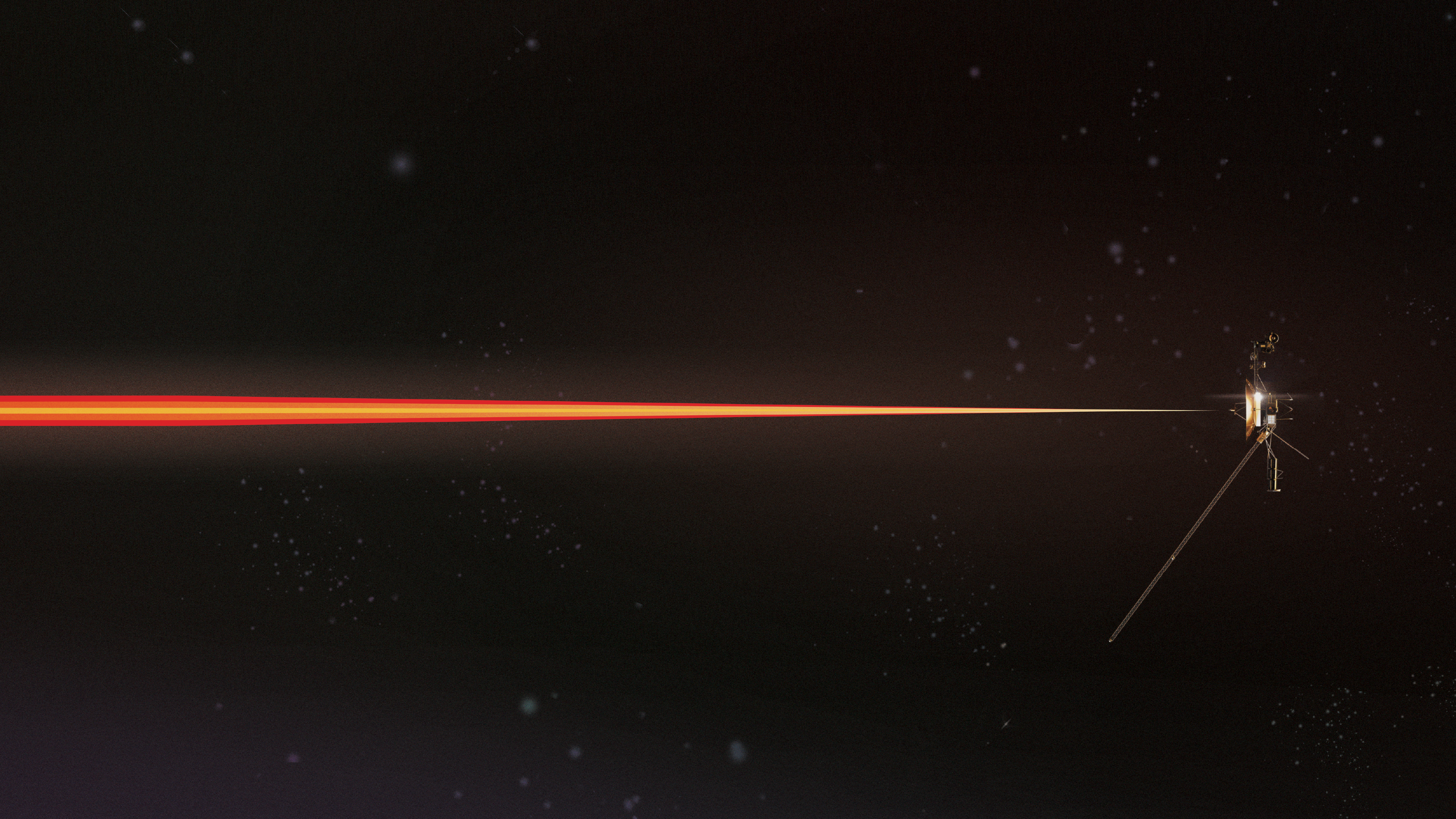
NASA's Voyager 1 reached one light-day from Earth at 2:16 a.m. PST on November 18, 2026 — meaning its radio signals now take a full 24 hours to reach mission controllers at JPL. That's 16.1 billion miles, or 25.9 billion kilometers. The milestone was confirmed not by science data but by carrier signal analysis and trajectory calculations, because the spacecraft hasn't transmitted science or engineering data since November 14.
Extraction Map
The data gap is the latest in a long series of aging-hardware crises that have defined Voyager operations for the past decade. Earlier this year, engineers shut down three devices on Voyager 1 and swapped in three lower-power alternatives — a risky move on a spacecraft 16 billion miles away with no repair option. The goal: squeeze enough juice from the probe's 50-year-old radioisotope thermoelectric generator, which converts heat from decaying plutonium-238 into electricity, to keep instruments running through the 50th launch anniversary next summer. Both Voyager probes lose approximately 4 watts of power per year as the plutonium depletes. That's the hard constraint. Every year, JPL engineers perform a kind of triage — which instruments stay on, which get switched off — to extend the mission. The latest round of power-saving measures is expected to keep the current science instrument suite operational until at least summer 2027. Voyager 1 entered interstellar space in 2012, the first human-made object to leave the heliosphere — the Sun's bubble of particles and magnetic fields that deflects cosmic radiation. Voyager 2 followed in 2018. Both continue to measure the Sun's magnetic field influence across vast distances, and project scientist Linda Spilker noted a key surprise: the Sun's influence extends far deeper into interstellar space than anticipated. Where the Sun's reach truly ends remains an open question Voyager may yet answer. Communication with both probes runs through NASA's Deep Space Network — large antennas at three facilities worldwide. Project manager Suzanne Dodd described the cadence: daily listening, weekly commands, 24-hour one-way signal travel. The math is unforgiving. A command-response cycle now takes 48 hours minimum. Eventually, when the power budget drops below what's needed to maintain the transmitter, Voyager 1 will go silent permanently. The Voyager mission launched in 1977 to exploit a rare planetary alignment for a Grand Tour of the outer planets. It was the first mission to return high-resolution imagery of Jupiter and Saturn's systems; Voyager 2 added Neptune and Uranus. That planetary science legacy alone would justify the program. The interstellar science phase — measuring conditions no instrument has ever sampled — is a bonus built on 1970s engineering that refuses to die. Both probes carry a Golden Record, a gold-plated copper phonograph encoding images and sounds from Earth. At 38,000 mph, Voyager 1 is not heading toward any particular star — it will drift through interstellar space long after its instruments and transmitter go dark, an artifact of a species that existed and was curious enough to throw something into the void.
Worth reading?
ESSENTIAL
Score
88
/100
Generative. A $865M mission (1977 dollars) has produced five decades of unrepeatable science, trained generations of engineers, and continues generating novel data from a region of space no other instrument can reach.
What Is GRIN?
GRIN stands for Generativity, Resilience, Innovation efficiency, and Novelty openness. These four dimensions capture the essential characteristics of any memetic intelligence — whether a nation, a corporation, a religion, or a movement.
About GRINGenerativity
5/5
Resilience
2/5
Efficiency
5/5
Novelty
5/5
Extractive
0/5
Inverted
Does this create new capability or just redistribute existing value?
Peak generativity from a 49-year-old probe. Voyager returns data from interstellar space — a region no other instrument can sample — on a budget that rounds to zero in NASA's annual spend.
Verified Facts (10)
Voyager 1 reached one light-day from Earth at 2:16 a.m. PST (5:16 a.m. EST) Nov. 18
A light-day equals about 16.1 billion miles (25.9 billion kilometers)
Science and engineering data not received from Voyager 1 since Nov. 14
Voyager 1 and Voyager 2 launched in 1977
Voyager 1 entered interstellar space in 2012; Voyager 2 crossed the boundary in 2018
Both probes lose about 4 watts of power each year
Traveling about 38,000 mph (61,155 kph)
Engineers turned off three devices on Voyager 1 and substituted them with three lower-power alternatives earlier this year
Power-saving expected to keep instruments operating until at least 50th launch anniversaries next summer
Light travels at about 186,000 miles (299,000 kilometers) a second in a vacuum
More latest news
Read all