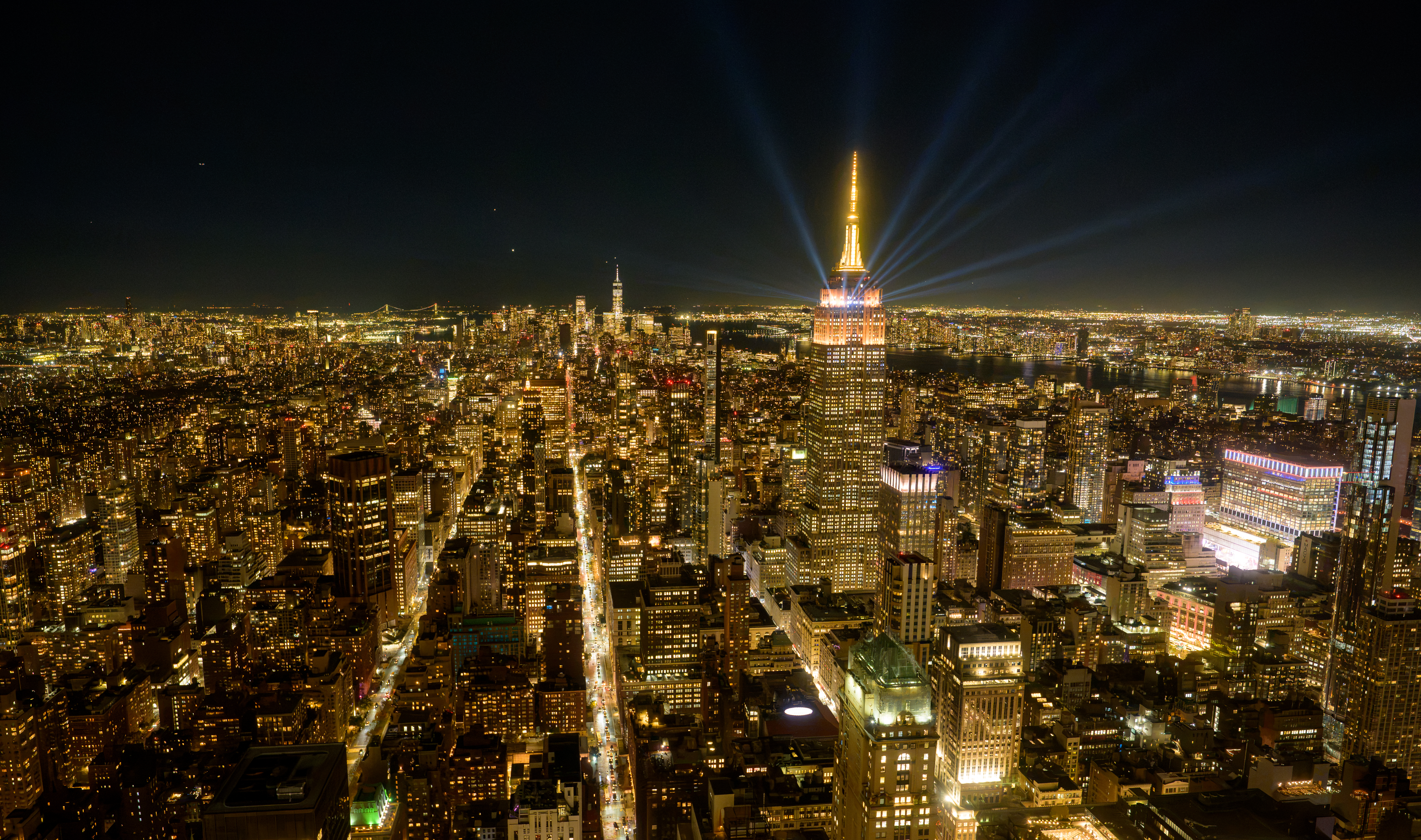
On the evening of November 17, 2026, the Empire State Building's tower lights turned gold — not for a sports championship or a corporate sponsor, but for a spacecraft launched in 1977 that just crossed the one-light-day threshold from Earth. Voyager 1, now farther from home than any object humans have ever built, got the New York City salute it deserved. One light-day is roughly 16 billion miles. At that distance, a signal from Voyager traveling at the speed of light takes a full 24 hours to reach a dish on Earth. The spacecraft itself is moving at about 38,000 miles per hour and has been doing so for nearly half a century. It is, by any measure, the most remote artifact of human civilization. The Empire State Building's lighting program has long served as a kind of civic scoreboard — marking holidays, mourning tragedies, celebrating championships. What makes this particular illumination notable is the scale mismatch it forces you to confront: a 1,454-foot Art Deco tower in Midtown Manhattan honoring an object 16 billion miles away, built with 1970s technology, still transmitting data back to a species that has since invented the internet, smartphones, and machine learning. Voyager 1 carries the Golden Record, a phonograph record containing sounds and images selected to portray the diversity of life and culture on Earth — curated by a committee chaired by Carl Sagan. The gold lighting, whether intentionally or not, rhymes with that artifact. Both are gestures aimed at something bigger than the audience that will actually see them. This is a moment of pure symbolic resonance. No policy was changed. No budget was allocated. No technology was demonstrated. But the act of a city's most iconic building marking the farthest reach of human engineering is the kind of civic ritual that reminds people what public institutions — including NASA — are actually for: expanding the horizon of what's possible and making sure people know about it. The Voyager program cost roughly $865 million at launch (about $4.4 billion in 2026 dollars) and has been returning data for 49 years. By any cost-per-year-of-discovery metric, it remains one of the most efficient scientific investments ever made. The gold lights cost the building's operators essentially nothing. Sometimes the best gestures are cheap. What stays with you isn't the lighting itself but the fact that Voyager is still out there, still sending data, still moving. The Empire State Building will be dark again by morning. Voyager will still be one light-day away, getting farther.
Worth reading?
OPTIONAL
Score
56
/100
Space enthusiasts, New Yorkers who care about their skyline's symbolic vocabulary, and anyone who finds the Voyager program genuinely moving rather than merely interesting.
Cultural Placement
Like Christo wrapping the Reichstag but scaled to a single evening and aimed at deep space rather than politics — a temporary public artwork that reframes an existing monument by pointing it at something vastly beyond its usual register. Closer in spirit to the Earthrise photograph's effect on environmental consciousness than to typical building-lighting spectacles. The gesture borrows from the tradition of civic illumination (Times Square ball drop, Tribute in Light) but redirects it toward scientific achievement rather than calendar ritual or mourning.
Honest assessment
This is a small, well-chosen civic gesture — not a major cultural event. Its power comes entirely from the object it honors: Voyager 1 is one of humanity's most astonishing achievements, and pointing a famous building at it for a night is a modest but resonant act of public attention. The image of the gold tower will outlast the evening itself.
What Is NOVEL?
56
/ 100
BedrockNews applies a structured analytical framework called NOVEL to cultural works — games, books, film, music, and more.
How NOVEL worksNerve
2/5
Originality
3/5
Voice
3/5
Endurance
3/5
Lineage
3/5
What did the artist risk? What could have failed?
Low structural risk. Building lightings are routine civic acts. The choice of subject — interstellar spacecraft — is unusual, but the form itself is well-tested and costs nothing to attempt.
Verified Facts (4)
The Empire State Building was illuminated in gold to celebrate NASA's Voyager 1 spacecraft
Voyager 1 is about to pass one light-day away from Earth
This distance has been reached by no other human-made object
The illumination took place Tuesday, Nov. 17, 2026, in New York City
More latest news
Read all