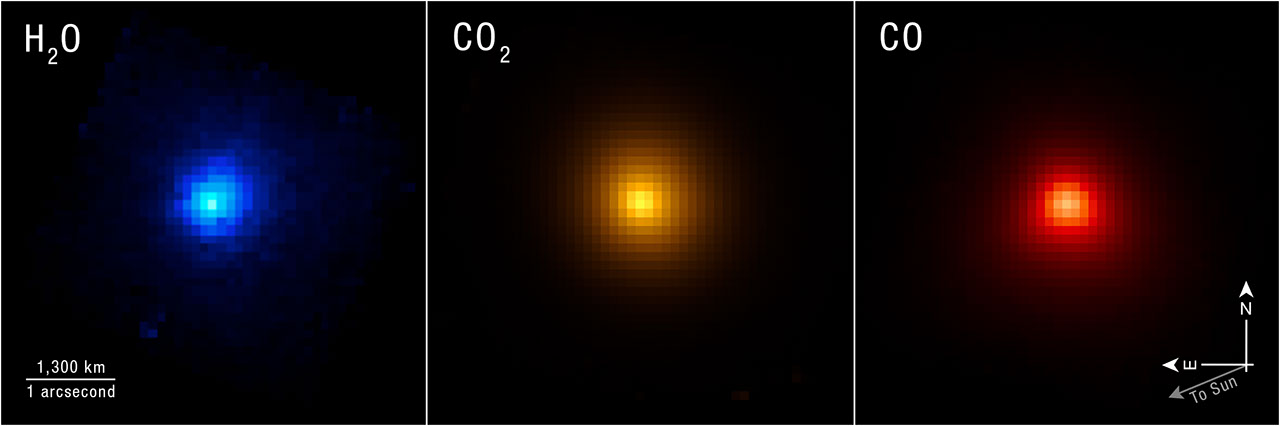
Imagine you find a wine bottle in your cellar with no label. You can't ask who made it, but you can run the chemistry — the isotope ratios of the grapes, the mineral content of the water, the specific yeast strains. From those measurements alone, you can reconstruct the climate, the soil, and the era of the vineyard. That's what Webb just did to a comet. The committed claim: comet 3I/ATLAS, the third confirmed interstellar object, carries isotopic signatures — specifically a deuterium-to-hydrogen ratio 30 times higher and a carbon-13 abundance far lower than any solar system comet — that place its formation at 10 to 12 billion years ago, during the universe's peak star-formation epoch known as cosmic noon. This is the first time isotopic ratios from an interstellar visitor have been used to date its origin system and characterize its birth environment with this specificity. The architecture is infrared spectroscopy via Webb's NIRSpec integral field unit, capturing the comet's coma as solar heating sublimated its ancient ices during the December 2025 perihelion departure. NIRSpec operates in the near-infrared where deuterated water (HDO) and carbon isotopologue lines are accessible. The instrument family is well-established — what's new is the target. You're running a known analytical technique on a sample that has never existed in your lab before. The team received a Target of Opportunity interrupt to Webb's schedule, meaning the telescope's time-allocation committee judged this scientifically urgent enough to bump planned observations. The ladder comparison is against solar system comets, which serve as the baseline. Solar system D/H ratios cluster around 1-3× Vienna Standard Mean Ocean Water; 3I/ATLAS shows roughly 30× that baseline. Carbon-13/carbon-12 ratios in the solar system reflect 4.5 billion years of stellar nucleosynthesis enrichment; 3I/ATLAS shows far less carbon-13, consistent with formation before multiple generations of stars had seeded heavier isotopes. The only prior interstellar comparison is 2I/Borisov (2019), which looked surprisingly solar-system-like. 3I/ATLAS is the opposite — wildly different — which makes the two-object sample suddenly interesting rather than boring. Integrity is solid for an observational astronomy result. Published in Nature on June 22, 2026, with peer review. A complementary study led by Cyrielle Opitom at the University of Edinburgh using the ESO Very Large Telescope independently analyzed carbon and nitrogen isotopes via cyanide spectroscopy, providing partial cross-validation from a completely different instrument and observatory. No pre-registration is standard in observational astronomy (you observe what the universe sends you). The main integrity question is model-dependence: converting isotope ratios to formation age requires assumptions about galactic chemical evolution models, which carry their own uncertainties. The milestone to track is the interstellar object sample size. We're at n=3 (1I/'Oumuamua, 2I/Borisov, 3I/ATLAS). 'Oumuamua had almost no spectral data. Borisov looked local. ATLAS looks ancient and alien. At n=10-15 interstellar objects with high-quality spectra, you start building a statistical picture of what other planetary systems' cometary reservoirs actually look like — and whether our solar system's chemistry is typical or unusual. LSST/Vera Rubin Observatory should accelerate detection rates substantially. The obvious experiment not run: comparing 3I/ATLAS's deuterium signature against a broader set of molecular species beyond water and simple carbon compounds. Webb's MIRI instrument could probe more complex organics and longer-chain molecules that would further constrain the birth environment's radiation field and temperature. The team did get earlier MIRI observations detecting methane (referenced in the article), so this may be a compute/analysis pipeline issue — the MIRI data exists but the full molecular inventory paper is likely being saved for a follow-up publication.
The analogy
Like finding an unlabeled wine bottle and reconstructing the vineyard's climate, soil, and era from the isotope ratios alone — you can't visit the origin, but the chemistry encodes where and when it was made.
Wine forensics
Isotope ratios in grapes and water encode the climate, soil chemistry, and era of a vineyard without needing a label
Comet isotopics
D/H and carbon-13/12 ratios in cometary ice encode the temperature, radiation environment, and galactic epoch of the birth system
Honest assessment
This is a strong observational result: a genuinely alien isotopic signature on an interstellar comet, cross-validated by an independent observatory, published in Nature. The load-bearing assumption is galactic chemical evolution models that convert isotope ratios to formation epoch — if those models are wrong, the 10-12 billion year date shifts. But the raw measurement (30× deuterium enrichment) stands regardless of interpretation. Anyone interested in astrochemistry, prebiotic chemistry, or the question of solar system typicality should pay attention now. For everyone else, this becomes important at n=10-15 objects, when statistics replace anecdote.
What Is CLAIMS?
77
/ 100
BedrockNews applies a structured analytical framework called CLAIMS to academic papers and technical research releases.
How CLAIMS worksClaim
4/5
Ladder
4/5
Architecture
3/5
Integrity
4/5
Milestone
4/5
Successor
4/5
What is this paper actually committing to?
Genuine first. No prior interstellar object has shown isotopic ratios this divergent from solar system baselines. Moves the field from 'interstellar objects exist' to 'they encode alien chemistry we can read.'
The field fight
Is our solar system's cometary chemistry typical or anomalous compared to the galactic average?
Side A
Solar system chemistry is broadly representative; interstellar objects will mostly look familiar
Held by: 2I/Borisov result (2019), uniformitarian models
Side B
Solar system chemistry is a product of specific local conditions; interstellar objects will reveal alien compositions
Held by: 3I/ATLAS, galactic chemical evolution models predicting epoch-dependent isotope ratios
Milestone tracker
Unlocks: Statistical distribution of extrasolar cometary chemistry — is our solar system typical or a chemical outlier?
Current
3
interstellar objects
detected to date
Next
10-15
objects with spectra
statistical sample
~3-5 years with Vera Rubin/LSST accelerating detections
Verified Facts (9)
NIRSpec revealed exceptionally high levels of deuterium, about 30 times more than seen in solar system comets
The research team estimates that 3I/ATLAS could have formed as long as 10 to 12 billion years ago, during the universe's 'cosmic noon'
NIRSpec showed only traces of carbon-13 compared to lighter-weight carbon-12
A paper detailing the findings published June 22 in the journal Nature
The comet's name comes from its status as the third confirmed interstellar comet
Our Sun formed relatively recently, 4.5 billion years ago
A separate study using the European Southern Observatory's Very Large Telescope, led by astronomer Cyrielle Opitom of the University of Edinburgh
Martin Cordiner of NASA's Goddard Space Flight Center in Greenbelt, Maryland, and lead author of the study
Stefanie Milam of NASA Goddard and co-author of the study
Practical Implications (4)
Establishes that interstellar objects can carry radically different isotopic signatures, validating the scientific case for rapid-response Webb observations of future visitors
Provides the first empirical constraint on cometary chemistry outside our solar system, directly relevant to models of prebiotic chemistry prevalence
Strengthens the science case for Vera Rubin/LSST's interstellar object detection program by demonstrating what high-quality follow-up spectroscopy can extract
Challenges the assumption from 2I/Borisov that interstellar comets will resemble local ones — future detection strategies should plan for chemically exotic targets
More latest news
Read all