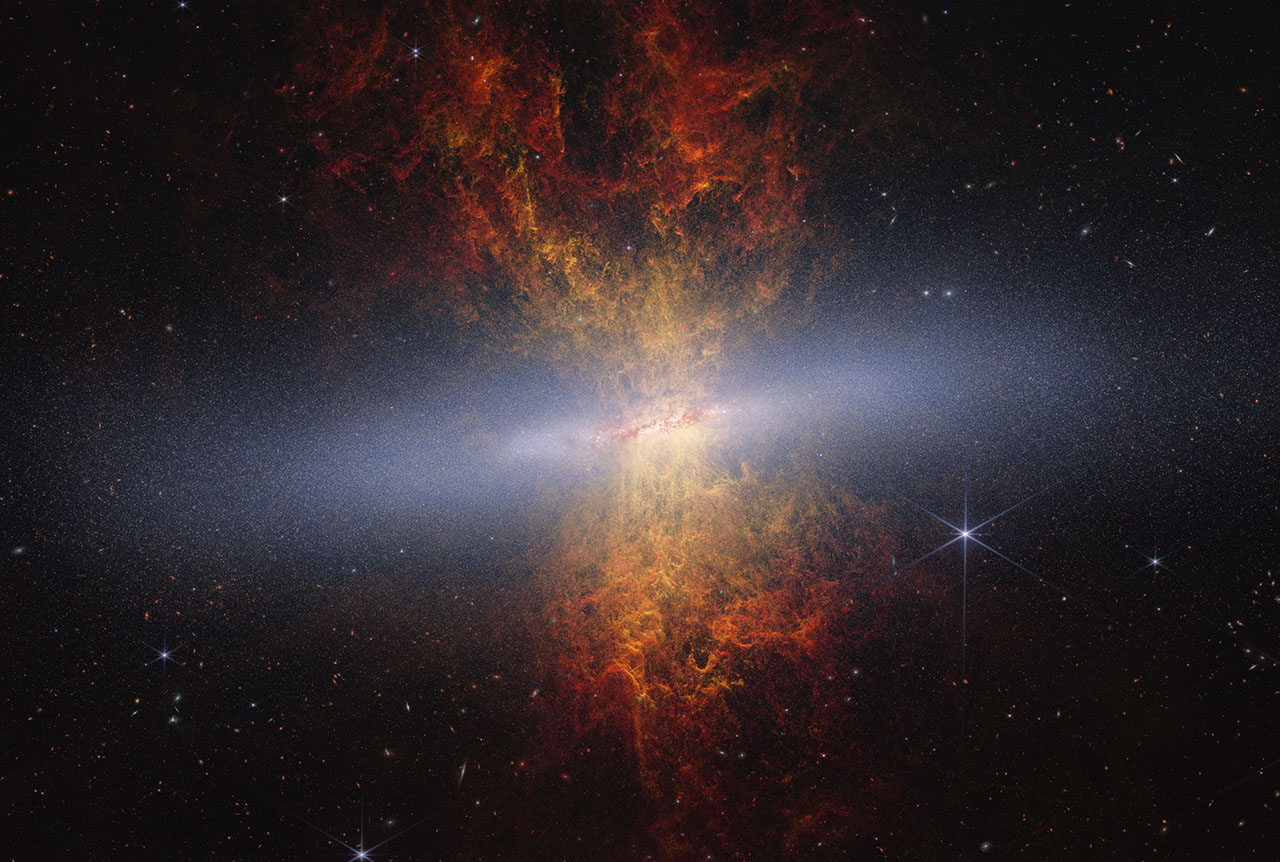
You know how a city looks from an airplane at night — a smear of light where you can't tell a house from a highway? Now imagine switching to a camera that can resolve every single streetlamp, every porch light, every headlight on the freeway. That's what Webb just did to Messier 82, the Cigar galaxy. Where Hubble saw a bright, dusty blur, Webb's 65-hour NIRCam survey individually resolved 16.5 million stars — and each one is a timestamp in the galaxy's formation history. The committed claim: Webb's near-infrared imaging survey of M82 has, for the first time, resolved millions of individual stars across the full disk of a starburst galaxy, providing a star-by-star fossil record of its evolutionary history. This isn't a methods paper or a pretty picture release — it's the first dataset that lets astronomers read M82's merger history from its stellar population rather than inferring it from gas dynamics alone. The ladder here matters. Prior observations from Hubble and the retired Spitzer telescope could characterize M82's gas and dust structure in visible and mid-infrared light, but the dust blocked resolved stellar photometry at the individual-star level. Webb's previous, shorter looks at M82 detected structures but couldn't go deep enough to catalog millions of stars. This 65-hour survey — the longest dedicated NIRCam program on M82 — is what crossed the threshold. The 16.5 million resolved stars represent only a fraction of the galaxy's total stellar population, but it's enough to construct color-magnitude diagrams that trace when and where stars formed over billions of years. Architecturally, this is resolved stellar population photometry using broadband near-infrared imaging from Webb's NIRCam instrument. The method leans on Webb's 6.5-meter primary mirror and its position at L2 (1.5 million km from Earth), which together deliver the angular resolution and infrared sensitivity needed to separate individual point sources through heavy dust columns. The technique itself — photometric surveys of resolved stars to reconstruct star formation histories — is classical. What's new is applying it at this depth and resolution to a starburst environment where dust previously made it impossible. The integrity picture is solid for observational astronomy. The data comes from direct observation, not simulation. The comparison to Hubble is shown side-by-side, making the improvement self-evident rather than requiring statistical argument. The team includes researchers from STScI, Tufts, University of Washington, University of Michigan, and University of Manchester — a multi-institutional collaboration with complementary expertise. What we don't have yet is the peer-reviewed analysis paper extracting the actual star formation histories from these photometric catalogs; this release describes the imaging survey and its qualitative findings (distorted disk, layered outflows, asymmetric radii). The quantitative science is still coming. The milestone to track: this survey gives you 16.5 million resolved stars in one starburst galaxy at 12 million light-years. The next threshold is constructing complete color-magnitude diagrams from this data to date stellar populations across the disk — essentially building a timeline of when each region of M82 formed its stars. Beyond that, applying the same technique to more distant starburst galaxies (50-100 Mly) would test whether M82's merger-driven starburst pattern is typical or anomalous. Webb can probably reach ~30 Mly with similar star-by-star resolution; beyond that requires next-generation extremely large telescopes. The experiment not run — and the honest read on why: the team hasn't yet published the quantitative star formation history derived from these 16.5 million stars. That's the whole point of the survey, and it's almost certainly in progress. The imaging release comes first because it demonstrates the capability; the population synthesis analysis takes months of careful photometric fitting. This is sequence (c) — saving the main result for the flagship paper. The other gap: spectroscopy of individual stars to get metallicities and velocities, which would nail the merger timeline. That would require NIRSpec multi-object spectroscopy on thousands of targets — feasible but enormously expensive in telescope time.
The analogy
Imagine a city photographed from an airplane at night — all you see is a glow. Now switch to a camera that resolves every individual streetlamp. Each lamp's age and type tells you when that neighborhood was built. That's what Webb did to M82: turned a luminous blur into 16.5 million individual timestamps.
Aerial city photo
Resolving individual streetlamps from a blur to date each neighborhood's construction era
NIRCam star survey
Resolving 16.5M individual stars through dust to date each region's formation epoch
Honest assessment
This is a capability demonstration more than a finished scientific result — the 65-hour NIRCam survey proves you can resolve individual stars in a dusty starburst galaxy, but the actual star formation history analysis is still in the pipeline. The imaging is genuinely unprecedented and the dataset is a goldmine that will produce papers for years. If you care about galaxy evolution, this is the dataset to track. If you want the science conclusions, wait 12-18 months for the population synthesis papers.
What Is CLAIMS?
70
/ 100
BedrockNews applies a structured analytical framework called CLAIMS to academic papers and technical research releases.
How CLAIMS worksClaim
4/5
Ladder
4/5
Architecture
3/5
Integrity
3/5
Milestone
3/5
Successor
4/5
What is this paper actually committing to?
Genuine first: 16.5M individually resolved stars in a starburst galaxy disk, through dust no prior telescope could penetrate. Not an incremental improvement — a new category of data for M82.
The field fight
Should starburst galaxies be understood primarily through gas dynamics or resolved stellar populations?
Side A
Gas kinematics and emission-line diagnostics are sufficient to reconstruct starburst histories
Held by: ALMA surveys, IFU spectroscopy programs, Hα mapping studies
Side B
Resolved stellar photometry provides a direct fossil record that gas diagnostics cannot match for temporal precision
Held by: HST resolved-star programs, this Webb survey, Local Group population studies
Milestone tracker
Unlocks: Testing whether M82's merger-driven starburst pattern generalizes or is a local anomaly
Current
16.5M
stars
M82 at 12 Mly
Next
30
Mly
Starburst at greater distance
~2-4 years for extended survey proposals and observation cycles
Verified Facts (14)
Located 12 million light-years away
Webb's image contains approximately 16.5 million individual stars
65 hours of observation time with Webb's NIRCam (Near-Infrared Camera) instrument
Star formation 10 times faster than the Milky Way galaxy's star formation rate
M82's intense star formation estimated to last a few hundred million years in its entirety
Adam Smercina, a NASA Hubble Fellow at the Space Telescope Science Institute in Baltimore, and incoming Assistant Professor at Tufts University
Benjamin Williams of the University of Washington
Eric Bell of the University of Michigan
Kristen McQuinn of the Space Telescope Science Institute
Thomas Williams of the University of Manchester
Dust grains called polycyclic aromatic hydrocarbons
Webb orbits the Sun 1.5 million kilometers from the Earth at L2
Webb launched on Dec. 25th 2021
International program led by NASA with partners ESA and CSA
Practical Implications (4)
Resolved stellar photometry in dusty starburst environments is now feasible with Webb, opening a new observational category for galaxy evolution studies
M82's distorted disk asymmetry, visible for the first time in stars rather than gas, provides direct structural evidence for the merger history that was previously inferred indirectly
The layered outflow structure (ionized gas inner, PAH dust outer) gives observers a template for interpreting starburst-driven winds in more distant galaxies
Multi-telescope dataset combination (Webb infrared + Hubble visible) is emerging as the standard methodology for complex galactic ecosystems
More latest news
Read all