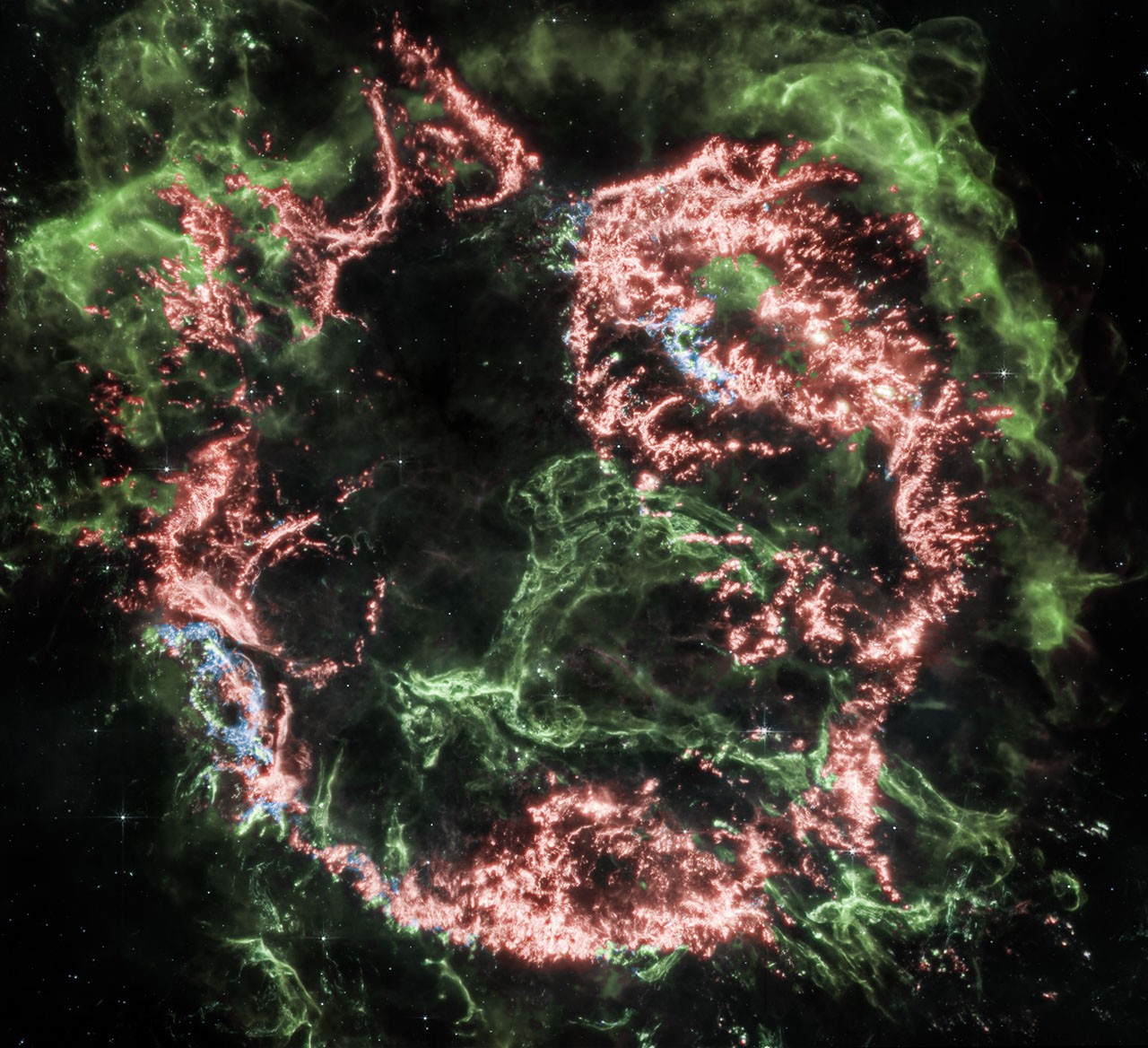
Imagine a layered cake where each ring is a different flavor — vanilla on the outside, chocolate in the middle, strawberry at the core. Now imagine someone jammed a spoon into the cake and stirred the layers together minutes before serving. The slices you cut afterward would look nothing like the original recipe. That is, structurally, what this paper argues happened inside the star that became Cassiopeia A: its interior shells of oxygen and carbon merged shortly before the supernova explosion, and the dust left behind carries the chemical fingerprints of that last-minute scramble. The committed claim: by resolving individual solar-system-sized dust clumps across the entire Cas A remnant using Webb's MIRI instrument, the team maps three distinct dust chemistries — silica, carbon, and complex magnesium silicates — and shows their spatial distribution is inconsistent with an undisturbed onion-shell stellar structure. The distribution instead matches predictions from shell-merger models, where convective mixing in the final hours before core collapse blends adjacent burning layers. This is the first time such a merger signature has been read from dust composition at this spatial resolution across a full supernova remnant. The ladder here is meaningful. Previous Spitzer observations of Cas A could identify broad spectral regions but couldn't resolve individual clumps — the article explicitly notes Spitzer identified three target regions that Webb then dissected. Chandra and XRISM provided X-ray elemental maps, but those trace hot gas, not condensed dust grains. Webb's MIRI fills a gap no other instrument can: mid-infrared spectroscopy at angular resolutions fine enough to map dust chemistry clump by clump. The advance is instrumental capability applied to a known target, not a new theoretical framework. Architecturally, this is observational astrophysics using mid-infrared spectral imaging. The method belongs to the family of spatially resolved spectroscopic dust-composition mapping — take spectra at each pixel, fit dust models to the emission features, and produce a composition map. The key hardware property is MIRI's combination of sensitivity and angular resolution at 5-28 μm wavelengths, which is unique to Webb. The paper leans heavily on Webb's resolving power to separate clumps that were blurred together in every prior observation. Integrity is solid for observational astronomy. The validation chain runs: Spitzer identified targets → Webb observed them → dust models were fitted to the spectra → the resulting composition maps were compared against supernova nucleosynthesis models with and without shell mergers. This is not circular — the dust observations and the stellar evolution models are independent. The team also cross-referenced X-ray data from Chandra and XRISM for the gas-phase elemental abundances. One caveat: dust model fitting involves degeneracies (grain size, temperature, composition can trade off), and the paper's confidence in distinguishing silica from carbon from magnesium silicates depends on those models being correct. No pre-registration is possible for observational astronomy, but the targets were identified from prior Spitzer data, which provides a natural prediction-then-test structure. The milestone question is about generalizability. Cas A is one of the best-studied supernova remnants in the sky — young (~340 years), nearby (~11,000 light-years), and bright. The method demonstrated here — reading progenitor star structure from resolved dust chemistry — needs to be applied to other remnants (Crab Nebula, SN 1987A, Tycho's remnant) to confirm that shell-merger signatures are common rather than a Cas A peculiarity. SN 1987A in the Large Magellanic Cloud is the obvious next target: it's younger, its progenitor star type is known, and Webb has already observed it. The successor experiment the authors did not run is a full quantitative comparison of the observed dust abundance ratios against a grid of shell-merger simulations with varying merger timings and progenitor masses. The paper establishes the qualitative match — the dust map looks like what shell mergers predict — but does not constrain the merger timing to, say, 2 hours versus 20 hours before collapse. Honest read: this is likely compute-limited on the simulation side and scope-limited for a Letters-format paper. The quantitative modeling is almost certainly the next paper.
The analogy
Imagine a layered cake where each ring is a different flavor. Someone stirs the layers together minutes before serving. The slices you cut afterward reveal the scramble — that's what Webb is doing with Cas A's dust: reading the chemical slices to detect that the star's interior layers mixed just before it exploded.
Stirred cake
Cutting slices of a layered cake after someone stirred the layers reveals the mixing pattern from the flavor distribution
Dust chemistry map
Resolving individual dust clumps in a supernova remnant reveals shell-merger mixing from the chemical composition distribution
Honest assessment
This is a capability demonstration dressed as a discovery paper — and that's not a criticism. Webb's MIRI can do something no other instrument can (resolve individual dust clumps in a supernova remnant and read their chemistry), and the team has used that capability to produce the first evidence that shell mergers leave readable signatures in dust. The result is real but singular: one remnant, qualitative match to models, no quantitative timing constraints yet. The load-bearing question is whether this pattern holds across other remnants. If it does, this paper becomes the founding observation of a new subfield — reading stellar death clocks from dust chemistry. If Cas A turns out to be unusual, this is a nice Webb showcase. Engineers and practitioners outside astrophysics: this matters as a demonstration of what spatially resolved spectroscopy at unprecedented resolution can reveal. The general pattern — 'higher resolution turns blurred averages into readable structure' — applies far beyond astronomy.
What Is CLAIMS?
70
/ 100
BedrockNews applies a structured analytical framework called CLAIMS to academic papers and technical research releases.
How CLAIMS worksClaim
4/5
Ladder
3/5
Architecture
3/5
Integrity
4/5
Milestone
3/5
Successor
4/5
What is this paper actually committing to?
Genuine first: full-remnant, clump-resolved dust-composition map revealing shell-merger signatures in Cas A. Not a methods paper — a result that provides a new observational window into pre-supernova stellar interiors.
The field fight
Can supernova remnant dust compositions reliably reconstruct progenitor star internal structure and final-hours dynamics?
Side A
Gas-phase X-ray elemental mapping (Chandra, XRISM) is the primary diagnostic for progenitor structure
Held by: Chandra teams, XRISM collaborations
Side B
Condensed dust grains preserve complementary and sometimes unique chemical information that gas-phase observations miss
Held by: Webb/MIRI dust teams, this paper
Milestone tracker
Unlocks: Confirmation that shell-merger signatures are universal pre-supernova physics, not a Cas A peculiarity
Current
1
remnant
Cas A dust-mapped
Next
3-5
remnants
Comparative sample
~2-4 years for SN 1987A and others
Verified Facts (10)
Cassiopeia A is a supernova remnant observed by Webb's MIRI instrument in mid-infrared
Three dust types identified: silica, carbon, and complex magnesium silicates
Two targets inside Cas A's reverse-shocked region, one in the Green Monster structure
Green Monster originated from material the star shed before it exploded, not from supernova ejecta
Results published in The Astrophysical Journal Letters
Lead author Tea Temim, Columbia University; co-author Dan Milisavljevic, Purdue University
Spitzer identified three specific regions that Webb then observed
Chandra X-ray Observatory and JAXA-led XRISM provided complementary X-ray observations
Shell merger refers to oxygen- and carbon-burning shells merging shortly before supernova explosion
Cas A's dust clumps are solar-system-sized
Practical Implications (4)
Establishes a new method for inferring progenitor star internal structure from supernova remnant dust — applicable to any remnant Webb can resolve
Demonstrates that shell mergers (a theoretically predicted but observationally unconfirmed phenomenon) leave detectable chemical signatures in dust
Provides a template for multi-observatory cross-referencing: Spitzer for target identification, Webb for dust chemistry, Chandra/XRISM for gas-phase elements
Opens a pathway to constraining the timing of pre-supernova stellar instabilities — relevant to supernova modeling and nucleosynthesis predictions
More latest news
Read all