Listen
Chandra X-ray Observatory Sonifications
on NASA
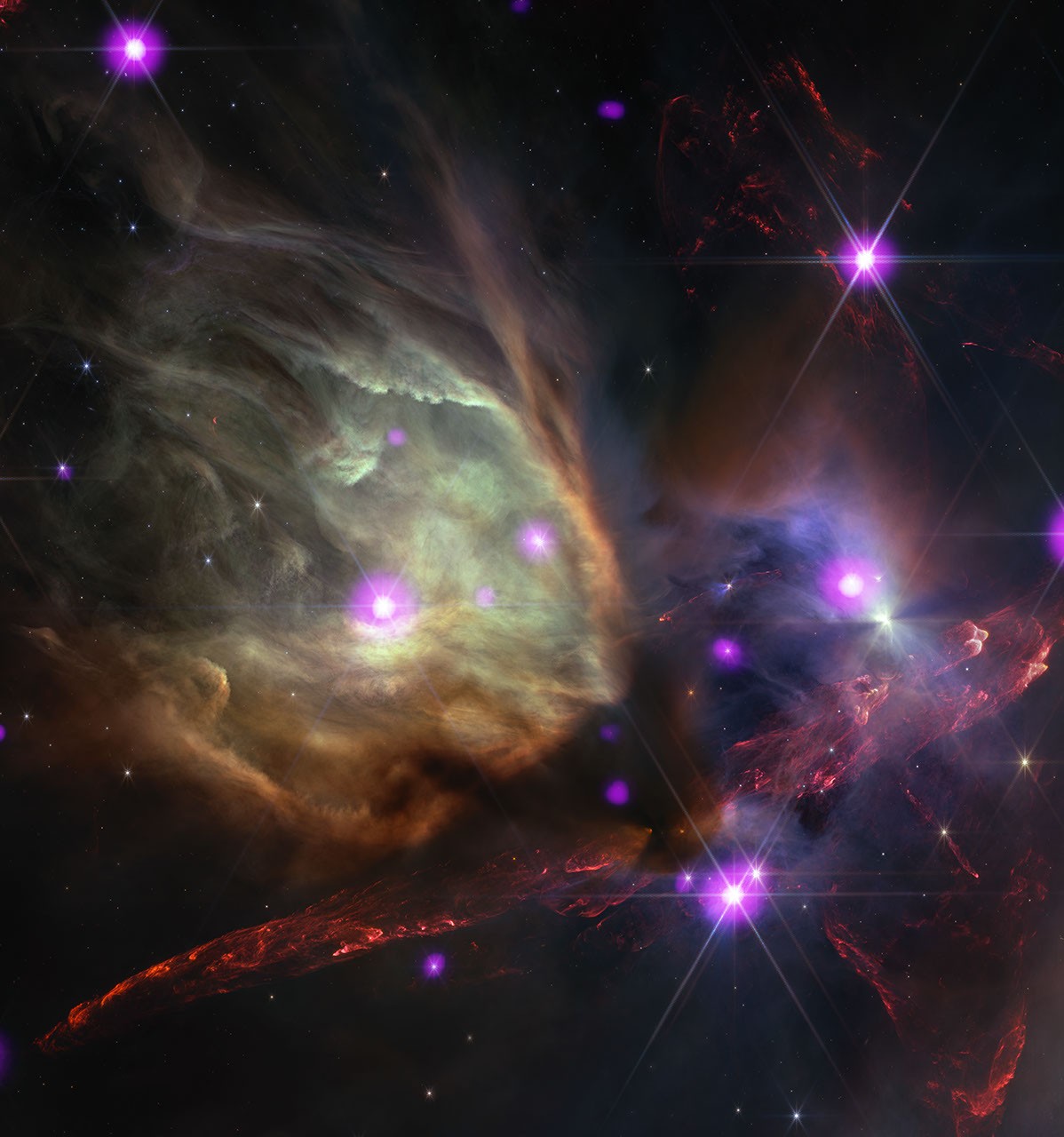
Data sonification — the practice of mapping scientific measurements to sound — has been around long enough to have its own clichés. Most attempts produce ambient washes that sound impressive for thirty seconds and then blur into screensaver music. What makes this Chandra collection worth your attention is the specificity of the mapping choices and the genuine compositional thinking behind them. The album covers four star-forming regions: Messier 82 (a starburst galaxy forming stars at tens to hundreds of times the Milky Way's rate), the Orion Nebula (one of the closest active stellar nurseries to Earth), the Carina Nebula's "Cosmic Cliffs," and Rho Ophiuchi. Each piece layers data from multiple telescopes — Chandra's X-rays, Hubble's optical data, Webb's infrared, and in one case Spitzer's infrared — into distinct sonic registers. X-rays map to high frequencies, infrared to low drones and plucked tones, optical to mid-range musical pitches. The structure isn't arbitrary. The team behind this — visualization scientist Kimberly Arcand at the Chandra X-ray Center, astrophysicist Matt Russo, and musician Andrew Santaguida of SYSTEM Sounds — has been refining this craft for years. The Rho Ophiuchi piece is the most striking: there's a silence in the middle caused by dark dust clouds emitting almost no light, and that gap tells you something real about the physics of the region. When the data dictates the form, sonification stops being decoration and starts being information. The Orion Nebula piece demonstrates the range well. Chandra sees over a thousand energetic infant stars in that region, rendered as twinkling sounds, while diffuse X-ray emission becomes sustained high tones. Webb's infrared reveals the gas and dust scaffolding those stars are built from, heard as lower musical tones, distorted strings, and digital harp. The layering isn't just pretty — it's making visible (audible) the relationship between raw material and finished product in star formation. M82's sonification is the most data-dense, combining four telescopes across three wavelength bands. A radar-like scan moves across the image, with loudness tracking brightness. The giant plumes of hot gas Chandra detects — byproducts of young massive stars exploding — register as distinct sonic events against the broader infrared and optical textures. The Carina Nebula piece, featuring cello by Johnny Mok, leans most toward conventional musicality, with individual baby stars rendered as short string sounds against sustained nebular tones. What this project does well is refuse the false choice between scientific accuracy and aesthetic pleasure. The mappings are principled — wavelength to frequency range, brightness to amplitude, spatial position to temporal position in the scan — but the timbral choices (distorted strings, metallic plucks, glassy tones) show someone thinking about how to make the differences between data sources perceptually distinct, not just technically correct. The limitation is inherent to the form: these are translations, not discoveries. No astronomer is going to hear something in the sonification they couldn't see in the image data. The audience is people who want to experience astronomical data through a different sensory channel — whether for accessibility reasons, curiosity, or the genuine pleasure of hearing what a starburst galaxy sounds like when you let the data compose the music.
Worth reading?
RECOMMENDED
Score
52
/100
Anyone curious about the intersection of astronomy and sound design; science educators looking for multisensory teaching tools; ambient music listeners who want their drones grounded in real data rather than synthesizer presets.
Cultural Placement
Like Brian Eno's generative ambient systems crossed with Edward Tufte's information-density principles, filtered through NASA's public-science mandate. The closest predecessors are Russo and Santaguida's own earlier Chandra sonifications and Carsten Nicolai's data-driven sound installations, but with a didactic clarity those lacked. Think of it as the science-communication equivalent of what Radiolab did for audio storytelling — using the medium's strengths to make abstract data viscerally legible.
Honest assessment
This is careful, principled data-art from a team that's been refining the form for years. It won't reshape music or data visualization, but it does something genuinely useful: it makes multi-wavelength astronomy perceptually accessible through a medium other than sight. Best experienced as companion pieces to the visual data, not standalone compositions.
What Is NOVEL?
52
/ 100
BedrockNews applies a structured analytical framework called NOVEL to cultural works — games, books, film, music, and more.
How NOVEL worksNerve
2/5
Originality
3/5
Voice
3/5
Endurance
2/5
Lineage
3/5
What did the artist risk? What could have failed?
Low structural risk. Sonification is established practice at CXC, the audience is built-in, and NASA's brand absorbs any experimental failure. The dust-gap silence in Rho Ophiuchi is the boldest formal choice.
Verified Facts (7)
M82 forms stars at a rate tens or even hundreds of times higher than the Milky Way
Chandra sees more than a thousand stars in the Orion Nebula region
The Carina Nebula's portion is nicknamed the 'Cosmic Cliffs'
Sonification collaboration driven by Kimberly Arcand (CXC), Matt Russo, and Andrew Santaguida (SYSTEM Sounds), along with Christine Malec, consultant
NASA's Marshall Space Flight Center in Huntsville, Alabama, manages the Chandra program
Cello by Johnny Mok in the Carina Nebula sonification
Rho Ophiuchi sonification has a gap in the middle due to dark dust clouds that emit very little light
More latest news
Read all