TOTAL SEED FUNDING
$171M
PROJECTS SELECTED
302
PHASE I CAP
$225K
PHASE II CAP
$1.3M
NASA's Small Business Innovation Research and Small Business Technology Transfer program has selected 302 projects for up to $171 million in seed funding, spread across Phase I contracts (up to $225,000 each for feasibility) and 98 Phase II contracts (up to $1.3 million each for demonstration). The awards target Artemis-era priorities: lunar surface power, autonomous robotics, extreme-environment batteries, and landing pad construction. This is industrial policy executed through a distributed pipeline rather than a single megacontract.
Extraction Map
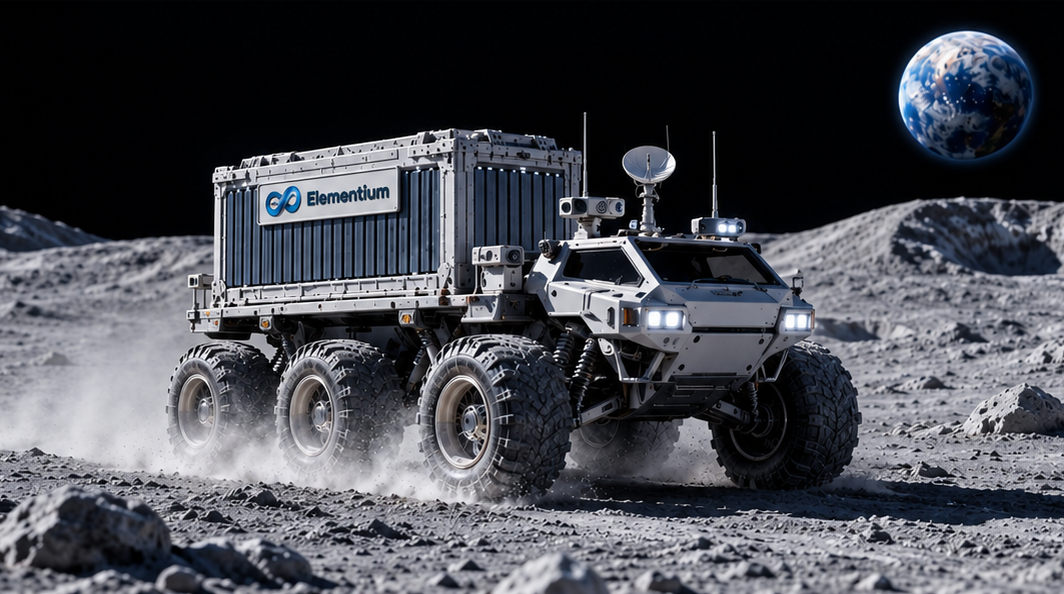
The program's structure is deliberate. Phase I money is small enough to be non-threatening to incumbents but large enough to validate a concept. Phase II funding, contingent on Phase I results, creates a natural filter — only feasible ideas advance. The two-phase design forces small firms to demonstrate merit before scaling, reducing the risk of funding vaporware while keeping the door open to firms that would never survive a traditional defense-procurement gauntlet. Four highlighted projects illustrate the range. Opterus Research and Development is building rollable, robotically-deployable solar arrays scalable to 50 kilowatts that work in dusty lunar conditions — a Phase II award, meaning the concept already passed feasibility review. Intelligent Fiber Optic Systems Corporation is developing a 10-foot extendable robotic arm with integrated vision and tactile sensing for autonomous lunar surface tasks, with direct terrestrial applications in hazardous infrastructure inspection. Elementium Materials Inc. is tackling one of the Moon's hardest engineering constraints: the 14-day lunar night, where temperatures plunge below minus 76 degrees Fahrenheit. Their ultra-cold-tolerant battery module eliminates the need for active heating systems, freeing mass and volume for science payloads. Slate Geotechnical Consultants and the Colorado School of Mines are evaluating methods to prepare lunar regolith for reusable landing pads — without which rocket exhaust blasts loose material into nearby infrastructure, a problem that scales with mission frequency. The dual-use pattern is consistent across the portfolio. Rollable solar arrays serve both NASA and commercial lunar operators. Cold-tolerant batteries apply to Earth's cold climates. Tactile robotic arms inspect nuclear reactors and power lines. This is not accidental — the SBIR/STTR program explicitly targets commercialization alongside mission infusion, building a supplier base that doesn't depend solely on government contracts for survival. The structural question is whether $171 million across 302 projects is enough to move hardware from feasibility to flight. Phase I at $225,000 buys a study and maybe a bench prototype. Phase II at $1.3 million buys a demonstration unit. Neither buys qualification for spaceflight. The gap between Phase II and an actual lunar deployment remains the program's perennial challenge — the so-called "valley of death" where promising small-business technologies stall without a bridge to production contracts or commercial customers. Still, the program's track record and distributed architecture make it one of NASA's most efficiently generative mechanisms. It seeds dozens of parallel technology bets rather than concentrating risk in one prime contractor, and it builds institutional capacity in firms that did not previously participate in the space economy. The question is not whether the model works — it does — but whether the downstream procurement pipeline is ready to absorb what it produces.
Worth reading?
RECOMMENDED
Score
76
/100
Generative. Distributes early-stage capital across hundreds of small firms, builds dual-use capability, and explicitly targets commercialization — the opposite of rent-seeking concentration.
What Is GRIN?
GRIN stands for Generativity, Resilience, Innovation efficiency, and Novelty openness. These four dimensions capture the essential characteristics of any memetic intelligence — whether a nation, a corporation, a religion, or a movement.
About GRINGenerativity
4/5
Resilience
4/5
Efficiency
3/5
Novelty
4/5
Extractive
1/5
Inverted
Does this create new capability or just redistribute existing value?
Textbook generativity. 302 parallel technology bets seed new capability in firms outside the traditional prime-contractor oligopoly, with explicit dual-use commercialization paths built into the program structure.
Verified Facts (8)
NASA's SBIR/STTR program recently selected 302 innovative projects, for a total investment of up to $171 million in seed funding.
The new Phase I contracts will receive up to $225,000 each to establish the merit and feasibility of their proposed innovation.
The Phase II awards, with 98 contracts valued at up to $1.3 million each, will continue work begun in Phase I projects selected in 2025.
Opterus Research and Development Inc. supports a project focused on bringing power to the surface of the Moon and Mars by developing a modular system of rollable solar arrays. The technology could be scaled up to 50 kilowatts.
Intelligent Fiber Optic Systems Corporation aims to help lunar rovers perform complex tasks independently on the Moon. The firm's 10-foot, extendable robotic arm can both 'see' and has a sense of touch.
Elementium Materials Inc. is developing an ultra-cold-tolerant battery module for space applications. The technology can operate down to minus 76 degrees Fahrenheit without active heating.
A collaboration between Slate Geotechnical Consultants Inc. and the Colorado School of Mines will evaluate two approaches to preparing lunar regolith for repeated lunar landings.
NASA's SBIR/STTR program is part of the agency's Research and Technology Mission Directorate and is managed by NASA's Ames Research Center in California's Silicon Valley.
More latest news
Read all