TECH DOMAINS
5
TARGET MATURITY
TRL 5–6
LUNAR NIGHT
14 days
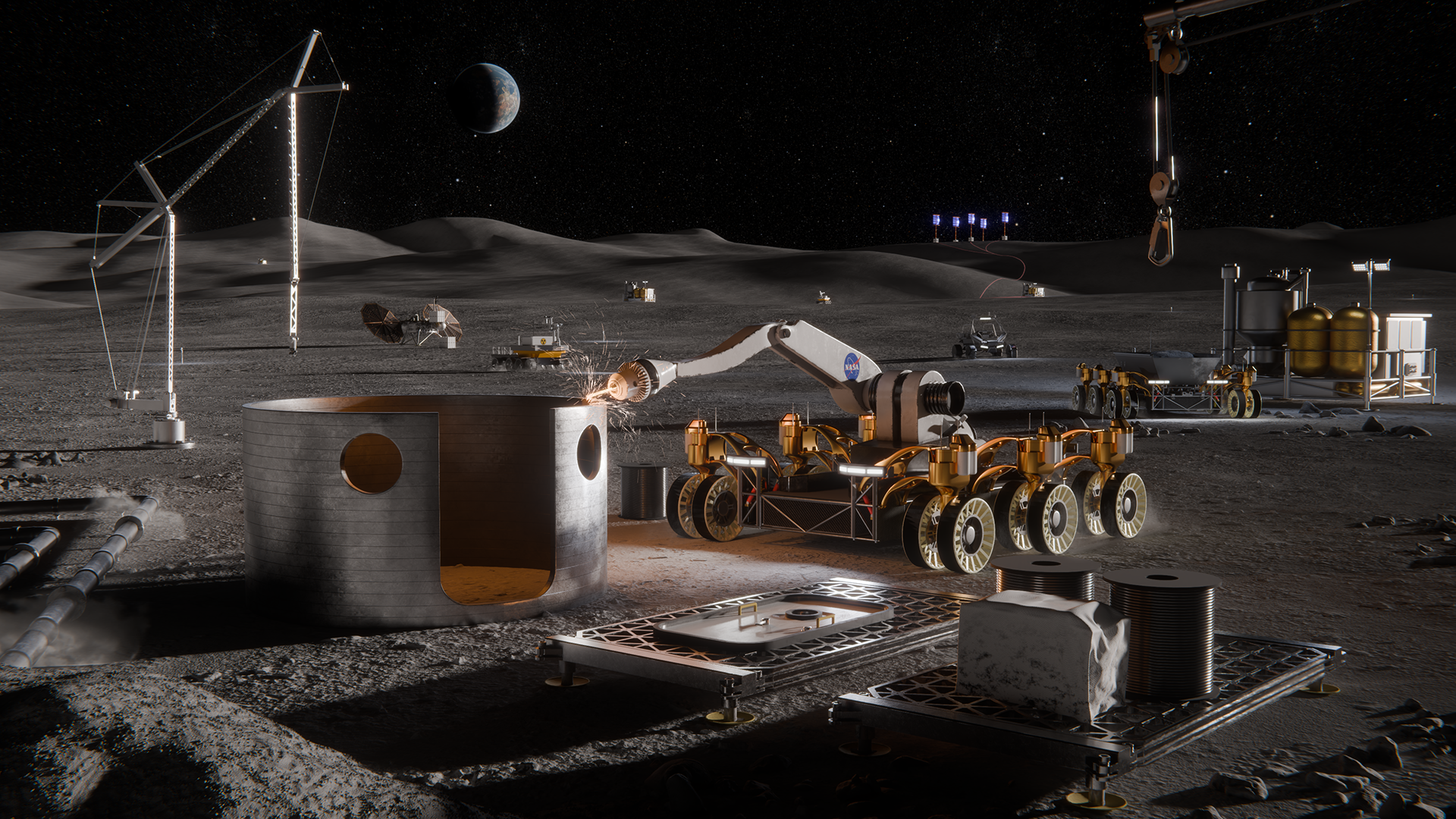
NASA issued a draft Broad Agency Announcement under NextSTEP-3, Appendix A, in June 2026, formally titled the Lunar Enabling Infrastructure Accelerator (LEIA). The solicitation targets five technology domains: vertical solar arrays, ISRU oxygen production systems, Stirling radioisotope generators, in-space manufacturing tools, and advanced nanomaterials production. Each represents a load-bearing dependency for any sustained lunar presence.
Extraction Map
The mechanism matters as much as the technologies. NextSTEP (Next Space Technologies for Exploration Partnerships) uses a BAA structure — competitive, milestone-gated, designed to mature multiple competing solutions in parallel rather than picking a single contractor early. The target maturity is TRL 5–6, meaning ground-based demonstrations in relevant environments. This is the valley of death for space hardware: past the lab, not yet on the manifest. ISRU oxygen production is the headline capability. If you can extract oxygen from lunar regolith at scale, you slash the mass budget for every subsequent mission — propellant, life support, and industrial processes all benefit. Without it, every kilogram of oxidizer rides up from Earth at roughly $50,000–$100,000 per kg to the lunar surface, making sustained presence economically absurd. Stirling radioisotope generators address the power-through-lunar-night problem. The Moon's 14-day night cycle kills solar-only architectures for permanent habitation. Radioisotope systems provide continuous baseline power independent of sunlight, but the technology has been in development limbo for over a decade. Whether this solicitation breaks that logjam depends entirely on funding levels and schedule pressure. Vertical solar arrays and in-space manufacturing represent the infrastructure layer — the difference between a flags-and-footprints program and an actual operating base. Nanomaterials production is the most speculative of the five, potentially enabling radiation shielding and structural materials manufactured in situ rather than launched. The structural signal here is NASA using competitive procurement to force technology maturation before committing to flight hardware. This is the opposite of the SLS approach, where a single architecture was selected early and costs ballooned. LEIA's design — multiple competitors, ground testing gates, TRL 5–6 targets — creates the conditions for genuine down-selection based on demonstrated performance rather than political constituency. The draft solicitation is posted on SAM.gov. The gap between draft and final BAA, and between funded awards and actual flight manifests, is where most lunar technology programs have historically died. The question is whether this procurement vehicle has the budget authority and schedule urgency to push hardware past the demonstration stage into actual mission integration.
Worth reading?
RECOMMENDED
Score
76
/100
Generative — the BAA structure is designed to create new physical capability (ISRU, power, manufacturing) across multiple competitors rather than concentrating value in a single contractor.
What Is GRIN?
GRIN stands for Generativity, Resilience, Innovation efficiency, and Novelty openness. These four dimensions capture the essential characteristics of any memetic intelligence — whether a nation, a corporation, a religion, or a movement.
About GRINGenerativity
4/5
Resilience
3/5
Efficiency
4/5
Novelty
4/5
Extractive
1/5
Inverted
Does this create new capability or just redistribute existing value?
Strongly generative if funded. Five technology domains each unlock compounding capability — ISRU oxygen alone could cut lunar logistics costs by orders of magnitude. Competitive BAA structure forces real demonstrations.
Verified Facts (8)
NASA issued a draft BAA under NextSTEP-3, Appendix A, on June 2026
Solicitation seeks to close key technology gaps in vertical solar arrays, ISRU oxygen production systems, Stirling radioisotope generators, in-space manufacturing, and advanced nanomaterials production
Focuses on maturing competing solutions to TRL 5–6
Formally titled Lunar Enabling Infrastructure Accelerator (LEIA)
Draft solicitation posted on SAM.gov
Funded efforts will advance the technology objectives of NASA's Moon Base
Editor: Loura Hall, Last Updated Jun 29, 2026
Related to Space Technology Mission Directorate and Glenn Research Center
More latest news
Read all