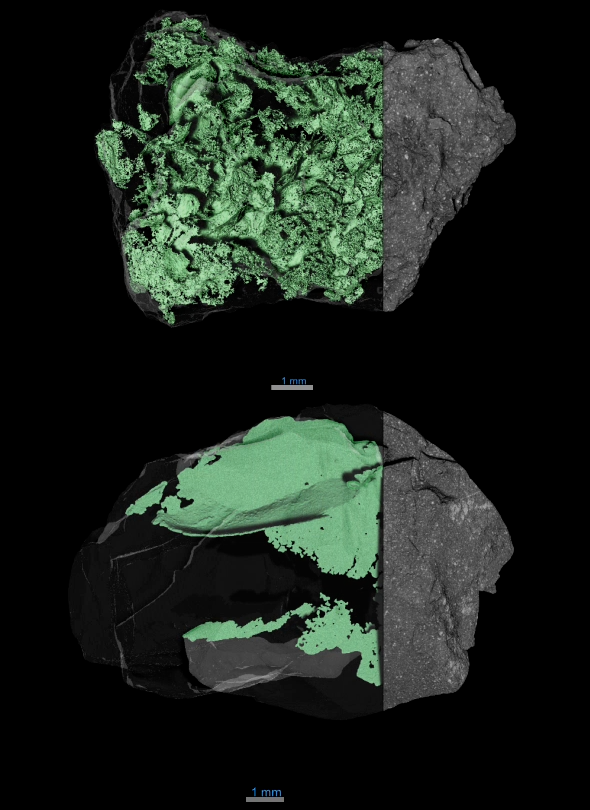
NASA has released X-ray computed tomography scans of particles returned from asteroid Bennu, revealing the most common types of crack networks observed in the samples. The image accompanies a brief caption — no detailed scientific findings, no paper citation, just the scans themselves and a title: 'Solving Asteroid Bennu's Mysteries.' The samples come from NASA's OSIRIS-REx mission, which collected material from Bennu's surface in October 2020 and delivered it to Earth in September 2023. Bennu is a near-Earth carbonaceous asteroid roughly 500 metres in diameter, selected specifically because its composition was expected to preserve organic molecules and hydrated minerals from the early solar system. The sample return was the largest from an asteroid by a NASA mission — approximately 121.6 grams. X-ray computed tomography is a non-destructive imaging technique that produces three-dimensional maps of a sample's internal structure. Using it on Bennu particles allows researchers to see crack networks, voids, mineral grain boundaries, and density variations without cutting or grinding the material — preserving the samples for future analysis with techniques that haven't been invented yet. The crack networks shown in these scans carry information about the mechanical and thermal history of the asteroid: how impacts, thermal cycling between sun-facing and shadow, and internal stresses over billions of years fractured the rock. The crack patterns matter for two distinct reasons. Scientifically, they record Bennu's physical history — the forces that shaped and fragmented it since the solar system's formation 4.5 billion years ago. Practically, understanding how asteroid material fractures is directly relevant to planetary defence: if you ever need to deflect or disrupt a near-Earth asteroid, knowing how its material breaks apart determines whether your kinetic impactor shatters the target or just rearranges it. NASA's DART mission tested kinetic deflection on asteroid Dimorphos in 2022; understanding Bennu's fracture mechanics adds data to that problem. This is a caption release — a single image with minimal context. The detailed scientific analysis of Bennu's crack networks will appear in peer-reviewed publications from the OSIRIS-REx sample analysis teams, which are distributed across institutions worldwide. The samples themselves will be studied for decades; the Bennu material, like Apollo lunar samples, is curated at Johnson Space Center with portions allocated to researchers over time.
Worth reading?
OPTIONAL
Score
48
/100
What Is What to Watch?
What to Watch highlights the specific signals, decisions, or events that will determine which direction this story goes next.
About GRINPEER-REVIEWED PUBLICATIONS OSIRIS-REX
Peer-reviewed publications from OSIRIS-REx sample analysis teams detailing the mineralogy, organic chemistry, and mechanical properties of Bennu material
COMPARATIVE STUDIES BETWEEN
Comparative studies between Bennu samples (OSIRIS-REx) and Ryugu samples (Hayabusa2) — two carbonaceous asteroids studied with similar techniques
Verified Facts (1)
These X-ray computed tomography (XCT) scans of particles from asteroid Bennu show the most common types of crack networks observed in Bennu samples
Solution Focus (3)
X-ray CT scans reveal the internal crack networks of Bennu particles without destroying the samples — preserving them for future analysis techniques
Crack network patterns encode billions of years of mechanical and thermal history from the early solar system
Understanding asteroid fracture mechanics has direct implications for planetary defence strategies
Community Actions (2)
Peer-reviewed publications from OSIRIS-REx sample analysis teams detailing the mineralogy, organic chemistry, and mechanical properties of Bennu material
Comparative studies between Bennu samples (OSIRIS-REx) and Ryugu samples (Hayabusa2) — two carbonaceous asteroids studied with similar techniques
More latest news
Read all