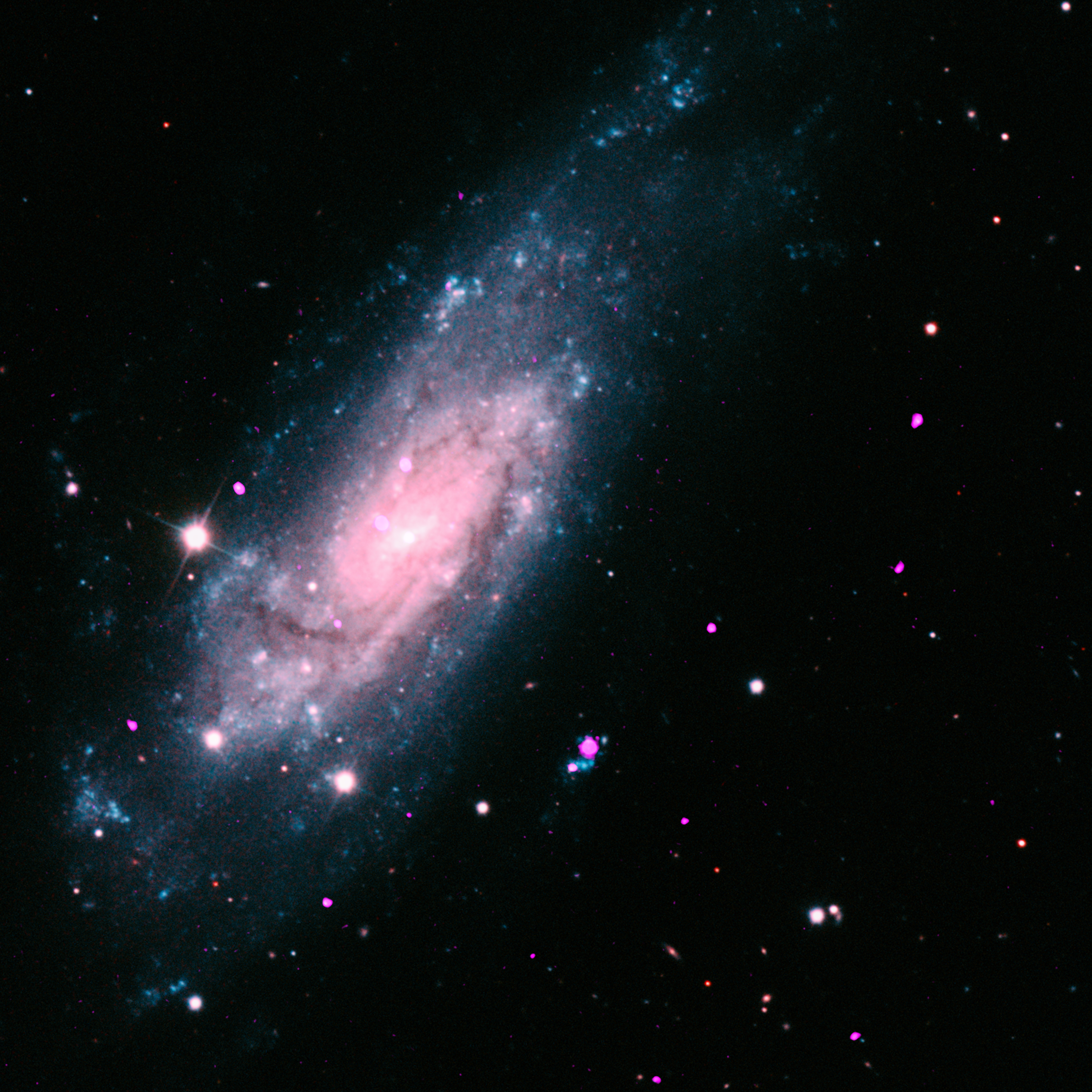
Imagine a pressure cooker with a faulty valve. Most of the time it holds, but periodically the internal pressure exceeds the seal's capacity and steam blasts out — not because anything hit it from outside, but because the system's own physics guarantee episodic failure. That is the core mechanism here: a massive, unstable star whose internal energy budget periodically overwhelms its own envelope, producing observable outbursts. Astronomers using NASA's Chandra X-ray Observatory have identified the trigger behind repeated eruptions from AT 2016blu, a volatile star in the spiral galaxy NGC 4559, roughly 30 million light-years from Earth. The star's mass is estimated at a minimum of 33 solar masses, placing it firmly in the regime where stellar instability mechanisms — luminous blue variable (LBV) eruptions, pair-instability pulsations, or binary interaction — become live possibilities. The significance of X-ray detection is the diagnostic lever it provides. Optical observations tell you something exploded; X-ray observations tell you HOW. The Chandra data likely reveals the thermal and density structure of the ejected material, constraining whether the outbursts are driven by envelope instabilities, binary mass transfer, or something else entirely. This is the difference between seeing smoke and seeing the wiring diagram of the fire. The research is led by M. Aghakhanloo at the University of Virginia, with image processing by NASA/CXC/SAO. Optical data from the Sloan Digital Sky Survey (SDSS) provides the galactic context — NGC 4559's spiral structure — while Chandra supplies the X-ray layer that makes the diagnostic possible. Massive stellar instability remains one of the more poorly constrained domains in stellar astrophysics. Stars above roughly 25-30 solar masses enter regimes where theoretical models diverge significantly: the physics of radiation-dominated envelopes, super-Eddington winds, and opacity-driven instabilities are all computationally expensive and observationally underconstrained. Each well-characterized outbursting massive star narrows the field. The limitation of this source summary is that it is a press-image release, not the paper itself. The actual mechanism identified, the specific outburst trigger, the X-ray spectral analysis, and the comparison to other LBV-like transients are all in the full publication by Aghakhanloo et al. What we know from this release: the star, the galaxy, the mass estimate, the observatory, and the fact that a trigger has been identified. The details are behind the 'Read more' link. Still, even the framing matters. AT 2016blu at 33+ solar masses in a well-resolved spiral galaxy at 30 Mly is a relatively nearby, relatively massive test case for eruption physics. If the trigger mechanism generalizes, it informs pre-supernova mass loss models — which directly feed into supernova yield predictions, chemical enrichment models, and the mass function of compact remnants (neutron stars and black holes).
The analogy
A pressure cooker with a faulty valve: the star's own internal energy budget periodically overwhelms its envelope, producing episodic outbursts. Chandra's X-rays are the thermal camera that shows you whether the valve failed from overpressure, corrosion, or someone bumping the pot — diagnosing the mechanism, not just the steam.
Pressure cooker
Internal steam pressure periodically exceeds valve capacity, producing episodic blowouts diagnosable by thermal imaging
AT 2016blu
Internal radiation/energy pressure periodically exceeds envelope stability, producing eruptions diagnosable by X-ray spectroscopy
Honest assessment
This is a press-image release, not a paper analysis — the actual scientific content (trigger mechanism, spectral diagnostics, model comparisons) is in the Aghakhanloo et al. publication we haven't seen. What's here is a well-characterized massive star in a nearby galaxy observed with the best X-ray telescope available. Solid incremental observational astronomy, likely meaningful to the massive stellar instability community, but the press release alone doesn't let us evaluate the core scientific claims.
What Is CLAIMS?
50
/ 100
BedrockNews applies a structured analytical framework called CLAIMS to academic papers and technical research releases.
How CLAIMS worksClaim
3/5
Ladder
2/5
Architecture
3/5
Integrity
2/5
Milestone
2/5
Successor
3/5
What is this paper actually committing to?
Observational diagnosis, not theoretical breakthrough. Identifying an outburst trigger for one massive star is a solid incremental result — valuable for the field but not paradigm-shifting from what's visible here.
The field fight
What drives episodic mass ejections from massive stars in the decades before core collapse?
Side A
Envelope instabilities (LBV eruptions, opacity-driven pulsations, super-Eddington winds) are the primary mechanism
Held by: Smith 2014, Owocki, classical LBV models
Side B
Binary interaction (mass transfer, common envelope, merger-driven ejections) dominates the observed population of massive transients
Held by: Kashi & Soker, binary progenitor models for SN 2009ip-like events
Milestone tracker
Unlocks: Empirically constrained pre-supernova mass loss rates feeding into supernova and compact remnant population models
Current
~5
well-characterized cases
X-ray diagnosed massive transients
Next
15-20
cases
Statistical sample for model constraints
~5-10 years, limited by Chandra lifespan and successor observatory availability
Verified Facts (9)
Star is designated AT 2016blu
Located in spiral galaxy NGC 4559
Galaxy is approximately 30 million light-years from Earth
Star mass estimated at least 33 times that of the Sun
Observations made using NASA's Chandra X-ray Observatory
Research led by M. Aghakhanloo at University of Virginia
Optical data from SDSS
Image processing by NASA/CXC/SAO/P. Edmonds
Image released November 9, 2026
Practical Implications (3)
For stellar astrophysicists: another X-ray-characterized massive transient to constrain eruption models against
For supernova modelers: pre-explosion mass loss rates from systems like AT 2016blu feed directly into core-collapse yield predictions
For observatory planning: demonstrates continued scientific productivity of Chandra at 27+ years, relevant to successor mission advocacy
More latest news
Read all