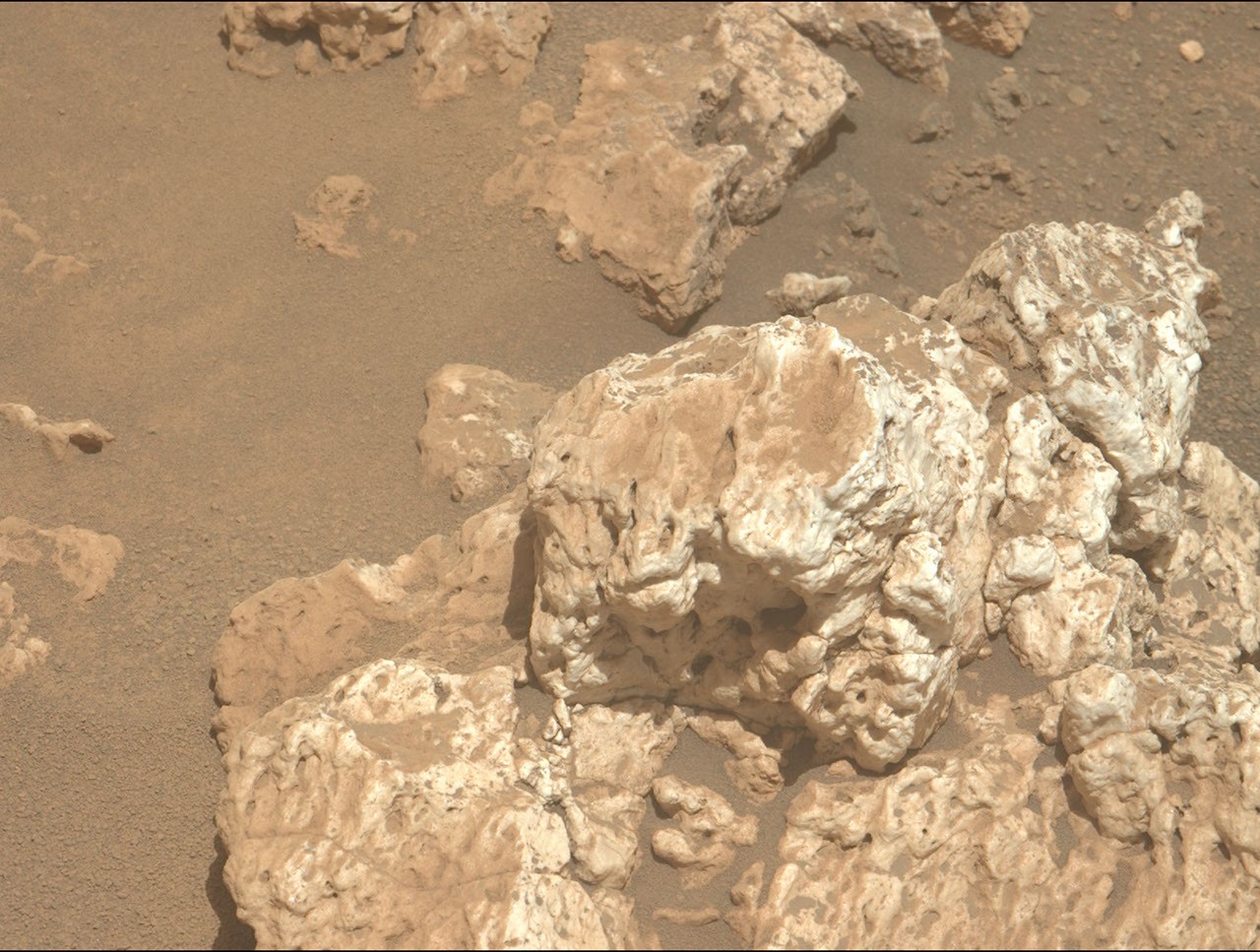
Imagine you've been walking through a desert for years, spotting tiny flecks of quartz in the sand — too small to pick up, too scattered to study. Then you round a corner and find a whole shelf of quartz boulders. That's what just happened to Perseverance. The rover has been poking at Mars' geology since 2021, and it previously encountered silica-rich deposits on Jezero Crater's inner rim, but those were too small to deploy proximity science instruments. At 'Idubi,' in the 'Lac de Charmes' region outside Jezero, the deposits are finally at a workable scale. The rocks themselves are striking: bright, light-toned fragments that stand out sharply against the darker, dust-covered Martian surface. SuperCam data confirms they're rich in hydrated silica — not igneous in origin, unlike most of what Perseverance has examined. This distinction matters because hydrated silica forms exclusively in aqueous environments. On Earth, that includes hydrothermal systems, pedogenic (soil-formation) processes, and groundwater systems. The astrobiological value is specific and well-understood: hydrated silica is one of the best-known minerals for preserving microfossils on Earth. The question the team is now pursuing is whether these pale rocks — remnants of an ancient Martian water system — could hold biosignatures. A detailed proximity science campaign is already underway, deploying instruments like SHERLOC's WATSON camera to gather high-resolution chemical and mineralogical data. What makes this finding operationally significant is scale. The Jezero rim silica deposits were scientifically tantalizing but practically useless — the rover couldn't bring its full instrument suite to bear on fragments that small. The Idubi deposits solve that problem. For the first time, the team can constrain both the origin of the silica (which aqueous environment produced it) and its biosignature preservation potential using the rover's complete proximity science toolkit. The location matters too. 'Idubi' sits in exposed ancient Martian crust outside Jezero crater, in terrain the mission was designed to explore precisely because it represents some of the oldest accessible geology on Mars. Finding hydrated silica here — not just inside the crater where water history is better established — expands the geographic footprint of Mars' known aqueous past. This is a mission-update blog post from the Perseverance team, written by Candice Bedford of Purdue University. It reports observational results from Sol 2023 (Oct. 29, 2026). No peer-reviewed paper is attached yet; the data is freshly downlinked and the proximity science campaign is in progress. The images were captured by Mastcam-Z and SHERLOC WATSON.
The analogy
You've been metal-detecting a beach for years, getting faint pings too deep to dig. Then you walk onto a shelf of exposed bedrock where the signals are loud and the targets are right on the surface. Same detector, same beach — but now the geology cooperates with your instrument reach. That's Idubi: the first time Perseverance's full proximity toolkit can actually engage silica deposits at usable scale.
Metal detector
Detector finds targets but they're too deep or small to excavate — signal without access
Perseverance at Idubi
Rover has instruments for silica analysis but prior deposits were too small — now scale matches capability
Honest assessment
This is an exciting observational report, not a scientific result. Perseverance found hydrated silica deposits large enough to actually study for the first time in the mission — a real operational milestone. But no quantitative mineralogy, no formation-environment constraints, and no biosignature assessments exist yet. The science that matters — what kind of water system made these rocks, and whether they preserve anything biologically interesting — is months away. Worth tracking as a leading indicator, not citing as a finding.
What Is CLAIMS?
40
/ 100
BedrockNews applies a structured analytical framework called CLAIMS to academic papers and technical research releases.
How CLAIMS worksClaim
2/5
Ladder
1/5
Architecture
2/5
Integrity
1/5
Milestone
3/5
Successor
3/5
What is this paper actually committing to?
Observational first: largest hydrated-silica deposits encountered by Perseverance, confirmed by SuperCam, enabling proximity science for the first time. Real finding, but it's a detection report, not a completed result.
The field fight
Where should Mars astrobiology focus — crater-lake sediments or subsurface aqueous alteration minerals?
Side A
Jezero delta sediments are the primary biosignature target — that's why we landed here
Held by: Original M2020 mission design, delta-focused campaigns
Side B
Hydrated silica and other alteration minerals may be better biosignature preservers regardless of depositional setting
Held by: Silica-focused astrobiology community, this finding
Milestone tracker
Unlocks: Constraining formation environment (hydrothermal vs groundwater) and assessing biosignature preservation potential
Current
Detection
confirmed
SuperCam ID of hydrated silica at scale
Next
Quantitative
mineralogy
SHERLOC/PIXL proximity results
Months — campaign is underway, publication timeline uncertain
Verified Facts (6)
SuperCam instrument confirmed the light-toned rocks are rich in hydrated silica and not igneous in origin
Images captured on Oct. 29, 2026 (Sol 2023) using left Mastcam-Z camera at local mean solar time 13:03:53
SHERLOC WATSON close-up image acquired on Oct. 29, 2026 (Sol 2023) at local mean solar time 17:33:55
Rocks are located in the 'Idubi' area of the 'Lac de Charmes' region, outside of Jezero crater
Perseverance previously encountered silica-rich rocks on the inner rim of Jezero Crater but deposits were too small to deploy proximity science instruments
Written by Candice Bedford, Research Scientist at Purdue University, published Nov. 16, 2026
Practical Implications (3)
Mars Sample Return mission planners should watch whether the team caches an Idubi silica sample — it could become one of the highest-priority tubes in the collection
Astrobiologists studying biosignature preservation in silica now have a confirmed Mars target at instrument-accessible scale for the first time
The finding outside Jezero crater expands the known geographic extent of Mars' aqueous alteration history
More latest news
Read all