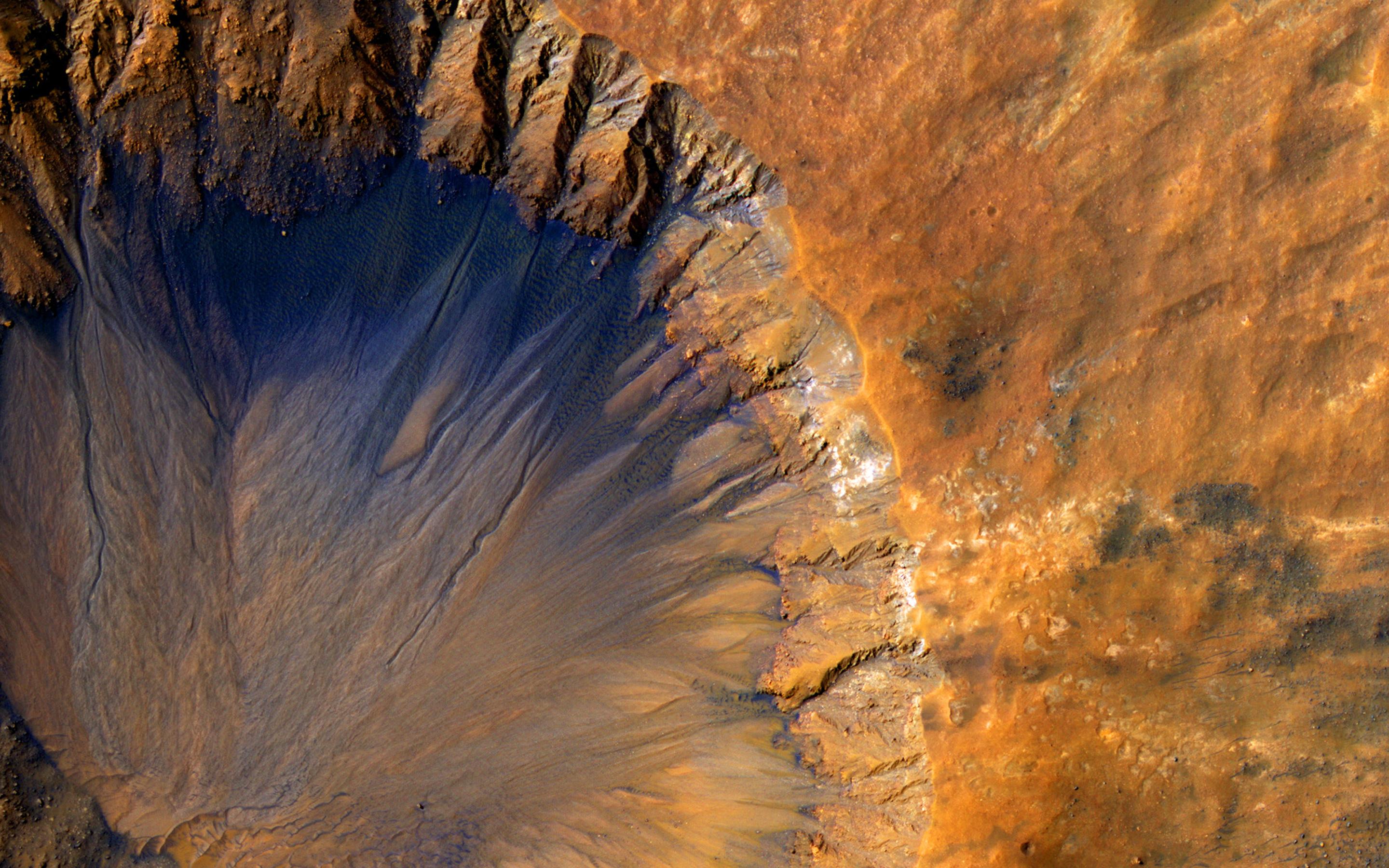
NASA is marking the 20th anniversary of the Mars Reconnaissance Orbiter with a highlight from the spacecraft's archive: an image captured in 2015 of an impact crater near Sirenum Fossae that appeared relatively recent at the time of observation. The crater's sharp rim and well-preserved ejecta pattern — the debris thrown outward by the impact — indicate it hadn't been significantly eroded by wind or dust deposition, placing its formation in geologically recent timescales. The source material is a single image and caption — one sentence of descriptive content. No crater diameter, no estimated age, no coordinates beyond 'near Sirenum Fossae,' no details on what instrument captured the image (though MRO's HiRISE camera is the likely candidate for high-resolution surface imagery). This is an anniversary celebration piece, not a science release. Sirenum Fossae is a system of troughs in Mars's southern highlands, part of a network of extensional fractures radiating from the Tharsis volcanic province. The region is geologically interesting because it shows evidence of past water activity and tectonic stress. A fresh impact crater here is notable because it exposes subsurface material — ejecta from recent impacts on Mars have occasionally revealed ice or compositionally distinct layers that would otherwise remain hidden. The Mars Reconnaissance Orbiter launched on August 12, 2005, and entered Mars orbit on March 10, 2006. Twenty years in, MRO remains one of the most productive planetary science missions ever flown. Its HiRISE camera has imaged the Martian surface at resolutions down to 25 centimetres per pixel — detailed enough to track new impact craters, monitor seasonal changes, and guide landing site selection for subsequent missions including Curiosity and Perseverance. The spacecraft also serves as a critical communications relay for surface assets. At 20 years, MRO is operating well beyond its designed mission lifetime, and the archive it has built — hundreds of terabits of data — continues to yield discoveries as researchers revisit images with new questions.
Worth reading?
SKIP
Score
35
/100
What Is What to Watch?
What to Watch highlights the specific signals, decisions, or events that will determine which direction this story goes next.
About GRINMRO MISSION EXTENSION
At 20 years, MRO is deep into extended mission territory. Watch for NASA's next senior review decision on continued funding — the spacecraft's role as a communications relay for Perseverance and future Mars missions makes it operationally critical beyond its science value.
FRESH IMPACT TRACKING
MRO's long baseline enables detection of new craters by comparing images taken years apart. Watch for updated Mars impact rate estimates — these calibrate the crater-counting chronology used to date surfaces across the entire solar system.
Verified Facts (1)
This impact crater, as seen by NASA's Mars Reconnaissance Orbiter in 2015, appeared relatively recent as it has a sharp rim and well-preserved ejecta
Solution Focus (3)
MRO turns 20 — one of the longest-lived and most productive planetary science missions in history, still operational and serving as a communications relay for Mars surface missions
The highlighted crater near Sirenum Fossae shows a sharp rim and well-preserved ejecta, indicating geologically recent formation — Mars is still being actively reshaped by impacts
Fresh impact craters on Mars expose subsurface material that is otherwise inaccessible, making them scientifically valuable windows into what lies beneath the surface
Community Actions (2)
At 20 years, MRO is deep into extended mission territory. Watch for NASA's next senior review decision on continued funding — the spacecraft's role as a communications relay for Perseverance and future Mars missions makes it operationally critical beyond its science value.
MRO's long baseline enables detection of new craters by comparing images taken years apart. Watch for updated Mars impact rate estimates — these calibrate the crater-counting chronology used to date surfaces across the entire solar system.
More latest news
Read all