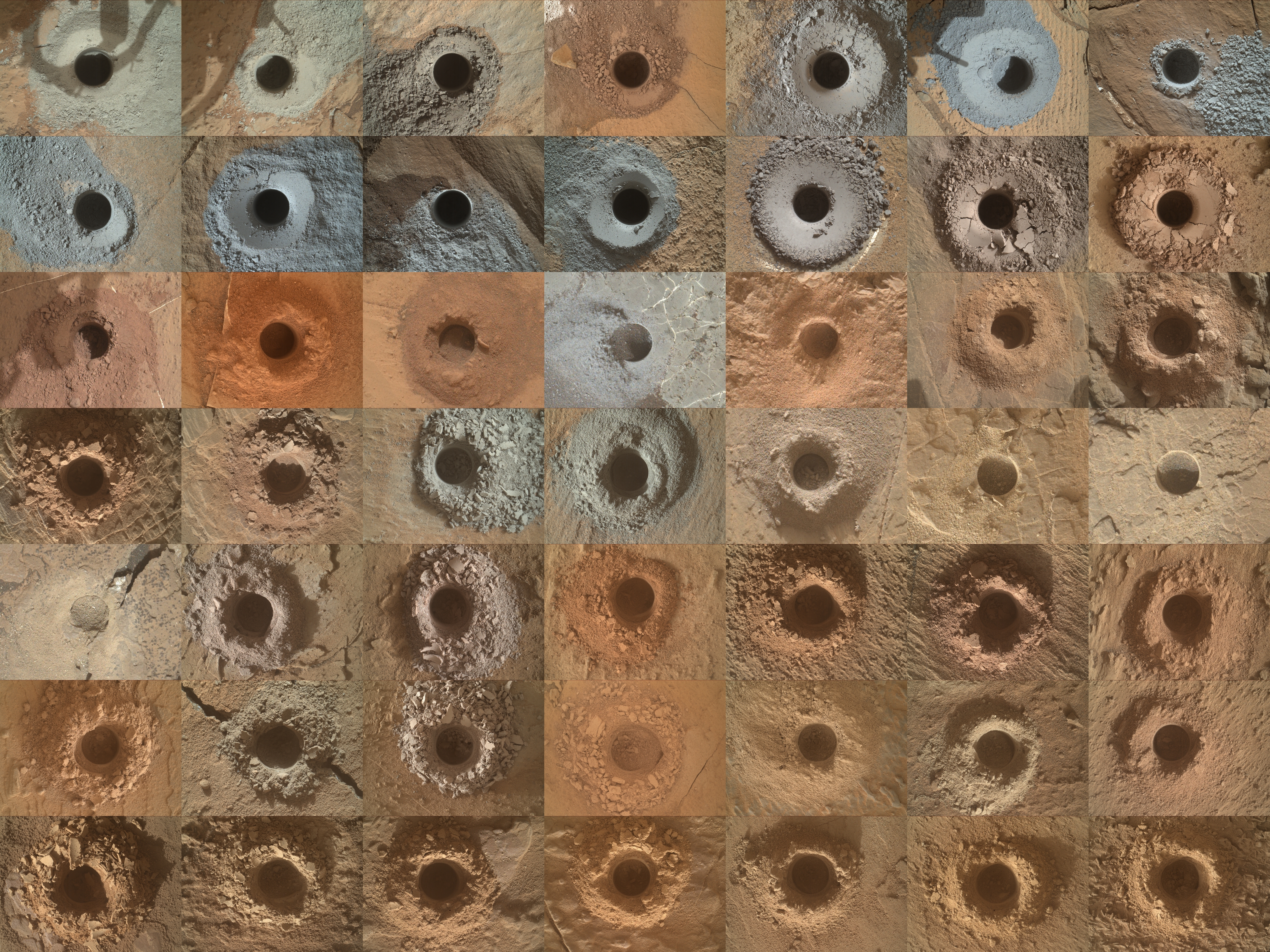
DRILL SAMPLES
49
YEARS ON MARS
14+
DESIGN LIFE EXCEEDED
7×
LANDING YEAR
2012
NASA released a collage showing all 49 drill holes captured by the Curiosity Mars rover through November 2026. Each hole represents a discrete geological sample extracted from Gale Crater's layered terrain, contributing to a dataset that has fundamentally reshaped our understanding of Mars's ancient water chemistry and habitability potential.
Extraction Map
The number itself — 49 — is worth sitting with. Curiosity landed in August 2012. That's roughly 14 years of operation for a mission originally designed for two. Each drill sample requires careful site selection, days of positioning, the drilling itself, sample processing through the rover's onboard chemistry labs (SAM and CheMin), and data transmission back to Earth. The pace is deliberate by necessity: one wrong move can damage irreplaceable hardware 140 million miles from the nearest repair shop. What the collage represents is not just engineering endurance but the slow construction of ground truth. Every paper claiming evidence of ancient Martian lakes, sulfate deposits, organic molecules, or clay minerals traces back to powder extracted from holes like these. The drill samples are the evidentiary bedrock — without them, orbital spectroscopy remains hypothesis. From a generativity standpoint, this is pure public-good science. The data flows into NASA's Planetary Data System, available to any researcher worldwide. No patents, no paywalls on the raw data. The knowledge generated — about planetary geology, astrobiology, and instrument engineering — feeds forward into Mars Sample Return planning, Perseverance's operations, and future human exploration architecture. The resilience story is more mixed. Curiosity is a single-point asset. There is no backup Curiosity. The drill mechanism has already experienced failures and workarounds (the drill feed mechanism broke in 2016, requiring engineers to invent a new drilling technique). Every additional sample is borrowed time on aging hardware. Efficiency is remarkable given the constraints. Operating a chemistry lab via remote control with a 4-to-24-minute signal delay, on a planet where dust storms can shut down operations for weeks, while keeping a nuclear-powered rover functional for seven times its design life — the overhead-per-discovery ratio is extraordinary by any space science standard. The novelty dimension is straightforward: this is ongoing execution of a proven mission architecture, not a new capability. The generative value is in accumulation — each sample adds marginal but real knowledge. The 49th hole matters because it's the 49th, not because it introduces a new method.
Worth reading?
RECOMMENDED
Score
68
/100
Generative. Pure public-good knowledge production with open data access, no rent-seeking, and compounding scientific returns — but constrained by single-asset fragility.
What Is GRIN?
GRIN stands for Generativity, Resilience, Innovation efficiency, and Novelty openness. These four dimensions capture the essential characteristics of any memetic intelligence — whether a nation, a corporation, a religion, or a movement.
About GRINGenerativity
4/5
Resilience
2/5
Efficiency
4/5
Novelty
2/5
Extractive
0/5
Inverted
Does this create new capability or just redistribute existing value?
Textbook generative science. Open-access geological data from an irreplaceable vantage point feeds astrobiology, geology, and future mission design across institutions worldwide.
Verified Facts (2)
Collage shows 49 drill holes captured by NASA's Curiosity Mars rover
Data as of November 2026
More latest news
Read all