PEATLAND CARBON
600Gt
VS ALL FORESTS
2×
YEARS ACCUMULATING
9,000+
LAND · 2× FOREST C
3%
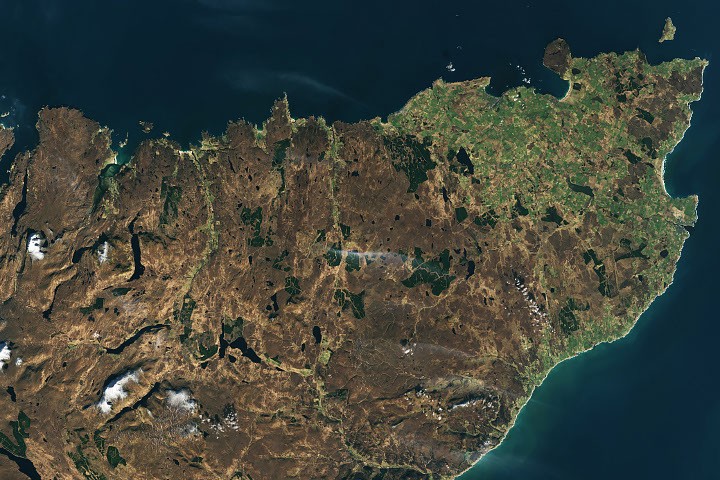
Northern Scotland's Flow Country is a soggy, treeless expanse of hummocky mosses, grasses, and heathers spread across 1,900 square kilometers of the Highlands. It looks like nothing. It is, by carbon accounting, one of the most valuable landscapes on Earth.
Extraction Map
The mechanism is simple and ancient. Waterlogged soils prevent microbes from fully decomposing dead plant matter. Instead of releasing carbon dioxide, the partially decayed material accumulates as peat — spongy, carbon-rich deposits that have been building for more than 9,000 years in some parts of the Flow Country, exceeding eight meters thick. This is carbon storage on geological timescales, not the decades-long cycle of living forests. The numbers are staggering. Peatlands globally cover just 3 percent of Earth's land surface but store more than 600 gigatons of carbon — roughly twice the carbon held in all the world's forests combined. Blanket bogs specifically, the type found in the Flow Country, are even rarer: just 120,000 square kilometers worldwide, less than one-tenth of one percent of land area. They require a precise combination of abundant rainfall, poor drainage, and low evapotranspiration to form. Landsat 8's OLI captured the landscape in spring, when waterlogging peaks and new biomass accumulation begins. The imagery reveals the bog's dark brown expanse dotted with lakes, bordered by light green farmland near Thurso and darker green geometric conifer plantations — the latter a legacy of mid-20th century afforestation that damaged significant portions of the peatland before conservation priorities shifted. The Flow Country became the first blanket bog inscribed as a UNESCO World Heritage Site, a designation that reflects growing recognition that these ecosystems are not wastelands but irreplaceable carbon infrastructure. Unlike forests, which release their carbon when trees burn or die, intact peat bogs lock carbon away for millennia. Destroying them — through drainage, plantation forestry, or development — reverses thousands of years of accumulation in a geological instant. More than 30 species of sphagnum moss drive the system's carbon capture, creating acidic, oxygen-poor conditions that further inhibit decomposition. The ecological simplicity is deceptive: this is a finely tuned biogeochemical engine that took nine millennia to build and cannot be rebuilt on any human timescale. Restoration of damaged areas is possible but slow, measured in decades to centuries rather than planting seasons. The policy implication is direct. Every hectare of intact peatland protected is carbon kept out of the atmosphere at zero ongoing cost. Every hectare drained or developed is a one-way release of ancient carbon that no reforestation program can match. The Flow Country's UNESCO designation is a start, but the real test is whether protection extends to the other 118,100 square kilometers of blanket bog worldwide that remain outside any comparable framework.
Worth reading?
ESSENTIAL
Score
80
/100
Generative — intact peatlands provide non-extractive, self-sustaining carbon sequestration at zero marginal cost, producing a global public good over millennia.
What Is GRIN?
GRIN stands for Generativity, Resilience, Innovation efficiency, and Novelty openness. These four dimensions capture the essential characteristics of any memetic intelligence — whether a nation, a corporation, a religion, or a movement.
About GRINGenerativity
5/5
Resilience
3/5
Efficiency
5/5
Novelty
3/5
Extractive
1/5
Inverted
Does this create new capability or just redistribute existing value?
Pure generativity at geological scale. 600Gt of carbon stored passively by a self-maintaining ecosystem. No inputs, no operating costs, no technology required — just non-destruction.
Verified Facts (7)
The bogs store tremendous quantities of carbon because their soils are so waterlogged that microbes cannot fully break down dead plant material
Blanket bogs cover just 120,000 square kilometers (46,000 square miles) globally, less than one-tenth of one percent of Earth's land surface
The peat bogs of northern Scotland are spread across some 1,900 square kilometers (730 square miles) of the country's Highlands region
Some parts of the Flow Country have been accumulating peat for more than 9,000 years, building deposits exceeding eight meters thick
All of the world's peatlands cover just 3 percent of Earth's land surface but store more than 600 gigatons of carbon—about twice as much as all the world's forests combined
More than 30 species of sphagnum moss
This peatland is the first of its type to be inscribed as a UNESCO World Heritage Site
More latest news
Read all