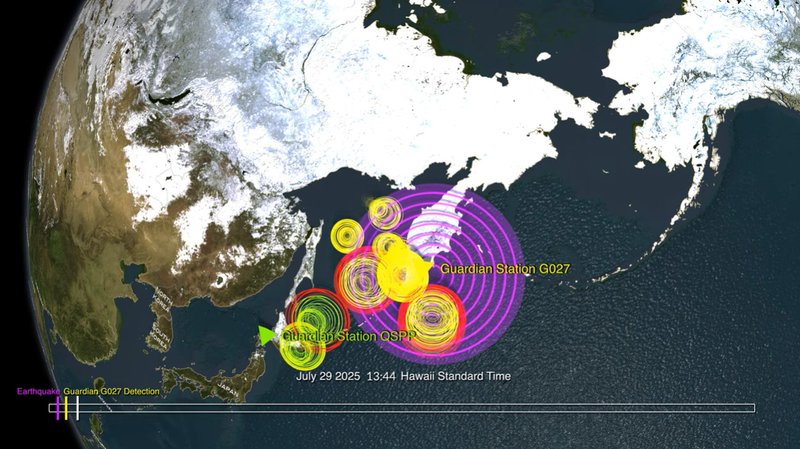
NASA's Jet Propulsion Laboratory has released a new animation illustrating how its GUARDIAN system — an AI-supported hazard scout — detects and tracks tsunamis. The animation breaks down the mechanism by which the system gets early warning on the ocean's largest waves. That's essentially the entirety of what's available here. The source material is a headline, a one-sentence description, and an animation. There are no technical specifications, no detection accuracy numbers, no deployment timelines, no comparison to existing tsunami warning systems like NOAA's DART buoy network or Japan's S-net. What we have is a communications product — a visual explainer designed to make GUARDIAN's work legible to a general audience. What we can say: GUARDIAN is a JPL project, it uses AI in some capacity for hazard detection, and its scope includes tsunami identification. The name suggests an acronym, though the full expansion isn't provided in this source. JPL's involvement places it in the context of NASA's broader Earth science and natural hazard monitoring portfolio, which includes satellite-based observation systems like the SWOT (Surface Water and Ocean Topography) mission. The animation format is worth noting as a trend. NASA and JPL have increasingly invested in high-quality visual communication to explain complex systems — a response to the reality that a well-made 60-second animation reaches more people than a technical paper ever will. This sits alongside JPL's other public-facing explainers for missions like Europa Clipper and Mars Sample Return. Without more technical detail, this is a bookmark, not a briefing. The interesting questions — what satellite or sensor data feeds GUARDIAN, what AI architecture it uses, how its detection speed and accuracy compare to existing systems, whether it's operational or experimental — remain unanswered by this source material.
Worth reading?
SKIP
Score
35
/100
What Is What to Watch?
What to Watch highlights the specific signals, decisions, or events that will determine which direction this story goes next.
About GRINGUARDIAN TECHNICAL PAPER
Watch for a JPL or NASA technical publication with actual detection metrics, AI architecture details, and comparison to existing tsunami warning systems like DART buoys. That's where the real story will be.
SWOT INTEGRATION
NASA's SWOT satellite mission measures ocean surface topography. Watch for whether GUARDIAN uses SWOT data — that would be a meaningful capability upgrade over existing seafloor-based detection.
OPERATIONAL STATUS
Is GUARDIAN experimental or deployed? Watch for any announcement of integration with NOAA's Tsunami Warning Centers or international warning networks.
Verified Facts (1)
A new animation breaks down how JPL's AI-supported hazard scout gets the drop on the ocean's biggest waves
Solution Focus (3)
GUARDIAN is a JPL AI-supported system designed to detect and track tsunamis — the animation is the delivery vehicle, not the substance
Minimal technical detail available from this source — no accuracy numbers, no architecture specifics, no deployment status
Useful as a pointer to follow JPL's hazard monitoring work, not as a standalone briefing
Community Actions (3)
Watch for a JPL or NASA technical publication with actual detection metrics, AI architecture details, and comparison to existing tsunami warning systems like DART buoys. That's where the real story will be.
NASA's SWOT satellite mission measures ocean surface topography. Watch for whether GUARDIAN uses SWOT data — that would be a meaningful capability upgrade over existing seafloor-based detection.
Is GUARDIAN experimental or deployed? Watch for any announcement of integration with NOAA's Tsunami Warning Centers or international warning networks.
More latest news
Read all