PEAK ELEVATION
3,283m
CALDERA WIDTH
9km
ASH PLUME · NOV 8
120km
AK FLIGHTS CANCELLED · JUL
Multiple
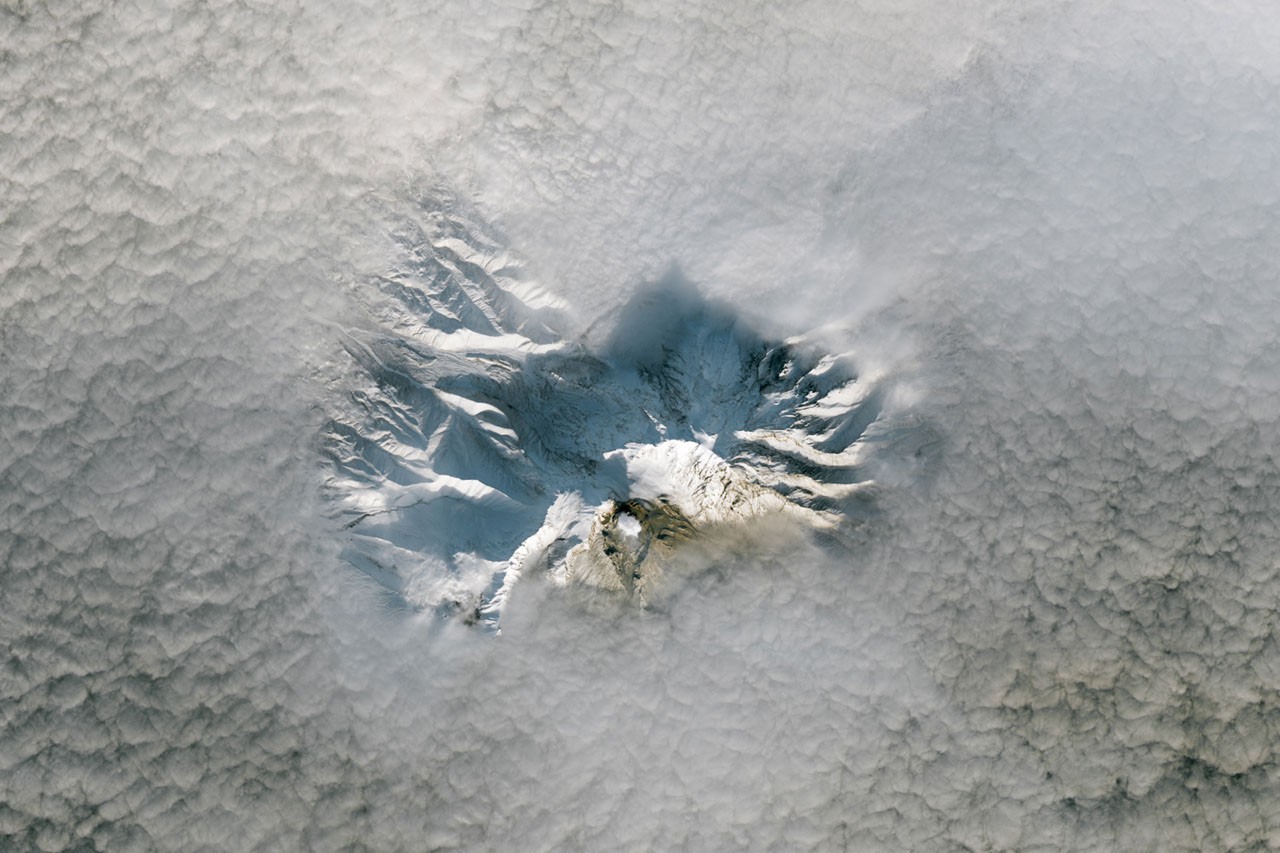
Shivelyuch, one of the most active volcanoes on Russia's Kamchatka Peninsula, has been in a state of near-continuous eruption for months. A Landsat 9 image captured on November 8, 2026, caught a rare cloud break over the 3,283-meter peak, revealing the dark lava dome growing inside its 9-kilometer-wide caldera. The volcano's cycles of dome growth and collapse produce pyroclastic flows — fast-moving avalanches of superheated ash and rock — that make it one of the most hazardous volcanic systems in the North Pacific.
Extraction Map
The Kamchatka Volcanic Eruption Response Team (KVERT) reported that on the day of the image, a resuspended ash plume extended 120 kilometers to the east. By Shivelyuch's standards, this was a quiet day. In July 2026, an explosive eruption sent ash into the jet stream, riding it across the Bering Sea into Alaskan airspace and forcing the cancellation of multiple flights — a concrete economic disruption from a volcano most people have never heard of. The story here is about monitoring capability versus volcanic persistence. Shivelyuch is chronically obscured by clouds, which means ground-based observation is functionally useless for most of the year. The entire monitoring regime depends on satellite-based thermal anomaly detection and teams like KVERT issuing advisories. When satellites detect heat signatures through cloud cover, that signal is what keeps North Pacific aviation routes safe. Landsat 9's OLI instrument provided the visual confirmation, but the operational monitoring is a patchwork. KVERT operates under Russia's Institute of Volcanology and Seismology, coordinating with the Anchorage Volcanic Ash Advisory Center to protect transpacific flight corridors. The dependency chain is long: satellite data, Russian ground teams, international aviation advisory systems, airline dispatch offices. Any break in that chain and ash meets turbine. Shivelyuch's lava dome cycles are geologically well-documented but practically unpredictable in timing. The dome grows through effusive eruption of viscous magma, then collapses, triggering explosive events. The July 2026 ash-into-Alaska event was not anomalous — it is the expected behavior pattern. The question is never whether Shivelyuch will produce aviation-threatening ash plumes, but when and whether the detection infrastructure catches it in time. The broader context is that Kamchatka hosts dozens of active volcanoes along the Pacific Ring of Fire, and monitoring budgets have not scaled with aviation traffic growth across the North Pacific. Transpacific routes have grown steadily, but the ground-truth infrastructure on the Russian side remains thin. Satellite coverage fills the gap, but satellite revisit times create windows of vulnerability. NASA's Earth Observatory image, produced by Lauren Dauphin using USGS Landsat data, is both a scientific artifact and a quiet argument for continued investment in remote sensing. The volcano does not care about budgets or geopolitics. It will keep erupting, and the only question is whether the instruments watching it keep pace.
Worth reading?
RECOMMENDED
Score
68
/100
Generative — satellite monitoring of remote volcanoes is a pure public good that protects aviation, climate science, and human safety with no extraction mechanism.
What Is GRIN?
GRIN stands for Generativity, Resilience, Innovation efficiency, and Novelty openness. These four dimensions capture the essential characteristics of any memetic intelligence — whether a nation, a corporation, a religion, or a movement.
About GRINGenerativity
4/5
Resilience
2/5
Efficiency
4/5
Novelty
2/5
Extractive
0/5
Inverted
Does this create new capability or just redistribute existing value?
Pure public good. Landsat 9 imagery and KVERT advisories generate safety data for global aviation at near-zero marginal cost per user. No private capture.
Verified Facts (7)
OLI (Operational Land Imager) on Landsat 9 captured this image on November 8, 2026
Shivelyuch's 3,283-meter (10,771-foot) peak
A caldera 9 kilometers (5.6 miles) wide that is open to the south
Effusive eruptions of lava and explosive activity at Shivelyuch had been ongoing for months according to KVERT
A plume of resuspended ash drifted 120 kilometers (75 miles) to the east
In July 2026, an ash plume rode the jet stream over the Bering Sea into Alaskan airspace, prompting the cancellation of multiple flights
NASA Earth Observatory image by Lauren Dauphin, using Landsat data from the U.S. Geological Survey
More latest news
Read all