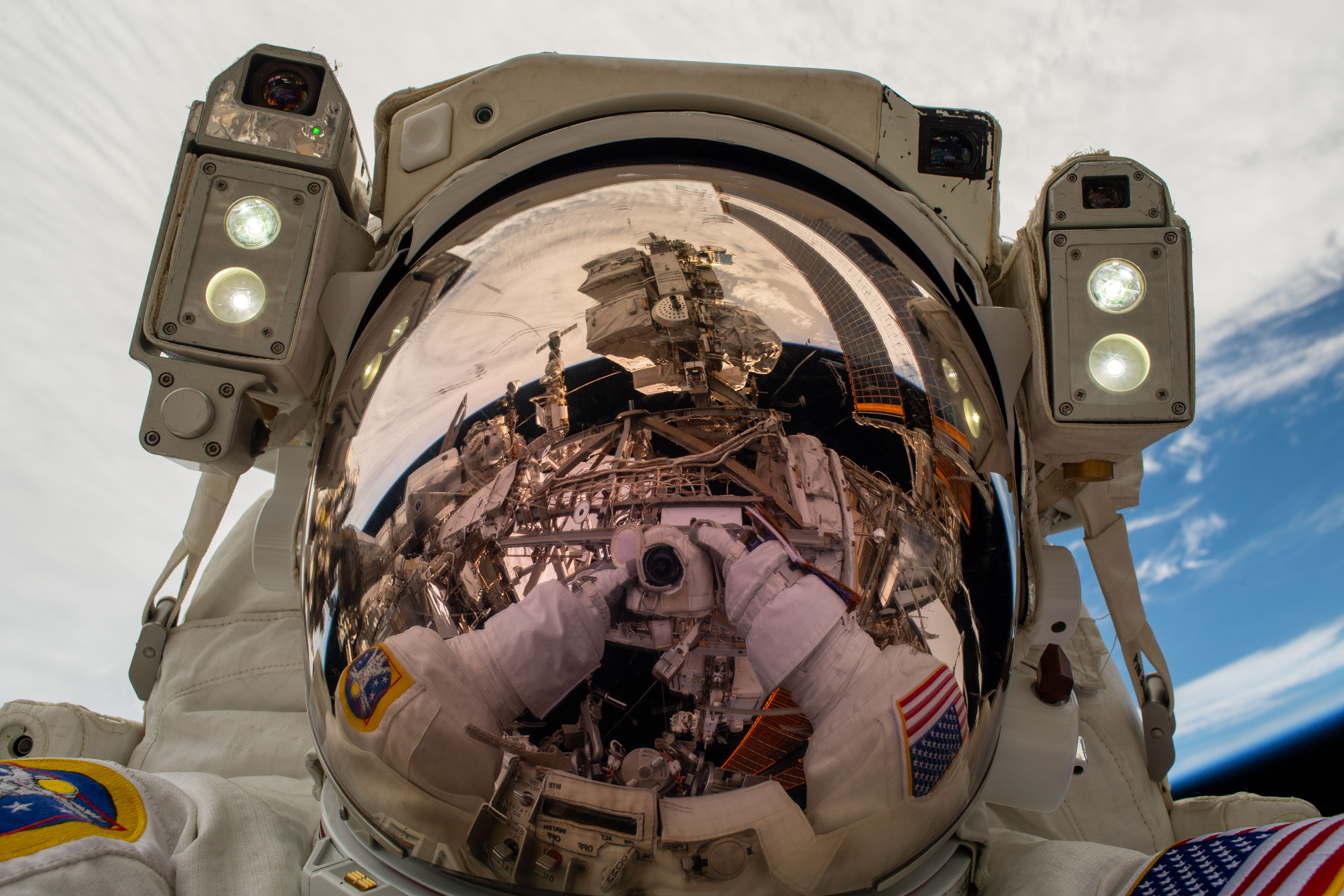
There's a specific genre of image that NASA has perfected over six decades: the spacewalk selfie. It sits at the intersection of engineering documentation and something almost absurdly human — a person floating in vacuum, visor reflecting the curve of the Earth, pausing to hold a camera at arm's length. Anil Menon's October 29, 2026 portrait belongs to this lineage, and it's worth pausing on what makes these images work. Menon and CSA astronaut Joshua Kutryk were outside the International Space Station to install a new roll-out solar array — iROSA panels, the ongoing upgrade program that has been incrementally boosting the station's power capacity since 2021. The work is unglamorous by space standards: bolting hardware to a truss, routing cables, confirming deployment. The selfie is the human punctuation mark on hours of methodical labor. What makes spacewalk selfies distinct from every other photograph is the literal impossibility of faking the context. The curvature of the helmet visor, the reflection of the station's geometry, the blackness behind — these are not reproducible on Earth. The image is its own proof of presence. That gives it a documentary weight that most photography has to earn through composition or timing. Menon's path to this moment is itself notable. A former SpaceX flight surgeon and emergency medicine physician, he was selected in NASA's 2021 astronaut class. This EVA represents a relatively new crew member performing one of the most demanding tasks in human spaceflight. The casualness of a selfie mid-EVA signals how normalized extravehicular activity has become — even as the inherent risk remains extreme. The roll-out solar array installation is part of the station's slow-motion race against its own aging infrastructure. The original arrays, deployed in the early 2000s, have degraded over two decades of thermal cycling and micrometeorite exposure. The iROSA panels roll out over the existing arrays, boosting power without requiring the old ones to be removed. It's a patch, not a replacement — pragmatic engineering for a station operating well past its original design life. As a photograph, Menon's selfie does what the best space imagery has always done: it makes the extraordinary look almost routine, then forces you to remember that it isn't. A doctor-turned-astronaut, 250 miles up, bolting solar panels to a structure the size of a football field, stopping to take a picture of himself. The image is mundane and staggering at the same time.
Worth reading?
OPTIONAL
Score
48
/100
Space enthusiasts, ISS followers, anyone tracking the iROSA upgrade program, and people who find the human-in-vacuum image genuinely awe-inducing regardless of how many times they've seen it.
Cultural Placement
Like the best Hasselblad shots from the Apollo program but with the vernacular intimacy of an iPhone selfie — the tension between institutional documentation and personal gesture that defines modern astronaut photography. Sits in the lineage of Chris Hadfield's social-media-era astronaut imagery, but with the specific visual grammar of EVA helmet reflections that traces back to Buzz Aldrin's 1966 Gemini XII selfie. The roll-out solar array installation grounds it in infrastructure maintenance rather than exploration spectacle, giving it a blue-collar quality closer to Lewis Hine's worker portraits than to the Overview Effect sublime.
Honest assessment
This is a solid entry in a well-established genre — the astronaut spacewalk selfie — that earns its interest primarily through context (Menon's biography, the specific infrastructure task) rather than formal innovation. It does what it needs to do: document a moment, humanize spaceflight, and remind you that someone is up there bolting solar panels to a 25-year-old structure. It's not trying to be art, and that's fine.
What Is NOVEL?
48
/ 100
BedrockNews applies a structured analytical framework called NOVEL to cultural works — games, books, film, music, and more.
How NOVEL worksNerve
1/5
Originality
2/5
Voice
3/5
Endurance
3/5
Lineage
3/5
What did the artist risk? What could have failed?
Low risk. The spacewalk selfie is an established form with built-in audience goodwill. The only risk is banality, and Menon doesn't entirely escape it — but the context does most of the heavy lifting.
Verified Facts (3)
NASA astronaut Anil Menon took this selfie during a spacewalk on Oct. 29, 2026.
He and CSA (Canadian Space Agency) astronaut Joshua Kutryk installed a new roll-out solar array on the International Space Station.
Image credit: NASA/Anil Menon
More latest news
Read all