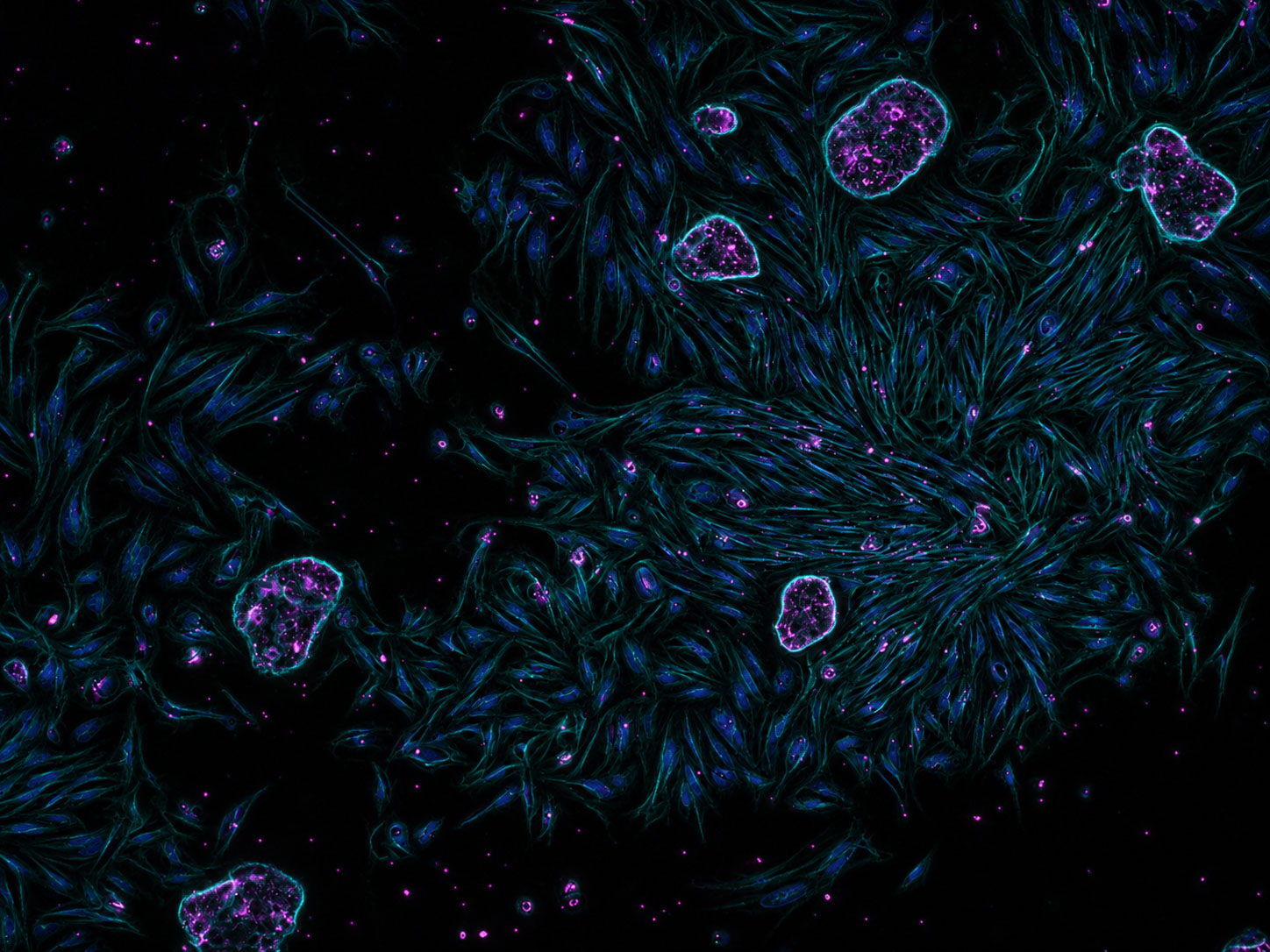
Imagine you're trying to understand how marbles roll through a maze, but someone bolted the maze to a tilted table. Every observation you make is contaminated by the tilt — you can't tell which movements come from the maze's design and which come from gravity pulling everything downhill. Now imagine you could float the maze in midair. That's what Encapsulate-1 is doing with cancer cells aboard the International Space Station. The core claim: by growing patient-derived gastric microtumors inside biochips in microgravity, researchers can observe how cancer cells move and interact without the mechanical cues that gravity imposes on Earth-bound cultures. On the ground, cells settle, stack, and organize partly because gravity tells them to. Remove that variable, and you're watching the cells' own programming — their intrinsic migratory behavior — in something closer to isolation. This matters because metastasis, not the primary tumor, is what kills most cancer patients. Predicting which tumors will spread and which will stay put remains one of oncology's hardest problems. Earth-based 3D culture systems (organoids, spheroids, tumor-on-chip platforms) have improved dramatically over the past decade, but they still operate in 1g. The hypothesis driving Encapsulate-1 is that microgravity-grown tumors will reveal migratory phenotypes that are masked or distorted by gravitational sedimentation and convection in terrestrial systems. The architecture here is organ-on-chip meets orbital laboratory. Encapsulate Inc.'s biochips provide a controlled microenvironment — nutrient flow, scaffold geometry, waste removal — while the ISS provides the one variable you can't simulate on Earth: sustained, high-quality microgravity at ~10⁻⁶g. The patient-derived samples mean this isn't a generic cell-line study; the ambition is to map individual patients' tumor behavior to personalized metastasis risk scores. What we don't have yet: results. This image, dated November 19, 2026, shows the microtumors growing inside the biochip, confirming the experiment is running. But no data on differential migration rates, gene expression changes, or predictive biomarkers has been published. The investigation is in its observation phase. The gap between "we grew tumors in space" and "here's a clinically validated metastasis predictor" is enormous — years of comparative analysis, ground-control matching, and clinical correlation. The honest framing: this is an enabling experiment, not a result. It demonstrates that patient-derived tumors can survive, grow, and presumably be analyzed after return from the ISS. Whether the microgravity condition actually reveals actionable differences in migratory behavior is the open question. The space station's value here is as a unique laboratory — if the hypothesis holds, the downstream applications (personalized metastasis prediction, drug screening in microgravity) are significant. If the signal is weak or confounded, it becomes an expensive proof-of-concept. Still, the experimental design is sound in principle: use microgravity to subtract a variable (gravity-driven cell behavior) and observe what remains. The field of space biology has moved past the "let's see what happens" phase into targeted mechanistic questions, and Encapsulate-1 represents that maturation.
The analogy
Like trying to study how marbles navigate a maze that's bolted to a tilted table — gravity contaminates every observation. Microgravity floats the maze, letting you see which movements come from the maze's own design rather than the tilt.
Tilted maze
Gravity biases marble paths, making it impossible to isolate the maze's intrinsic routing from the environmental tilt
ISS biochip
Gravity biases cancer cell migration and stacking, making it impossible to isolate intrinsic migratory phenotype from mechanical sedimentation
Honest assessment
This is a progress photo, not a scientific result. Encapsulate-1 confirms that patient-derived gastric tumors can grow inside biochips aboard the ISS — a necessary enabling step, but far from the claimed payoff of personalized metastasis prediction. The hypothesis that microgravity reveals masked migratory phenotypes is plausible and worth testing, but zero data has been published. Engineers and scientists should file this under 'interesting experiment running' and check back in 1-2 years for actual comparative results.
What Is CLAIMS?
30
/ 100
BedrockNews applies a structured analytical framework called CLAIMS to academic papers and technical research releases.
How CLAIMS worksClaim
1/5
Ladder
0/5
Architecture
3/5
Integrity
0/5
Milestone
2/5
Successor
3/5
What is this paper actually committing to?
No result claimed — this is an operational update confirming tumors grow in ISS biochips. The underlying hypothesis (microgravity reveals masked migratory phenotypes) is interesting but entirely untested here.
The field fight
Can microgravity platforms deliver clinically actionable cancer biology that Earth-based 3D culture systems cannot?
Side A
Ground-based organoids and tumor-on-chip are sufficient; microgravity adds cost without proven clinical value
Held by: Most oncology labs, Emulate, TissUse
Side B
Microgravity removes gravitational confounds and reveals intrinsic tumor behavior invisible on Earth
Held by: Encapsulate, NASA space biology, BioServe
Milestone tracker
Unlocks: Personalized metastasis risk prediction based on patient-derived tumor migration phenotype
Current
1
ISS experiment running
Encapsulate-1
Next
1
comparative dataset
μg vs 1g migration data
~1-2 years for initial publication, 5-10 years for clinical correlation
Verified Facts (5)
Image dated Nov. 19, 2026 showing gastric microtumors grown within Encapsulate biochip
Encapsulate-1 investigation studies patient-derived tumor samples aboard the ISS
ISS orbits more than 200 miles (320 km) above Earth
Results could help develop testing to predict patient's risk of metastasis and support personalized cancer treatments
Image credit: Encapsulate Inc.
Practical Implications (3)
No immediate practical implications — this is an experiment in progress with no published results
If successful, could eventually add a microgravity-derived biomarker panel to oncology's metastasis prediction toolkit
Demonstrates that patient-derived (not cell-line) tumor samples can survive ISS transport and culture, opening the door for future personalized space biology experiments
More latest news
Read all