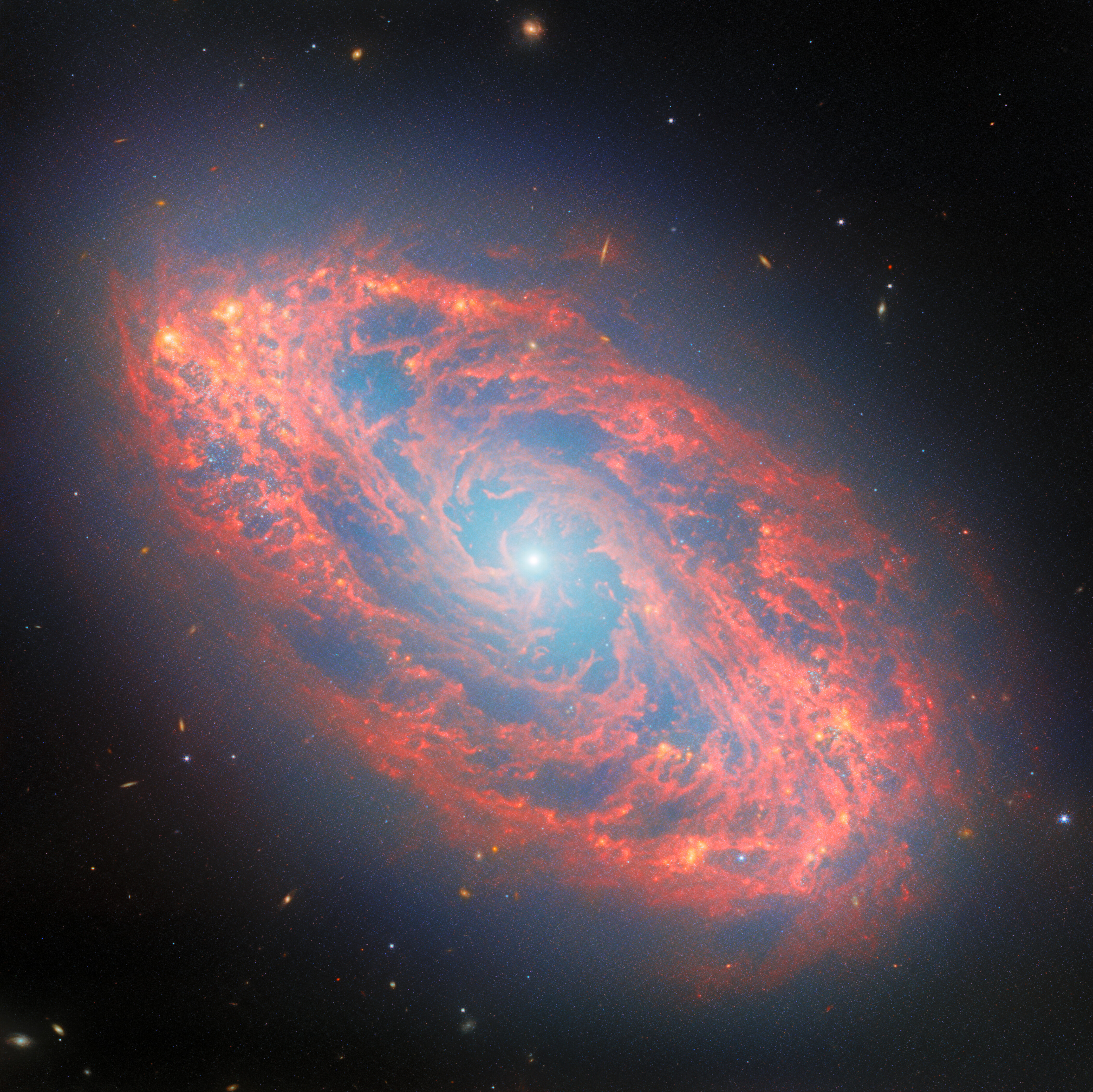
The James Webb Space Telescope — a joint project of NASA, ESA, and CSA — has produced a new image of NGC 5134, a spiral galaxy located 65 million light-years away in the constellation Virgo. The image combines data from two of Webb's instruments, though the source material does not specify which two were used. NGC 5134 sits at a distance that places it well beyond the Local Group but within the broader Virgo neighborhood — a region rich in galaxies of every morphological type. At 65 million light-years, it's far enough that individual stars blur into the collective light of spiral arms, but close enough that Webb's infrared sensitivity can resolve structural details — dust lanes, star-forming regions, and the architecture of the spiral pattern itself — that ground-based telescopes and even Hubble struggle to distinguish. The brief source material — essentially a caption — offers little about the scientific purpose of this observation. Webb's galaxy imaging programme spans multiple science goals: mapping star formation rates, studying dust distribution, resolving the structure of galactic nuclei, and cataloguing the properties of nearby spirals as a baseline for understanding more distant, earlier-universe galaxies. NGC 5134 likely falls within one of these survey programmes, though the specific investigation isn't named here. What's worth noting is the multi-instrument approach. Webb carries four instruments: NIRCam (near-infrared camera), NIRSpec (near-infrared spectrograph), MIRI (mid-infrared instrument), and FGS/NIRISS (fine guidance sensor / near-infrared imager and slitless spectrograph). Combining two instruments on the same target produces data across a wider wavelength range than either alone — typically pairing near-infrared (which traces stars and ionised gas) with mid-infrared (which traces dust and embedded star formation). The result is a more complete physical picture of the galaxy's structure and activity. Even as a brief image release, this serves as a quiet reminder that Webb is now deep into its operational rhythm — producing science-grade multi-instrument observations of targets across the sky as routine output rather than milestone events.
Worth reading?
SKIP
Score
35
/100
What Is What to Watch?
What to Watch highlights the specific signals, decisions, or events that will determine which direction this story goes next.
About GRINPHANGS SURVEY
The Physics at High Angular resolution in Nearby Galaxies survey is Webb's major nearby-galaxy programme. Watch for whether NGC 5134 data appears in PHANGS publications — it would indicate this observation feeds into the largest systematic study of nearby galaxy structure.
INSTRUMENT PAIRING
Which two instruments were combined matters for what science is being done. NIRCam + MIRI is the most common pairing for galaxy structure. Watch for the full data release to see the specific wavelength coverage.
WEBB CYCLE 4
Webb's observing time is allocated in annual cycles. Track which nearby galaxy programmes are approved in upcoming cycles — the density of spiral galaxy observations signals how much demand exists for this type of survey work.
Verified Facts (2)
Two powerful instruments of the NASA/ESA/CSA James Webb Space Telescope joined forces to create this scenic galaxy view
This spiral galaxy is named NGC 5134, and it's located 65 million light-years away in the constellation Virgo
Solution Focus (3)
Two Webb instruments combined on a single target, producing a multi-wavelength view that reveals both stellar populations and dust structure simultaneously
NGC 5134 at 65 million light-years in Virgo — close enough for Webb to resolve spiral arm detail, far enough to represent the broader galaxy population beyond the Local Group
A demonstration of Webb operating in steady-state science mode rather than showcase mode — routine multi-instrument observations of survey targets
Community Actions (3)
The Physics at High Angular resolution in Nearby Galaxies survey is Webb's major nearby-galaxy programme. Watch for whether NGC 5134 data appears in PHANGS publications — it would indicate this observation feeds into the largest systematic study of nearby galaxy structure.
Which two instruments were combined matters for what science is being done. NIRCam + MIRI is the most common pairing for galaxy structure. Watch for the full data release to see the specific wavelength coverage.
Webb's observing time is allocated in annual cycles. Track which nearby galaxy programmes are approved in upcoming cycles — the density of spiral galaxy observations signals how much demand exists for this type of survey work.
More latest news
Read all