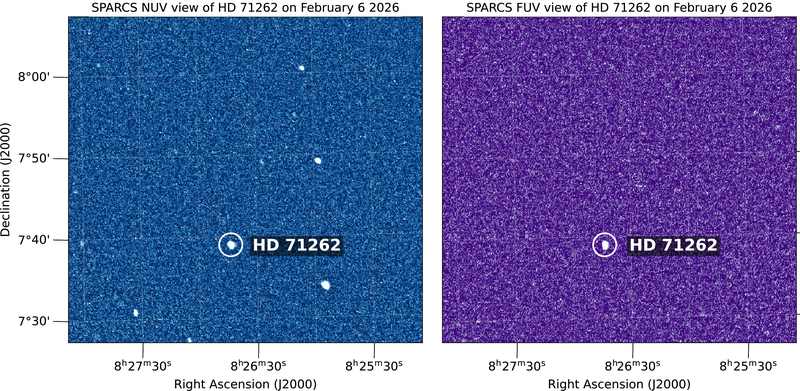
NASA's SPARCS (Star-Planet Activity Research CubeSat) has delivered its first images, marking the transition from commissioning to active science operations. The cube satellite — a spacecraft roughly the size of a shoebox — is now ready to begin its primary mission: studying low-mass stars and characterising the radiation environments experienced by the exoplanets that orbit them. The mission targets a specific question in exoplanet science. Low-mass stars — M-dwarfs, the most common stellar type in the galaxy — are where most rocky, potentially habitable exoplanets have been found. But these stars are also prolific emitters of ultraviolet radiation, particularly during flare events. Whether planets orbiting M-dwarfs can retain atmospheres and liquid water under that UV bombardment is one of the central open questions in habitability research. SPARCS is designed to monitor the UV variability of these stars over time. The CubeSat form factor is the engineering story within the science story. SPARCS demonstrates that meaningful astrophysical research can be conducted from a platform that costs a fraction of a flagship mission. CubeSats have been used for Earth observation and technology demonstrations for years, but dedicated exoplanet-adjacent science missions in this form factor remain relatively novel. The constraints are real — limited aperture, limited power, limited data downlink — but the cost-to-science ratio is the point. The source material here is minimal: a headline, a one-line description, and first-light images. No technical specifications, no UV sensitivity numbers, no target star list, no timeline for first science results. This is a mission-milestone announcement, not a data release. The substantive science is ahead of us.
Worth reading?
OPTIONAL
Score
40
/100
What Is What to Watch?
What to Watch highlights the specific signals, decisions, or events that will determine which direction this story goes next.
About GRINFIRST SCIENCE DATA
Watch for SPARCS's first science-quality UV observations of M-dwarf stars. The data release will reveal whether the CubeSat's sensitivity is sufficient to characterise flare UV profiles at the precision needed for atmospheric modelling.
TARGET STAR LIST
Which M-dwarfs SPARCS observes first will signal priorities. Stars with known rocky planets in habitable zones (e.g., TRAPPIST-1, Proxima Centauri) would make results immediately relevant to JWST atmospheric characterisation work.
CUBESAT SCIENCE TREND
SPARCS is part of a growing pipeline of science-focused CubeSats. Watch for whether NASA expands this model — more small missions for targeted questions — or treats SPARCS as a one-off demonstration.
Verified Facts (1)
The SPARCS cube satellite is ready to begin studying low-mass stars and to reveal details about the habitability of the planets they host
Solution Focus (4)
SPARCS has returned first images and transitioned to science operations — the commissioning phase is complete
The mission targets UV variability of low-mass stars (M-dwarfs) to assess exoplanet habitability — a specific, well-defined observational niche
CubeSat form factor demonstrates that meaningful astrophysical science can be done at a fraction of flagship mission cost
This is a milestone announcement, not a data release — the substantive science is ahead
Community Actions (3)
Watch for SPARCS's first science-quality UV observations of M-dwarf stars. The data release will reveal whether the CubeSat's sensitivity is sufficient to characterise flare UV profiles at the precision needed for atmospheric modelling.
Which M-dwarfs SPARCS observes first will signal priorities. Stars with known rocky planets in habitable zones (e.g., TRAPPIST-1, Proxima Centauri) would make results immediately relevant to JWST atmospheric characterisation work.
SPARCS is part of a growing pipeline of science-focused CubeSats. Watch for whether NASA expands this model — more small missions for targeted questions — or treats SPARCS as a one-off demonstration.
More latest news
Read all