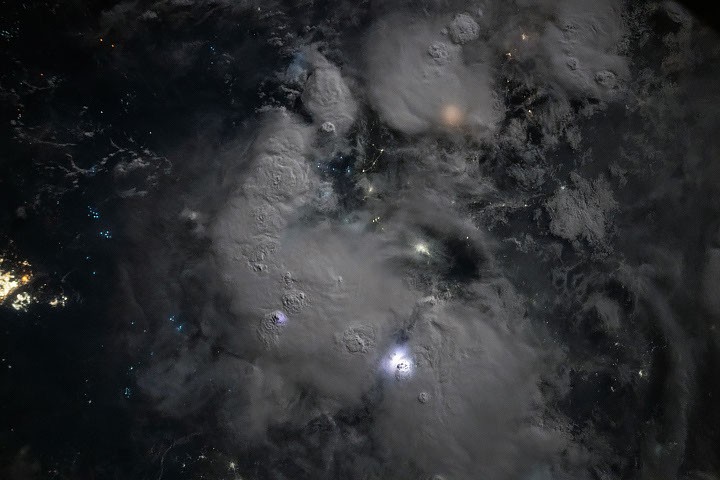
There's a specific kind of image that NASA's Earth Observatory does better than anyone: the astronaut photograph accompanied by just enough context to make you see it differently. This one — shot over the South China Sea near Borneo on October 28, 2026, at 9:20 p.m. local time — is a showcase of that form. A Nikon Z9 at 14mm focal length, pointed at a planet doing three spectacular things at once. The photograph captures Singapore's 6.2-million-person glow on the left, a cluster of blue fishing-boat lights west of the city that an astronaut might mistake for a star cluster, scattered orange gas flares offshore, and two thunderstorm overshooting tops lit from within by lightning. It's a single frame that holds civilization, industry, and weather in the same composition. The Singapore Strait curves through the middle, separating the city-state from Batam and Bintan islands. What elevates this beyond pretty-picture-of-the-week is the layered astronaut testimony. Donald Pettit described city lights as "tendrils outlined with the glimmer of a Broadway marquee." Sally Ride wrote that lightning storms spanning hundreds of miles looked "like a transcontinental brigade tossing fireworks from cloud to cloud." Anil Menon called lightning "my favorite sight from space" and posted real-time video showing the flashes dancing across Earth's limb. Three astronauts, three eras, same awe. The science embedded in the image is quietly dense. Overshooting tops — those domelike protrusions punching above a thunderstorm's anvil into the stratosphere — are markers of intense convective energy. The blue fishing lights use specific wavelengths to attract squid and schooling fish like sardines, a practice documented across Southeast Asian waters. NASA estimates 2,000 thunderstorms active on Earth at any moment, producing roughly 5 million lightning flashes per day. The piece also works as a quiet argument for the ISS Crew Earth Observations program, which makes astronaut photography freely available online. The image was processed — cropped, contrast-enhanced, lens artifacts removed — but the underlying data is public. It's science communication that trusts the reader to find the wonder without being told where to look. There's a reason astronaut night photography has its own devoted following. These images sit at the intersection of art, science, and the particular human experience of seeing your planet from outside it. This one is a strong entry in that tradition — not because it shows anything unprecedented, but because the composition catches three distinct phenomena in a single frame, and the accompanying text lets three astronauts explain why it matters to them.
Worth reading?
RECOMMENDED
Score
52
/100
Anyone who follows Earth-from-space photography, ISS science communication, or atmospheric science. Also for anyone who hasn't looked at NASA's Earth Observatory before — this is a strong introduction to what the program does.
Cultural Placement
Like the best Astronomy Picture of the Day entries crossed with a New Yorker 'Talk of the Town' vignette — visual spectacle paired with curated first-person testimony that reframes what you're seeing. Closest kin is Chris Hadfield's ISS photography and commentary, but more institutional and less personality-driven. The form owes something to the Overview Effect literature (Frank White, Edgar Mitchell) where the act of seeing Earth from orbit becomes its own subject. Within NASA's own output, this sits in the lineage of the original Blue Marble and Earthrise photographs — images that changed how humans understood their planet by showing it from outside.
Honest assessment
A well-executed entry in a proven form. It won't surprise anyone familiar with the Earth Observatory, but the three-phenomena composition and the layered astronaut testimony make it one of the stronger recent entries. Best consumed as a two-minute visual pause, not as deep science reading.
What Is NOVEL?
52
/ 100
BedrockNews applies a structured analytical framework called NOVEL to cultural works — games, books, film, music, and more.
How NOVEL worksNerve
1/5
Originality
2/5
Voice
3/5
Endurance
3/5
Lineage
4/5
What did the artist risk? What could have failed?
Zero risk taken. This is the Earth Observatory doing exactly what it does — astronaut photo plus contextual essay. The form is proven and safe. No structural gamble, no editorial surprise.
Lineage tree
Earthrise (1968)
founding ancestor — first photograph that reframed Earth as a subject seen from outside
Blue Marble (1972)
direct ancestor — established the whole-Earth photograph as cultural artifact
Chris Hadfield's ISS photography
tonal influence — personality-driven astronaut photography that built a public audience
Donald Pettit's night photography
direct ancestor — pioneered long-exposure ISS techniques and the 'cities at night' genre
Overview Effect literature (Frank White)
conceptual framework — the idea that seeing Earth from orbit transforms perception
Verified Facts (6)
ISS passed over the South China Sea near Borneo at 14:20 UTC (9:20 p.m. Western Indonesian Time) on October 28, 2026
Astronaut photograph ISS075-E-250951 was acquired with a Nikon Z9 digital camera using a focal length of 14 millimeters
Singapore, a city-state of 6.2 million people
NASA scientists estimate that there are 2,000 thunderstorms occurring on Earth at any one moment, producing nearly 60 flashes per second—roughly 5 million flashes per day
Sally Ride—the first American woman to fly in space
The image was taken by a member of the Expedition 75 crew
More latest news
Read all