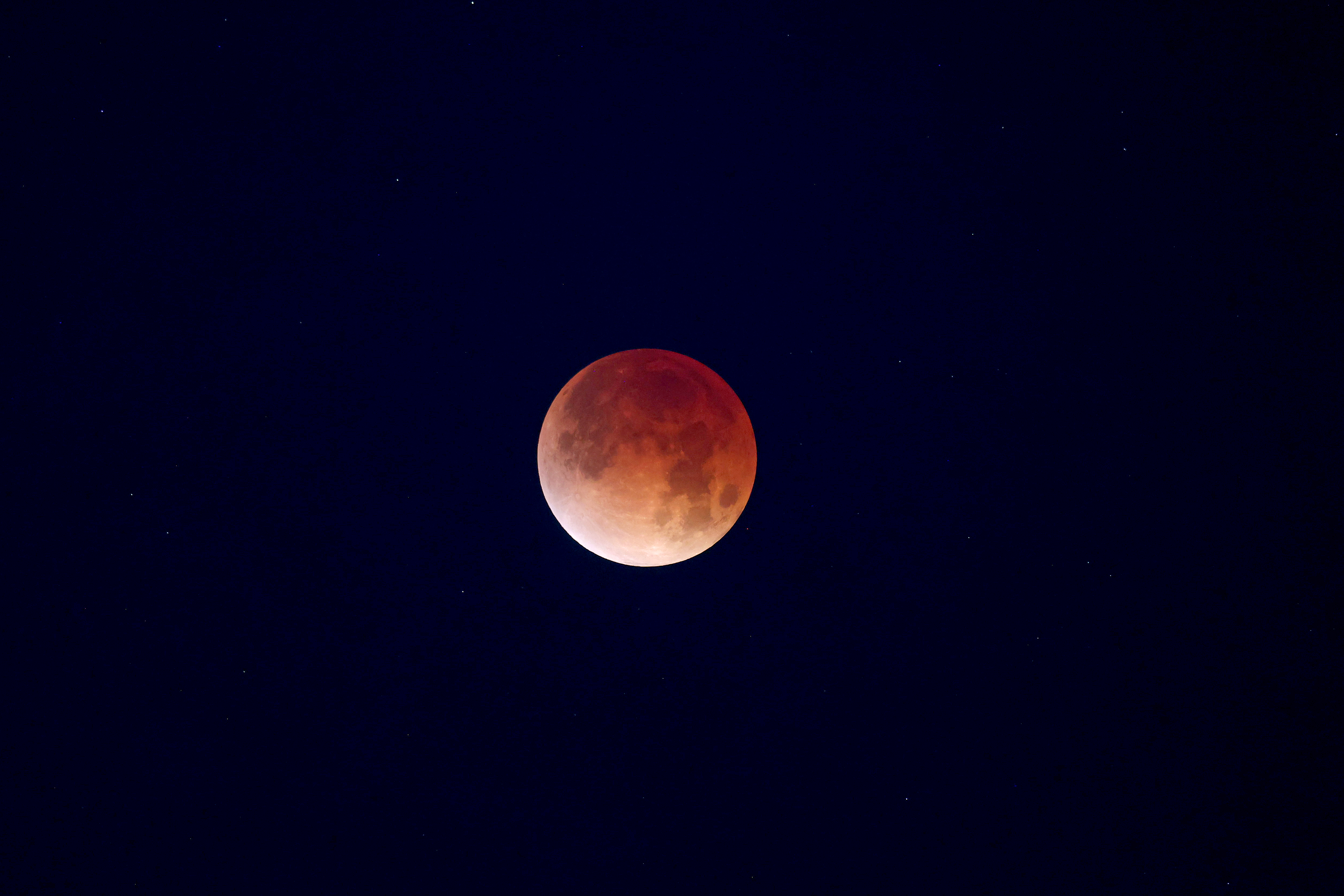
A total lunar eclipse rose over New Orleans in the early morning hours of Tuesday, March 3, captured in an image framed above NASA's Michoud Assembly Facility. The Moon turned dark red and orange as Earth passed directly between the Sun and Moon, casting its shadow across the lunar surface. The mechanics are straightforward and worth knowing precisely. A lunar eclipse occurs when the Sun, Earth, and Moon align so that Earth blocks direct sunlight from reaching the Moon. The Moon doesn't go dark — it turns red because sunlight filtering through Earth's atmosphere bends around the planet and reaches the lunar surface, with shorter blue wavelengths scattered out and longer red wavelengths passing through. The same physics that makes sunsets red makes the eclipsed Moon red. You're seeing every sunrise and every sunset on Earth projected onto the Moon simultaneously. The New Orleans framing is a NASA communications choice, not an accident. Michoud Assembly Facility, located in eastern New Orleans, is where NASA manufactures the core stage of the Space Launch System rocket — the hardware that powers Artemis missions. Positioning the eclipse above Michoud connects a celestial event visible to millions with the specific infrastructure that sends humans toward the Moon. It's smart institutional storytelling. The source material here is a photo caption — three sentences and an image. No observation data, no eclipse timing details, no duration, no next-eclipse scheduling. This is a public engagement product, not a science briefing.
Worth reading?
SKIP
Score
35
/100
What Is What to Watch?
What to Watch highlights the specific signals, decisions, or events that will determine which direction this story goes next.
About GRINNEXT LUNAR ECLIPSE
Total lunar eclipses occur roughly every 2-3 years for any given location. Check NASA's eclipse schedule for the next one visible from your region — they're the easiest major astronomical events to observe with no equipment.
MICHOUD · SLS
Michoud Assembly Facility is actively manufacturing SLS hardware for Artemis missions. Watch for Artemis II and III timeline updates — the facility's output is on the critical path for returning humans to the Moon.
Verified Facts (3)
A total lunar eclipse rises over New Orleans, home of NASA's Michoud Assembly Facility, in the early morning hours of Tuesday, March 3
A lunar eclipse occurs when Earth passes directly between the Sun and Moon, casting a huge shadow across the Moon's surface
The Moon appears dark red or orange as the Sun's light filters through Earth's atmosphere
Solution Focus (3)
Total lunar eclipse observed over New Orleans on Tuesday, March 3 — the Moon appeared dark red or orange as sunlight filtered through Earth's atmosphere
Photographed above NASA's Michoud Assembly Facility, where SLS rocket core stages are manufactured — an intentional framing connecting celestial mechanics to human spaceflight infrastructure
The red colour comes from the same Rayleigh scattering that produces red sunsets — every sunrise and sunset on Earth projected onto the Moon at once
Community Actions (2)
Total lunar eclipses occur roughly every 2-3 years for any given location. Check NASA's eclipse schedule for the next one visible from your region — they're the easiest major astronomical events to observe with no equipment.
Michoud Assembly Facility is actively manufacturing SLS hardware for Artemis missions. Watch for Artemis II and III timeline updates — the facility's output is on the critical path for returning humans to the Moon.
More latest news
Read all