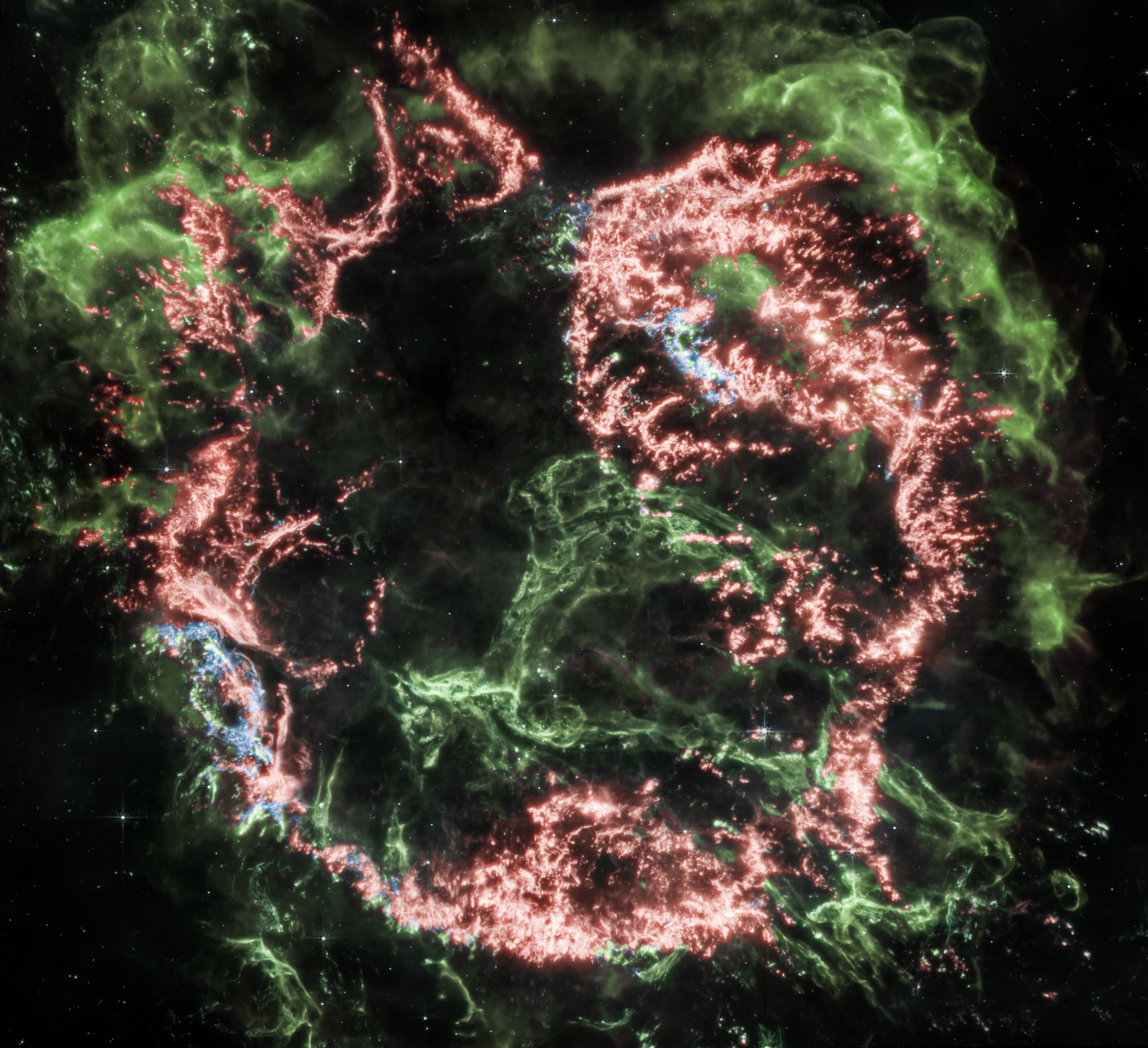
Imagine you're a forensic investigator arriving at a demolition site, but instead of rubble uniformly scattered, you find the building's internal walls rearranged — as if someone remodeled the living room minutes before the wrecking ball hit. That's the core mechanism Webb is exploiting here: reading the chemical fingerprints of dust grains in Cassiopeia A to reverse-engineer the internal structure of a star that exploded roughly 340 years ago, and finding evidence the interior reshuffled dramatically just before the end. The claim, stripped bare: mid-infrared imaging from JWST resolves the hot dust composition of Cas A at unprecedented spatial detail, and the dust distribution supports a scenario in which the star's interior underwent a dramatic structural change — possibly hours before core collapse. This is not a new discovery of Cas A itself (it's been studied since the 1940s in radio and since Chandra in X-ray), but it is a genuinely new observational window. Mid-infrared at this resolution, from space, on a supernova remnant — that combination did not exist before Webb. The ladder here matters. Previous Cas A observations from Spitzer (mid-IR, lower resolution), Chandra (X-ray), and Hubble (optical/near-IR) each revealed different layers of the remnant. Spitzer saw warm dust but couldn't resolve its spatial structure at this scale. Webb's MIRI instrument delivers both the wavelength coverage and the angular resolution to map dust composition spatially — not just detect it. The result is that you can now see which dust species sit where in the remnant, and that map tells you about the progenitor star's layered structure at the moment of explosion. The architecture is observational astronomy at its most direct: MIRI (Mid-Infrared Instrument) on JWST, imaging at wavelengths where hot dust radiates strongly. The data processing pipeline (STScI) produces calibrated images; the science team (Temim, Arendt, Milisavljevic) interprets dust composition from spectral features. No simulation is making the claim — the image itself is the evidence, with interpretation layered on top. This is instrument-driven science: the breakthrough is the telescope, and the result follows from pointing it at the right target. Integrity is strong for what this is: a direct observational result from a flagship space telescope with well-characterized instruments, processed by the official STScI pipeline, and released with named PIs. The interpretation — that the star's interior restructured hours before collapse — is model-dependent and will require theoretical follow-up. But the observation itself is as solid as space-based IR astronomy gets. No pre-registration applies here; this is targeted observational science, not a statistical hypothesis test. The milestone to watch: Webb's Cas A data feeds directly into the open question of how massive stars actually die. The specific next number is whether JWST spectroscopy (not just imaging) can identify the nucleosynthetic yields — exact elemental abundances — in the dust, which would constrain the progenitor mass and explosion mechanism to a degree Spitzer never could. That spectroscopic follow-up is almost certainly planned or underway. The successor experiment the team did not report here is full MIRI spectroscopy across the remnant. The release is an image — stunning and scientifically informative — but the deep chemical constraints come from spectra, not photometry. The honest read: this is the imaging result published first because it's visually spectacular and scientifically novel, with the spectroscopic analysis either in progress or being saved for the flagship paper. Standard practice for a high-profile JWST target.
The analogy
Like a forensic investigator arriving at a demolition site and discovering the building's interior walls were rearranged minutes before the wrecking ball struck — Webb reads dust composition to reverse-engineer a star's final hours from its debris field.
Forensic demolition
Analyzing debris patterns and material placement to reconstruct what the building's interior looked like moments before destruction
JWST Cas A imaging
Analyzing mid-IR dust composition and spatial distribution to reconstruct the star's internal layering hours before core collapse
Honest assessment
This is a genuine observational first — no other instrument has mapped supernova remnant dust composition at this spatial resolution in mid-infrared. The imaging result is rock-solid; the interpretive claim about hours-before-collapse restructuring is suggestive but model-dependent and will need theoretical follow-up and spectroscopic confirmation. Engineers and physicists outside astrophysics should care because this demonstrates Webb's MIRI capability on extended objects, not just point sources — the instrument is delivering on its design promise. The real payoff paper will be the spectroscopic follow-up.
What Is CLAIMS?
70
/ 100
BedrockNews applies a structured analytical framework called CLAIMS to academic papers and technical research releases.
How CLAIMS worksClaim
4/5
Ladder
4/5
Architecture
3/5
Integrity
4/5
Milestone
3/5
Successor
3/5
What is this paper actually committing to?
New observational window, not new target. First mid-IR imaging of a supernova remnant at this resolution, revealing pre-collapse stellar restructuring. Genuinely novel capability applied to a well-studied object.
The field fight
How do massive stars actually die — what triggers core collapse and shapes the explosion geometry?
Side A
Neutrino-driven convection is the primary explosion mechanism; asymmetries arise from turbulence
Held by: Burrows et al., Janka group, most 3D simulations
Side B
Late-stage interior restructuring (shell burning instabilities, Si/O convection) dramatically reshapes the star hours to minutes before collapse, imprinting on the remnant
Held by: Couch & Ott, Müller, this observation
Milestone tracker
Unlocks: Progenitor mass constraint to ~1-2 M☉ and discrimination between explosion mechanisms
Current
Imaging
MIRI photometry
This release
Next
Spectroscopy
MIRI MRS
Elemental abundances
~1-2 years if data collection is underway
Verified Facts (4)
NASA's James Webb Space Telescope reveals the hot dust that makes up Cassiopeia A (Cas A) in this high-resolution, mid-infrared image released on Nov. 23, 2026
The Webb data supports a scenario in which the interior of the star underwent a dramatic change, possibly just hours before its demise
Remnants like these are the clouds of gas and dust that remain following the explosion of a massive star and will eventually seed a new generation of stars and planets
Image credit: NASA, ESA, CSA, STScI, Tea Temim (Columbia University), Rick Arendt (UMBC), Dan Milisavljevic (Purdue University); Image Processing: Joseph DePasquale (STScI)
Practical Implications (3)
Demonstrates JWST MIRI's capability for spatially-resolved mid-IR science on extended objects, validating the instrument for a wide class of galactic targets
Constrains supernova dust production models that feed into interstellar medium chemistry and next-generation star/planet formation simulations
Supports late-stage stellar instability models, which matter for gravitational wave source predictions from massive star populations
More latest news
Read all