PHASES
3
VIPER LAUNCH
2027
VIPER RANGE
15+ mi
CRATER TEMP
-334°F
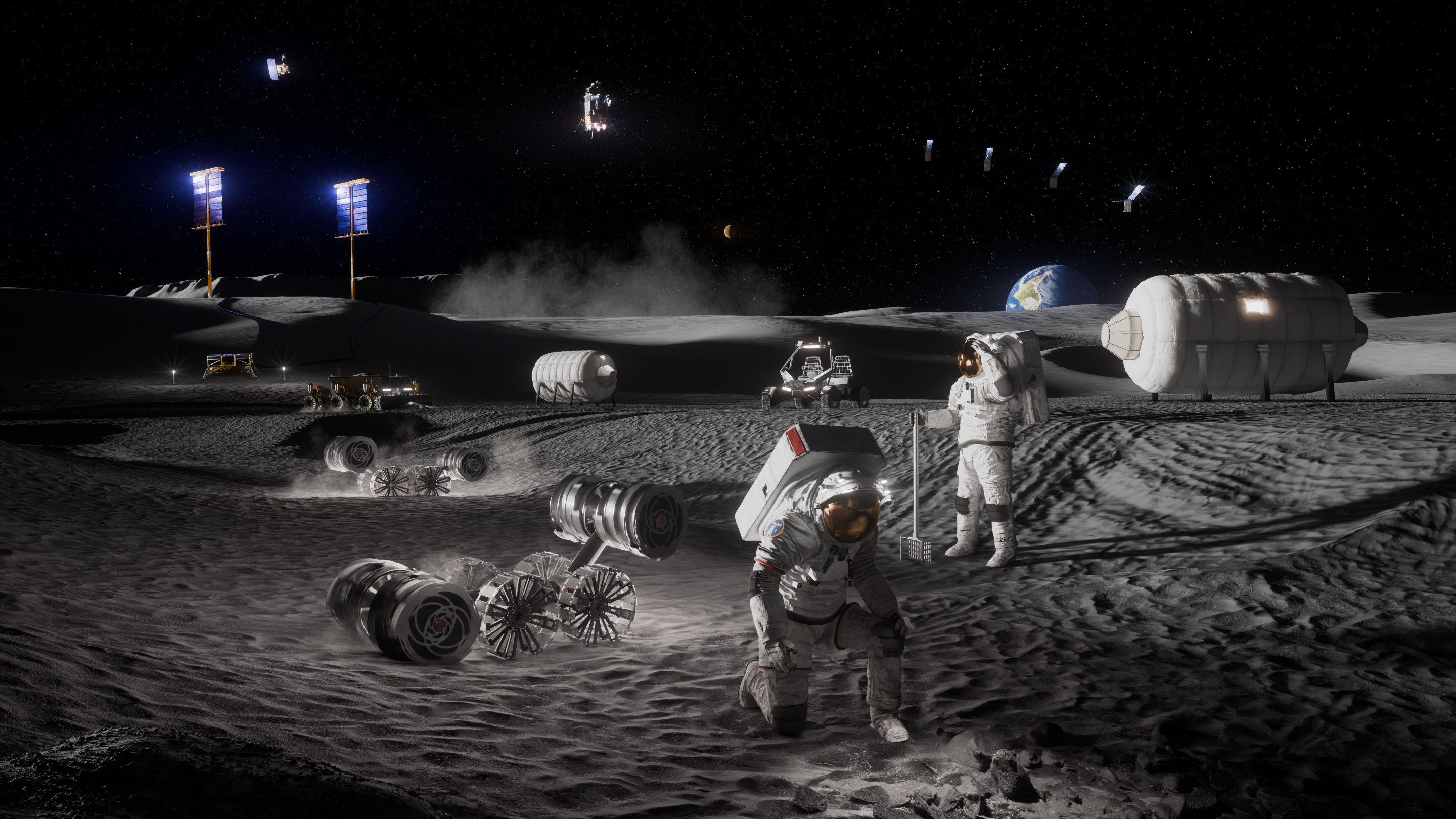
NASA has formalized a three-phase plan to construct the Moon Base, humanity's first permanent outpost on the lunar surface, situated at the South Pole. The region was chosen for its dual properties: extended sunlight windows for solar power generation and permanently shadowed craters that may harbor frozen water ice — a potential game-changer for in-situ resource utilization.
Extraction Map
Phase One is already underway. Over the next few years, robotic missions will scout the South Pole region, test landing technologies, and identify optimal construction sites. The VIPER rover, fully built and in testing at Johnson Space Center, will launch in 2027 to explore permanently shadowed craters across more than 15 miles of terrain. PROMISE, a nuclear-powered rover repurposed from Mars mission hardware, targets a late 2028 launch to probe for subsurface water ice. Lunar terrain vehicles and the MoonFall propulsive drone mission round out the robotic vanguard, all targeting 2028. Phase Two, planned for 2029-2032, shifts to infrastructure deployment: power systems, cargo transportation, and communications hardware distributed across multiple locations to allow future expansion. Phase Three moves into permanent habitat assembly — the point at which astronauts begin extended stays on the lunar surface. The engineering challenges are severe. Temperatures swing from 130°F in sunlight to -334°F in shadowed craters. The lunar South Pole terrain includes Shackleton Crater, more than twice as deep as the Grand Canyon, with steep slopes, ridges, and deep craters complicating navigation. Lunar regolith — the sharp-edged rocky debris blanketing the surface — degrades spacesuits and equipment rapidly and poses inhalation hazards to crew. The workforce pipeline is part of the pitch. NASA explicitly names space tire engineers, exploration geologists, manufacturing technicians, and instrument technicians as the career paths feeding Moon Base development — a signal that this program is designed to sustain a skilled industrial base, not just produce science outputs. The strategic logic is straightforward: the Moon Base is explicitly framed as a proving ground for Mars. Landing techniques, construction methods, life support, and resource extraction validated on the lunar surface reduce the risk profile of human Mars missions. Whether this timeline holds depends on funding continuity, commercial partner delivery, and whether VIPER and PROMISE actually find the water ice that makes long-term habitation economically viable. This is a generative infrastructure program by design — building new capability rather than redistributing existing value. The question is execution risk and political durability across multiple administrations.
Worth reading?
RECOMMENDED
Score
72
/100
Generative — this is a capability-expansion program building new infrastructure, workforce pipelines, and technology platforms that did not previously exist, with explicit forward application to Mars missions.
What Is GRIN?
GRIN stands for Generativity, Resilience, Innovation efficiency, and Novelty openness. These four dimensions capture the essential characteristics of any memetic intelligence — whether a nation, a corporation, a religion, or a movement.
About GRINGenerativity
4/5
Resilience
3/5
Efficiency
3/5
Novelty
4/5
Extractive
1/5
Inverted
Does this create new capability or just redistribute existing value?
Genuine capability creation. New rovers, habitats, power systems, and in-situ resource tech expand what humanity can do, not just redistribute existing assets. Career pipeline adds domestic industrial capacity.
Verified Facts (10)
VIPER will travel more than 15 miles, collecting data and analyzing the lunar soil
PROMISE is a nuclear-powered rover being built from existing hardware that was created for NASA's Mars rover missions
Lunar terrain vehicles will launch to the lunar South Pole region by 2028
Temperatures can reach more than 130°F (54°C) in sunlit areas and as cold as -334°F (-203°C) inside permanently shadowed craters
Shackleton Crater is more than twice as deep as the Grand Canyon
MoonFall mission will send a group of propulsive drones to the Moon by 2028
Phase Two is planned for 2029-2032
VIPER is fully built and being tested at NASA's Johnson Space Center in Houston, launching in 2027
PROMISE mission is targeted to launch by late 2028
MoonFall drones will operate over the course of a single lunar day (about 14 Earth days)
More latest news
Read all