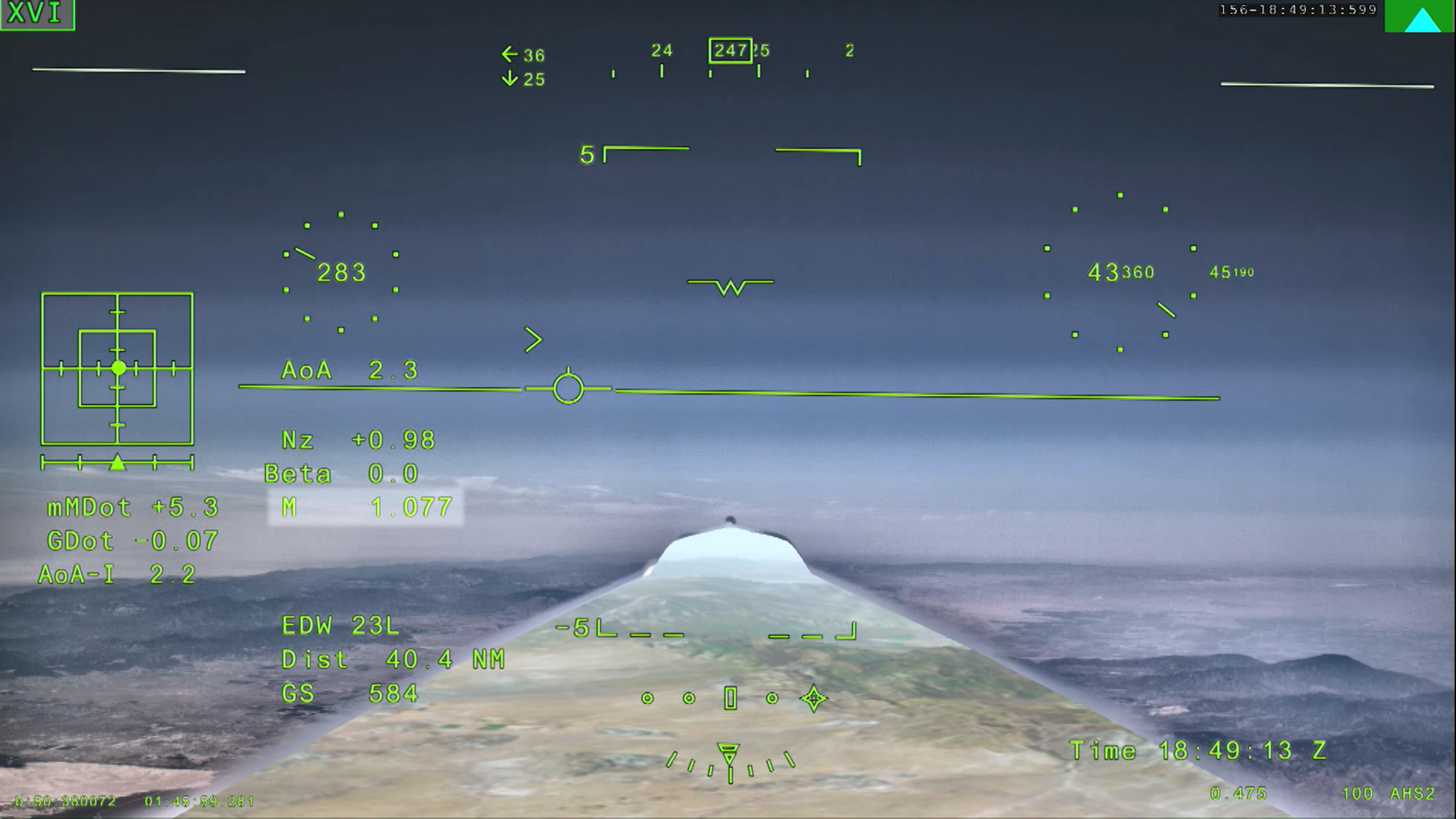
TOP SPEED
Mach 1.1
FLIGHTS · 90 DAYS
16
NEXT TARGET
Mach 1.4
OVERLAND BAN
53 yrs
NASA's X-59 flew supersonic for the first time on June 5, 2026, reaching Mach 1.1 (713 mph) at 43,400 feet during an 81-minute flight from Edwards Air Force Base. Test pilot Jim "Clue" Less focused on flying qualities at both subsonic and supersonic speeds, with an F-15 chase plane monitoring alongside. The F-15's own sonic booms obscured any sound the X-59 made — a problem that will be resolved when the aircraft flies solo over communities later this year.
Extraction Map
The milestone matters less for what the X-59 did than for what it enables next. Within days, the aircraft is expected to reach Mach 1.4 (925 mph) at 55,000 feet — its designed "mission conditions" cruising speed. That's the speed at which the X-59's shaped fuselage is engineered to convert a conventional sonic boom into a quiet thump, potentially inaudible at ground level. Since the aircraft's first flight on October 28, 2025, the team has completed 16 flights in 90 days, methodically expanding the flight envelope. The X-59 is the centerpiece of NASA's Quesst mission, and Quesst's real product isn't an airplane — it's a dataset. The plan: fly the X-59 over several U.S. communities, measure how residents perceive the quiet thump, and hand that data to FAA and ICAO regulators. The goal is to replace the blunt 1973 ban on supersonic overland flight with data-driven noise standards that could open a viable commercial market. NASA Administrator Jared Isaacman framed the flight as the start of a broader X-plane rebuilding effort, crediting both the NASA team and Lockheed Martin Skunk Works. Michael Kratsios, the White House science advisor, claimed it for the administration's deregulatory agenda. The political framing is predictable; the engineering is not. Shaping a fuselage to scatter shock waves rather than stack them into a single boom is a decades-old theoretical concept that has never been validated at this scale with real community perception data. The Quesst pipeline has a clear structure: envelope expansion (current phase, with chase planes), then acoustic validation (measuring the thump profile), then community overflights. NASA will also deliver design tools and validated aerodynamic models to U.S. manufacturers, giving them confidence that quiet supersonic designs will meet future noise requirements before committing billions to airframe development. The 20-year question is whether this creates a genuinely new transportation capability or becomes another Concorde — technically successful, commercially stillborn. The difference this time is the regulatory-first approach. Concorde failed not because it couldn't fly but because it couldn't fly where people lived. If Quesst's community data convinces regulators to write workable noise standards, the X-59 could unlock a market that has been legally impossible for over 50 years. If the data shows even quiet thumps annoy residents, the ban stays and the technology sits on a shelf.
Worth reading?
RECOMMENDED
Score
72
/100
Generative. Public R&D dollars are being spent to create a shared regulatory dataset and validated design tools that any U.S. manufacturer can use — expanding capability rather than concentrating it.
What Is GRIN?
GRIN stands for Generativity, Resilience, Innovation efficiency, and Novelty openness. These four dimensions capture the essential characteristics of any memetic intelligence — whether a nation, a corporation, a religion, or a movement.
About GRINGenerativity
4/5
Resilience
2/5
Efficiency
3/5
Novelty
5/5
Extractive
1/5
Inverted
Does this create new capability or just redistribute existing value?
High generativity. NASA builds the aircraft, flies the tests, and hands the data and design tools to industry. Creates a market where none legally exists. Classic public-good infrastructure.
Verified Facts (9)
NASA's experimental X-59 aircraft flew faster than the speed of sound for the first time on Friday, June 5, 2026
NASA test pilot Jim "Clue" Less took off and landed at Edwards Air Force Base in California
Reaching a top speed of approximately Mach 1.1 (713 mph) and altitude of 43,400 feet
The X-59's flight began at 11:08 a.m. PDT and lasted 81 minutes
Since the aircraft's first flight on Oct. 28, 2025, the team has made tremendous progress, flying 16 times in the last 90 days
In the coming days, we expect to take the next step and push to Mach 1.4 — NASA Administrator Jared Isaacman
First mission conditions flight expected at cruising speed of Mach 1.4 (925 mph) and altitude of approximately 55,000 feet
The loud sonic booms from the F-15 obscured any sound made by the X-59
Michael Kratsios, Assistant to the President for Science and Technology and Director of the Office of Science and Technology Policy
More latest news
Read all