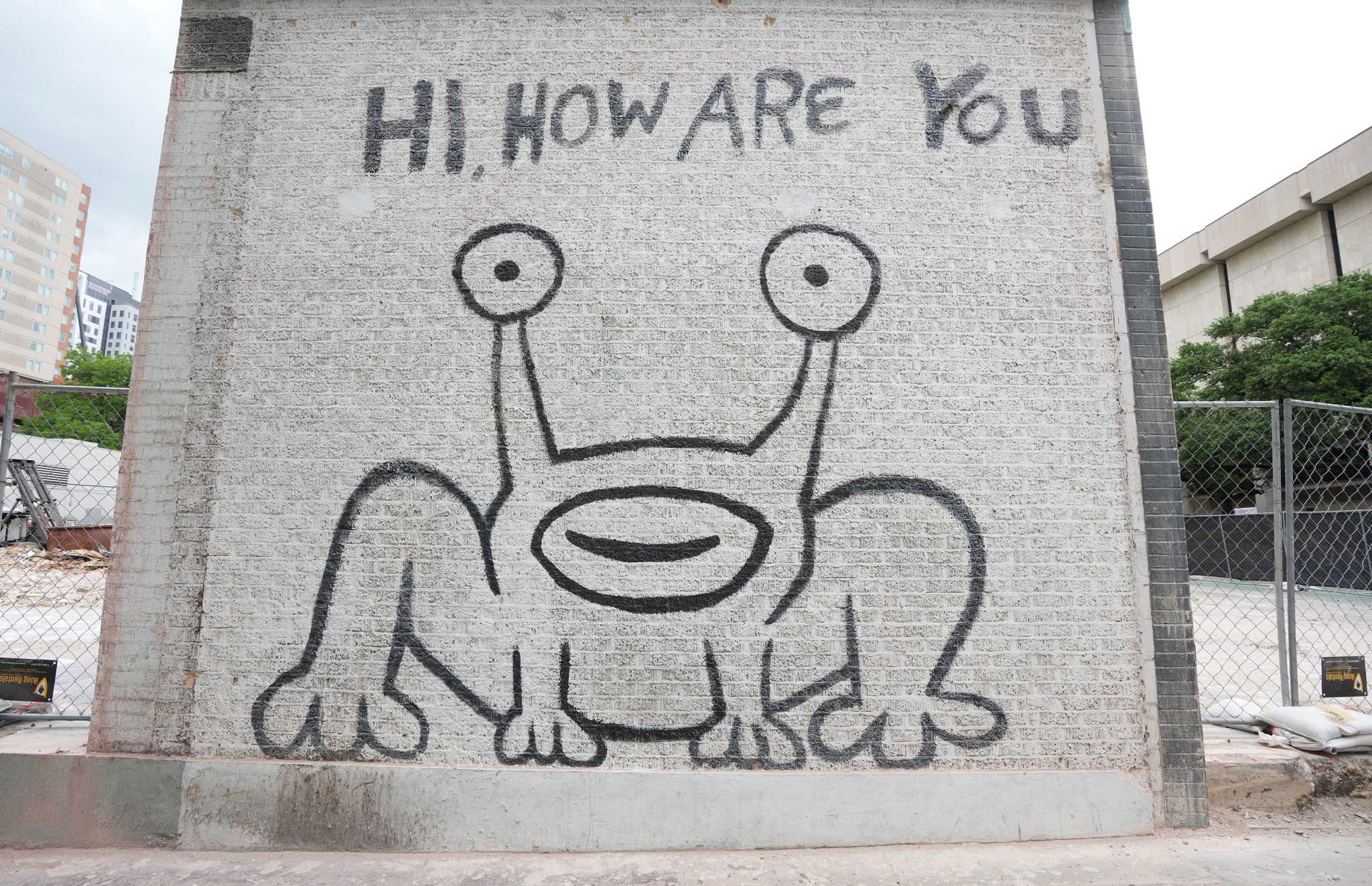
Austin's murals are not wallpaper. They are the city's alternative public record — storing cultural memory that official institutions often fail to preserve. Mars Salazar's tour of five walls reads like a catalog of what Austin considers worth remembering, and the choices are revealing. The oldest entry, 'Austintatious,' has survived more than 50 years on the University Co-Op wall at 23rd and Guadalupe, restored and updated multiple times by its original three UT art-student creators. It functions as a living inventory of local institutions — Peter Pan Mini Golf, Continental Club, Broken Spoke, Matt's El Rancho — with patron saints like Stevie Ray Vaughan, Willie Nelson, and Roky Erickson scattered through a painted skyline. The interactive website at 23rdstreetmural.com turns the wall into a navigable archive. This is civic mythology maintained in real time. Mexic-Arte Museum's 'El Mero Muro' program operates differently — it's a rotating platform for bilingual social commentary, with Amado Castillo III's 2022 'Lead to Live' as its permanent anchor and rotating works addressing the Austin-Saltillo sister-city relationship and Latino cultural figures. The program accepts artist applications, making the wall itself a curated but accessible venue. The 'ReSpec't Texas Music' mural outside Spec's on North Lamar takes a lighter approach, transforming nine Texas music legends into the liquor store's white-rabbit mascot — Willie Nelson's bunny ears tied back with a red bandana, ZZ Top rebranded as ZZ Hop. It's commercial art doing cultural work without pretending otherwise. The 'Vegetarians of the World' mural at East Cesar Chavez and Chicon tells a stranger story. Venezuelan artist Uloang and Argentinian artist Nano Berks painted the three-story piece in 2018 using 20 gallons of paint and 500 spray-paint cans, depicting 15 famous vegetarians from Buddha to Prince. It was a blockchain project sponsored by Swamp Fund and paid for entirely with cryptocurrency — a detail that dates the mural to its precise cultural moment as sharply as the figures it depicts. The most politically charged entry is 'We Rise' at 12th and Chicon in East Austin. The Black history mural was painted over by a newly opened boutique in 2017 — the kind of gentrification flashpoint that generates citywide outrage. Artist Chris Rogers repainted it that same year and has continued updating it since, adding brighter colors in 2024 after reaching 10 years of sobriety, and incorporating images of Michael Ramos and George Floyd as tributes to victims of police brutality. The mural was most recently updated during the 2026 Juneteenth celebration. 'We Rise' is not static art; it is an ongoing argument about who East Austin belongs to. What Salazar's selection reveals in aggregate is a city that stores its identity on exterior walls because the interiors keep changing. Buildings get demolished — Daniel Johnston's 'Hi, How Are You' frog outlived its building as a freestanding wall. Neighborhoods turn over. Boutiques replace murals and then community pressure reverses the erasure. The murals are not just about music and history; they are the contested ground where Austin negotiates what it was, what it is, and what it refuses to let go of.
Worth reading?
RECOMMENDED
Score
52
/100
Anyone visiting or living in Austin who wants a self-guided walking tour with actual backstory — especially if you care about the politics of public art and neighborhood change.
Cultural Placement
Like a chapter from a WPA Federal Art Project catalog crossed with the hyper-local sensibility of Texas Monthly's city coverage. The form is the annotated walking tour — closer to Lucy Lippard's 'The Lure of the Local' than to a Lonely Planet listicle, though it doesn't push as far into critical territory as Lippard would. Think of it as a city's visual autobiography told through five representative pages, with the journalist as docent rather than critic.
Honest assessment
This is solid local cultural journalism that does exactly what it promises: five murals, five stories, specific enough to use as a walking guide. It's not critical art writing — it doesn't argue a thesis about muralism or push into what these walls mean as a collective statement. But the curation is smart, the details are precise, and the 'We Rise' section carries real weight.
What Is NOVEL?
52
/ 100
BedrockNews applies a structured analytical framework called NOVEL to cultural works — games, books, film, music, and more.
How NOVEL worksNerve
2/5
Originality
2/5
Voice
3/5
Endurance
3/5
Lineage
3/5
What did the artist risk? What could have failed?
Low structural risk. The five-murals-of-Austin format is proven, comfortable territory for a city-beat reporter. The 'We Rise' gentrification angle is the sharpest move but isn't pushed hard.
Verified Facts (8)
Originally painted by three University of Texas art students in 1973
Amado Castillo III and his son painted 'Lead to Live' in 2022
Venezuelan artist Uloang and Argentinian artist Nano Berks painted the mural in 2018, using 20 gallons of paint and 500 spray-paint cans
The piece was a blockchain project sponsored by Swamp Fund and paid for entirely with cryptocurrency
The Black history mural was painted over by a newly opened boutique in 2017
In 2024, after reaching 10 years of sobriety, Rogers returned to the mural, adding brighter colors and images of Michael Ramos and George Floyd
Daniel Johnston's 'Hi, How Are You' mural outlived the building it was attached to, prevailing as a freestanding wall after demolition
Mr. Natural, a fully vegetarian restaurant operating in East Austin since 1988
More latest news
Read all