EL NIÑO PERSISTENCE
83%+
TX DROUGHT LEVEL
L1–L2
WHITE XMAS ODDS
<10%
STRONG ENSO WINDOW
Q1 2027
El Niño is running at historic intensity and shows no sign of backing off. NOAA's Climate Prediction Center puts the probability of a strong or very strong event persisting through the first three months of 2027 at more than 83%. Both the Farmers' Almanac and NOAA's official winter outlook converge on the same structural driver: unusually warm sea-surface temperatures in the eastern tropical Pacific are bending the jet stream southward and eastward, tilting the odds toward a wetter, stormier winter across the southern United States.
Extraction Map
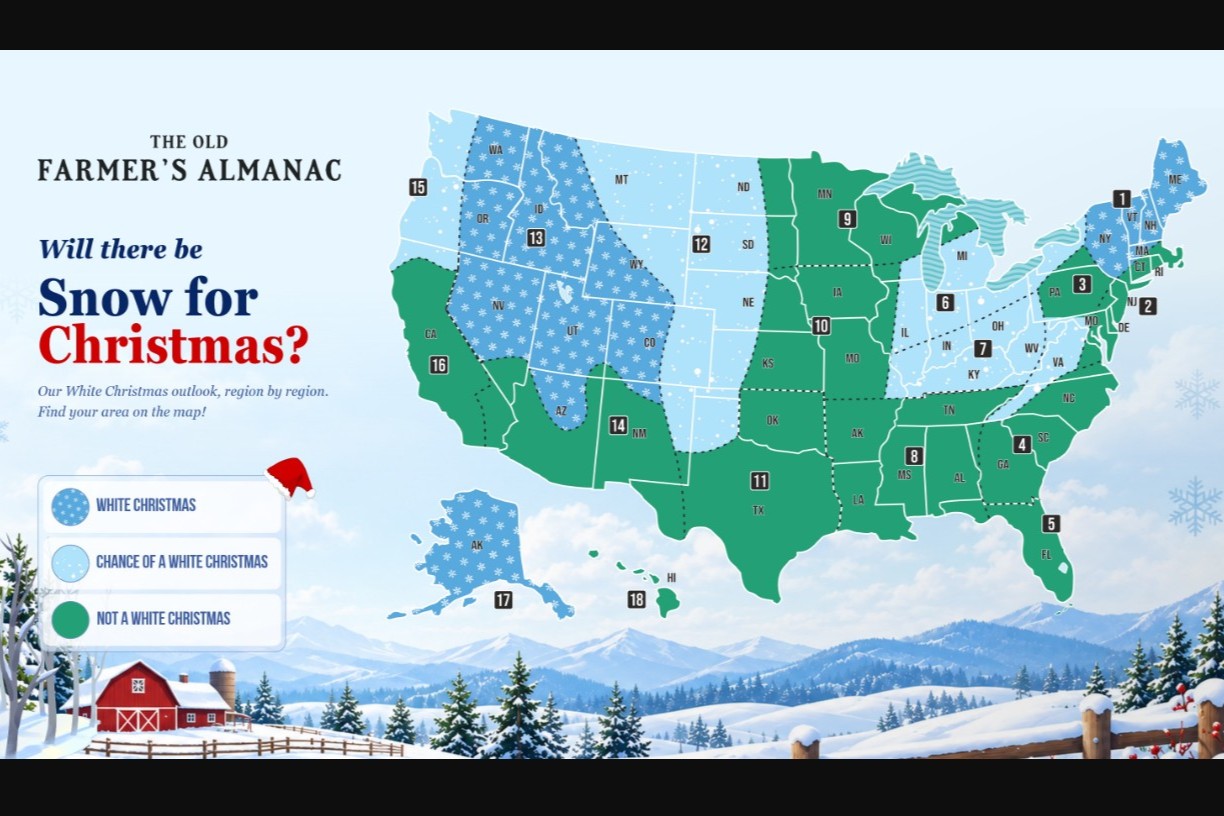
For Texas, the mechanism is straightforward. A southward-displaced jet stream steers Pacific moisture into the southern tier of the country. NOAA director Ken Graham put it plainly: decades of observations confirm that a very strong El Niño brings stormier weather to the South. Central Texas, currently sitting at Level 1 to 2 drought conditions, stands to benefit from the additional rainfall — but the benefit comes with a trap door. Heavy precipitation falling on drought-hardened soil runs off instead of soaking in, creating flash flood and mudslide risk. The white Christmas question is the headline hook, but the data is thin. The Old Farmer's Almanac — a separate publication from the Farmers' Almanac — flags the Texas Panhandle as having "at least some chance" of snow on Dec. 25, defined by NOAA as one inch of snow on the ground. Historical climate data from 1991-2020 shows that most of Texas falls well below 10% probability for a white Christmas in any given year. El Niño can nudge those odds, but not dramatically for areas south of the Panhandle. The real story is water management under uncertainty. A wetter winter is net positive for reservoirs, aquifers, and ranchers across drought-affected areas. But the timing and intensity of precipitation matter enormously. Flash flooding on parched ground can destroy infrastructure and lives while doing little to recharge deep water supplies. The National Weather Service is already urging Texans to prepare for both drought relief and flood hazards — a dual-threat posture that is characteristic of El Niño winters in the southern Plains. The broader climate context is worth noting. El Niño events have been intensifying in recent decades, and the current episode is described as maintaining "historic levels." Whether this reflects long-term ocean warming trends or natural variability is a live scientific question, but the practical implication is the same: the weather pattern driving this winter's forecast is unusually powerful, and its downstream effects on precipitation, temperature, and storm tracks will be felt across the hemisphere. For Central Texas specifically, the next three months are a stress test for infrastructure built during a drought cycle. Stormwater systems, soil management, and emergency flood response will all be tested if the wetter-than-normal forecast verifies. The opportunity to recharge water supplies is real, but so is the risk of destructive flooding events that drought-conditioned communities may not be prepared for.
Worth reading?
OPTIONAL
Score
56
/100
Mildly generative — the article translates climate science into actionable public information about drought relief and flood risk, though it lacks structural depth on infrastructure preparedness or water management policy.
What Is GRIN?
GRIN stands for Generativity, Resilience, Innovation efficiency, and Novelty openness. These four dimensions capture the essential characteristics of any memetic intelligence — whether a nation, a corporation, a religion, or a movement.
About GRINGenerativity
2/5
Resilience
3/5
Efficiency
3/5
Novelty
2/5
Extractive
1/5
Inverted
Does this create new capability or just redistribute existing value?
Modest generative value. Translates NOAA and CPC data into public awareness of drought relief potential, but creates no new capability or infrastructure response.
Verified Facts (6)
El Niño has a more than 83% chance of persisting as a strong or very strong event through the first three months of 2027
Central Texas is currently experiencing Level 1 to 2 drought conditions
NOAA defines a white Christmas as having at least an inch of snow on the ground on Dec. 25
The Old Farmer's Almanac highlights the Texas Panhandle as an area with at least some chance of a white Christmas
Ken Graham, director of NOAA's National Weather Service, stated a very strong El Niño will likely bring a southward and eastward shift to the jet stream
Historical probability data based on climate data from 1991-2020
More latest news
Read all