GROUND STOP
4+ hrs
DUFFY'S ASK
$50B
AUS SAT CANCELLATIONS
95
FUNDS SPENT
1/3
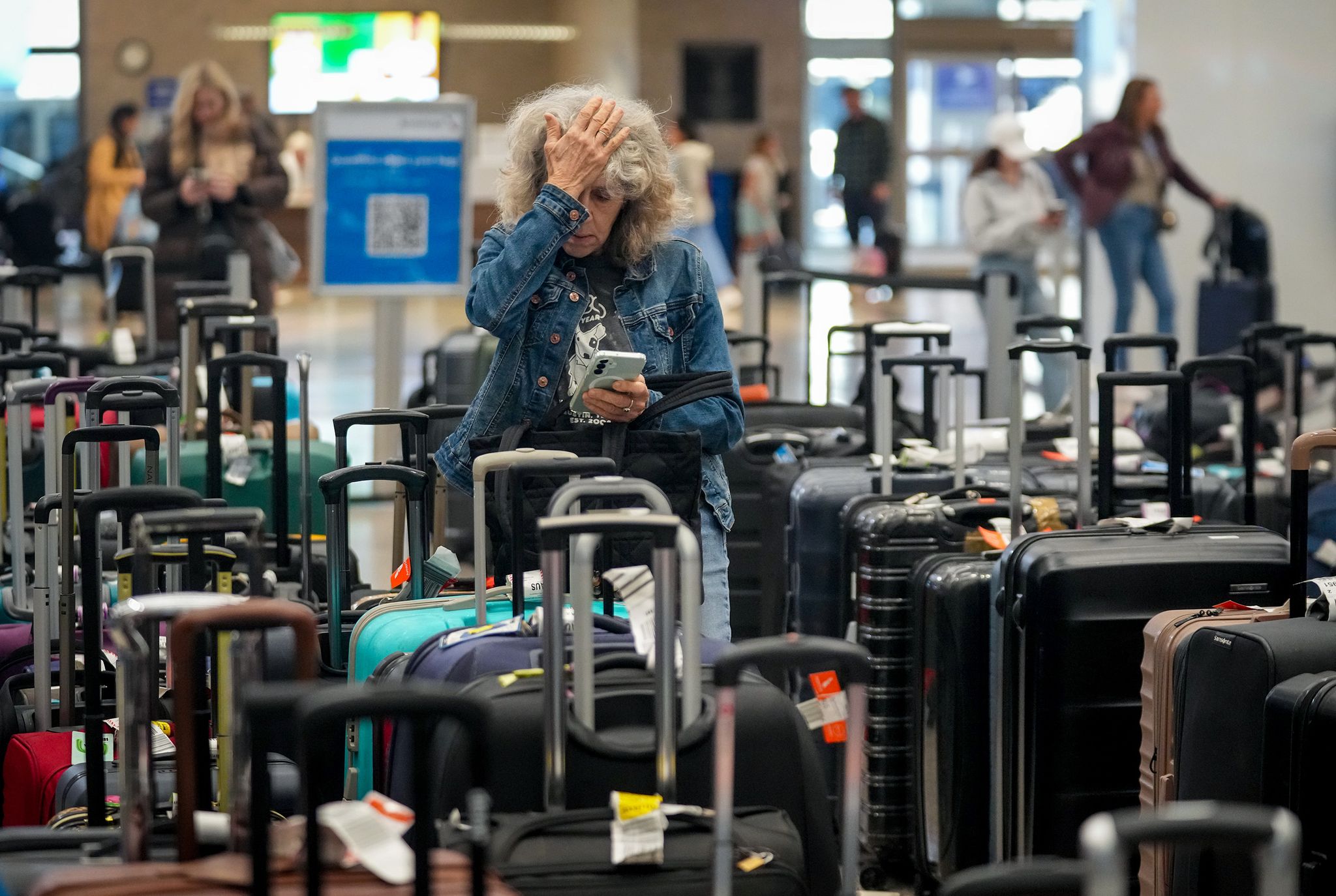
On Friday, a routine router upgrade at an FAA facility in Arkansas flooded a network with data, destabilized aircraft communications and radar feeds, and triggered a nationwide ground stop lasting more than four hours. By Monday, Austin-Bergstrom International Airport had mostly recovered — but hundreds of unclaimed bags still lined the Barbara Jordan Terminal, a physical monument to the fragility underneath American air travel.
Extraction Map
The mechanics of the failure are worth sitting with. A single router at a single facility in a single state created instability across the entire national airspace system. The FAA also pointed to a radar facility in Amarillo. This is not a redundant system absorbing a shock — it is a brittle network where one node failure cascades into full shutdown. The last time the FAA grounded all flights nationwide was January 2023, when a key computer system malfunctioned. Before that, September 11, 2001. The country's air traffic control infrastructure is now producing 9/11-scale disruptions from IT maintenance. Transportation Secretary Sean Duffy responded by asking Congress for $50 billion to upgrade aging air traffic control infrastructure. Rep. Lloyd Doggett, the Austin Democrat, fired back that Duffy has spent only about a third of already-approved funds and called for a "thorough and swift investigation." Both claims can be simultaneously true: the system is underfunded AND the existing funds are being poorly deployed. The political fight obscures the structural diagnosis. The baggage situation at Austin illustrates how disruption costs cascade downward. Airlines — Southwest, Delta, United, American — issued statements about recovery and reunification. But the actual burden falls on individual travelers: stranded passengers on layovers who never intended to be in Austin, families like Joanne Neal searching through piles for luggage belonging to relatives. The airlines' recovery is measured in operational metrics; the travelers' recovery is measured in hours spent standing in a terminal. By Monday, 62 arriving and 71 departing flights at Austin-Bergstrom faced delays. Seven flights were canceled. A separate FAA directive held flights from Texas and much of the surrounding region until 1:15 p.m. to accommodate runway construction — adding a routine 45-minute delay atop the residual chaos. Saturday had seen 95 outbound cancellations by 9 a.m. alone. The system was recovering, but slowly and unevenly. Southwest said it was directly contacting affected customers. Delta said all bags had been sent to their tagged destinations and pointed customers to an online claims process. United said most customers had been reunited with bags. These are process statements, not accountability statements. No airline or agency has yet explained why a network with known single-point-of-failure vulnerabilities was being upgraded without failover protocols that could prevent a full national shutdown. The $50 billion ask is the right scale of ambition and the wrong framing. The question is not whether Congress will appropriate more money. The question is whether the FAA's infrastructure architecture can be redesigned so that a router swap in Arkansas does not ground every plane in America. That is an engineering problem first and a funding problem second. Until that architecture changes, the country is one maintenance window away from another nationwide freeze.
Worth reading?
SKIP
Score
12
/100
Extractive — costs of decades of infrastructure underinvestment and poor redundancy design are borne entirely by travelers and airline workers, while political actors extract messaging value from the crisis.
What Is GRIN?
GRIN stands for Generativity, Resilience, Innovation efficiency, and Novelty openness. These four dimensions capture the essential characteristics of any memetic intelligence — whether a nation, a corporation, a religion, or a movement.
About GRINGenerativity
0/5
Resilience
0/5
Efficiency
1/5
Novelty
1/5
Extractive
4/5
Inverted
Does this create new capability or just redistribute existing value?
Zero new capability created. A maintenance task destroyed value for millions of travelers and produced only a $50B funding request with no architectural redesign attached.
Verified Facts (11)
FAA issued nationwide ground stop Friday afternoon, halting air travel for more than four hours
FAA stated flights grounded 'out of abundance of caution' after data flooded into an FAA network and 'created instability with aircraft communications and radar feeds'
Transportation Secretary Sean Duffy said the instability came while workers were upgrading a router at a facility in Arkansas
Failures also tied to a radar facility in Amarillo
Duffy on Friday asked Congress for an additional $50 billion to upgrade aging air traffic control infrastructure
Rep. Lloyd Doggett stated: 'Secretary Duffy has only spent about a third of Congressionally-approved funds'
95 outbound flights were canceled by 9 a.m. Saturday at Austin-Bergstrom
By Monday 2:45 p.m., 62 arriving and 71 departing flights delayed, 7 canceled at Austin-Bergstrom
FAA directed flights from Texas and much of Louisiana, Oklahoma, New Mexico and Arizona to hold until 1:15 p.m. Monday
Last nationwide ground stop occurred January 2023 when key FAA computer system malfunctioned
Southwest Airlines is Austin's largest carrier; Delta is second-busiest
More latest news
Read all