THOMAS OPINIONS
475
ON SCOTUS
34 yrs
LANDMARK CASES CITED
3
MARSHALL ON SYLLABUS
0
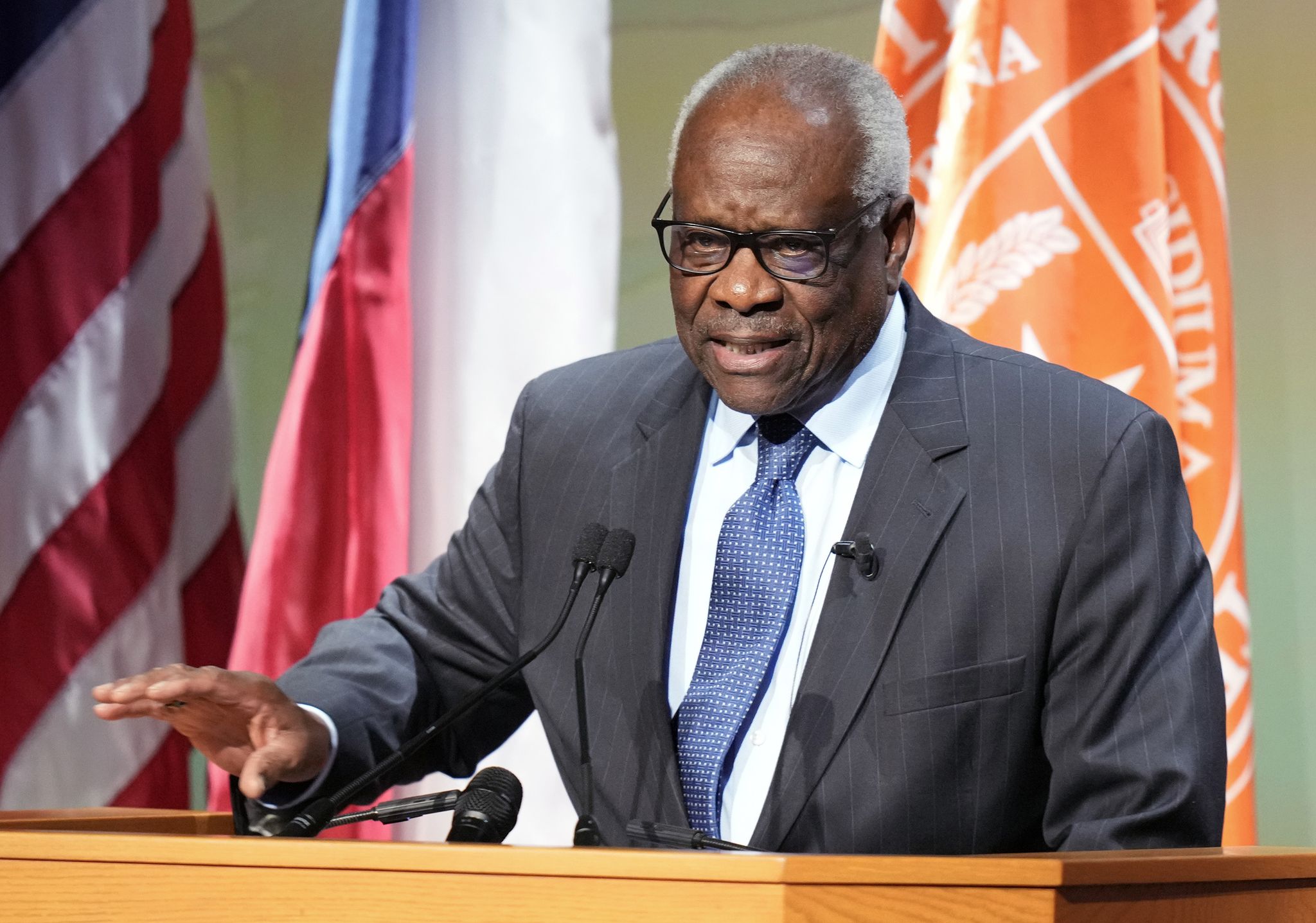
Jim Harrington spent 27 years teaching civil rights law at UT Austin. He watched in real time as Justice Clarence Thomas helped disassemble the legal architecture his seminar studied. Now UT has invited Thomas to teach undergraduates what civil rights mean — a decision Harrington calls doublespeak.
Extraction Map
The factual record is specific. Thomas joined the 2013 Shelby County v. Holder majority that gutted the Voting Rights Act's preclearance requirement, a provision that had blocked thousands of discriminatory voting changes. He joined the 2023 Students for Fair Admissions ruling that ended race-conscious college admissions. In 2025, he voted to let Texas' gerrymandered congressional maps stand — maps that the pre-Shelby Voting Rights Act would have prohibited. These are not marginal concurrences. They are the spine of a three-decade project to narrow the federal civil rights framework. The seminar's reading list tells its own story. Frederick Douglass, MLK, Lincoln, Malcolm X, Booker T. Washington, W.E.B. Du Bois — conspicuously absent is Thurgood Marshall, the justice Thomas replaced. Harrington argues Thomas will interpret these texts through what he calls a "narrow, ahistorical lens," stripping the icons' arguments from the institutional struggles they waged against. Harrington's sharpest point is structural. Thomas' interpretation of the Fourteenth Amendment's Equal Protection Clause — that it was not specifically designed to protect formerly enslaved people but to establish universal equality — contradicts the historical record of Reconstruction. That reading provides the jurisprudential basis for opposing affirmative action while claiming fidelity to the Constitution's text. It is the legal mechanism by which race-conscious remedies are recast as race-based discrimination. The UT context makes the invitation more pointed, not less. The university has removed DEI programs, consolidated ethnic and gender studies, and eliminated courses supporting civil rights education. Designing a "civil rights" seminar featuring a justice who helped dismantle those very protections is, as Harrington frames it, Orwellian — the word meaning the opposite of itself. Harrington invokes the sociological concept of "border watchdog" — someone who protects establishment interests while using the vocabulary of the communities those interests harm. Thomas' well-documented personal relationships with wealthy benefactors like Harlan Crow add texture to this framing. The question isn't whether a sitting Supreme Court justice can teach at a university. The question is what institutional message UT sends by choosing this justice for this subject. This is an opinion piece by a credentialed advocate with a clear perspective. The facts it marshals — case names, dates, vote records, reading lists — are verifiable. The analysis is pointed but not dishonest. What it reveals most clearly is the gap between institutional prestige ("a Supreme Court justice!") and institutional coherence ("teaching what, exactly?").
Worth reading?
SKIP
Score
20
/100
Extractive — institutional prestige is captured to legitimize a record of narrowing rights, while the communities affected by that record bear the cost of diminished legal protections and reduced educational representation.
What Is GRIN?
GRIN stands for Generativity, Resilience, Innovation efficiency, and Novelty openness. These four dimensions capture the essential characteristics of any memetic intelligence — whether a nation, a corporation, a religion, or a movement.
About GRINGenerativity
1/5
Resilience
1/5
Efficiency
1/5
Novelty
1/5
Extractive
4/5
Inverted
Does this create new capability or just redistribute existing value?
Zero new capability created. A weeklong seminar adds prestige signaling, not scholarship. No new legal thinking, no new research, no expanded access — just institutional branding dressed as pedagogy.
Verified Facts (7)
Thomas has written 475 opinions, including 171 majority opinions and 138 concurrences in approximately 10% of the cases the court decided since he became a justice in 1991.
Thomas sided with the majority in Shelby County v. Holder (2013) eviscerating the Voting Rights Act by invalidating the federal preclearance requirement (Section 5).
Thomas joined the majority in Students for Fair Admissions, Inc. v. President and Fellows of Harvard College (2023) striking down consideration of race in college admissions.
Thomas in 2025 voted to allow Texas' gerrymandered congressional districts to proceed.
Thurgood Marshall, whom Thomas replaced on the court, is conspicuously absent from the reading list shared so far.
Jim Harrington led a civil rights seminar at the UT Law School for 27 years, approximately 21 of which overlapped with Thomas' tenure.
UT has removed courses and programs that support greater civil rights, including DEI-related positions.
More latest news
Read all