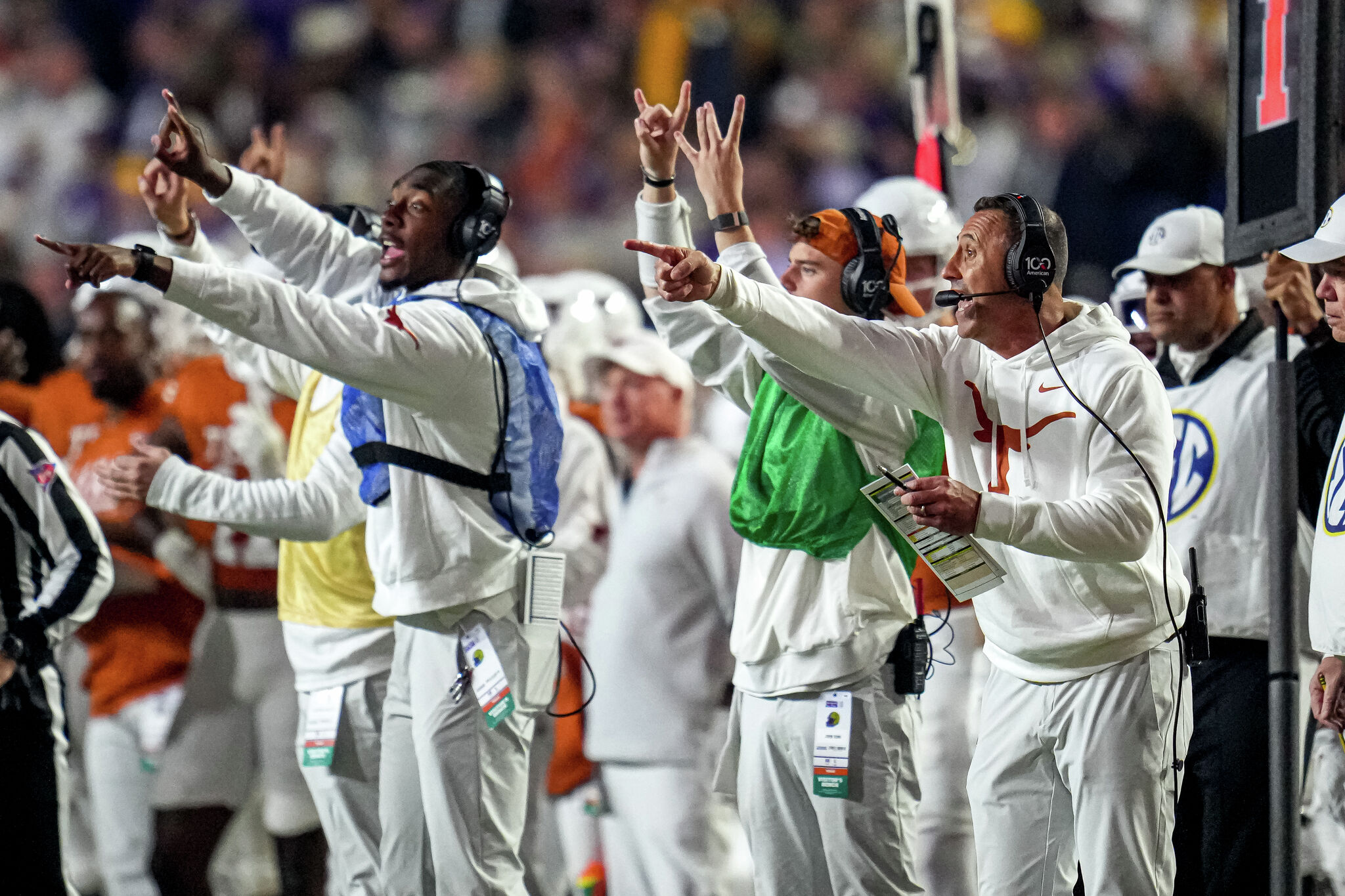
Steve Sarkisian had already signaled two fingers. The Longhorns had just taken a 22-21 lead over LSU with three seconds left on Arch Manning's touchdown pass to Raleek Brown, and the head coach's gut said go for two. Then two staffers got in his ear and changed his mind in the span of a few heartbeats. Manning took the snap and kneeled. Game over. The man in the white hoodie was John Michael Jones, Texas' director of player personnel and de facto analytics translator on the sideline. Jones runs the numbers in real time — kneel-down logic, timeout calculus, penalty acceptance, 10-second runoff scenarios — and feeds Sarkisian condensed verdicts when the clock is running and the noise is deafening. The other voice belonged to Michael Bimonte, the assistant quarterback coach and co-passing game coordinator. Both arrived at the same conclusion independently: below five seconds, with the lead, you take a knee and eliminate the nonzero chance of a catastrophic defensive touchdown off a botched two-point attempt. The probability of LSU scoring on a failed two-point conversion was slim. But slim isn't zero, and the marginal upside of a 24-21 lead versus 22-21 was negligible with three seconds on the clock. This is textbook expected-value reasoning — the kind coaches talk about embracing in press conferences but routinely override when adrenaline hits. What's notable here is that Sarkisian's system actually worked the way it's designed to: the emotional decision got intercepted by the analytical one before it reached the field. Bimonte's other contribution to Texas football is less visible but arguably more important. He runs weekly "situational-masters meetings" where he scours NFL, college, and high school football for examples of smart and avoidable decisions, then presents them to coaches and players. There's a companion reel of "anti-situational masters" — a lowlight tape of preventable mistakes. The meetings are designed to build pattern recognition before the moment arrives, so when it does arrive at 11 p.m. in Tiger Stadium, the right answer is already cached. The Jones-Bimonte dynamic illustrates how analytics actually functions in elite college football programs now. It's not a spreadsheet emailed before the game. It's a human standing next to the head coach, authorized to contradict him in real time, trusted enough that the contradiction lands. Sarkisian described a clear chain: he gets the analytics input, talks to Jones, sometimes loops in defensive coordinator Will Muschamp, then makes the final call. The hierarchy is explicit, the roles are defined, and the system held under maximum pressure. What makes this worth studying isn't the kneel-down itself — any sharp football mind would have arrived there given ten calm seconds to think. It's that two staffers recognized their head coach was about to make an emotional call, intervened within the window where intervention was still possible, and did so clearly enough that Sarkisian changed course mid-celebration. That's organizational design, not analytics. The numbers just gave them the authority to speak up. Texas won 22-21. The margin between that and a potential 23-22 loss was three seconds, one kneel-down, and two staffers who did their jobs.
Worth reading?
OPTIONAL
Score
36
/100
Texas football followers and anyone interested in how real-time analytics pipelines work inside coaching staffs. Skip if you don't care about the specific program.
Cultural Placement
Like a Michael Lewis process piece compressed into 800 words — the same fascination with the person-behind-the-person who changes the outcome by whispering the right number at the right time. Closer to the procedural rhythm of Chris B. Brown's Smart Football breakdowns than to a traditional game recap, but without the tactical depth. Think of it as a Moneyball vignette: one decision, one moment, the system that produced it.
Honest assessment
A well-reported beat piece that lands one genuinely interesting detail — the weekly situational-masters meetings — inside an otherwise standard post-game process story. It does its job for the Austin American-Statesman readership. It doesn't transcend the beat.
What Is NOVEL?
36
/ 100
BedrockNews applies a structured analytical framework called NOVEL to cultural works — games, books, film, music, and more.
How NOVEL worksNerve
1/5
Originality
2/5
Voice
2/5
Endurance
1/5
Lineage
3/5
What did the artist risk? What could have failed?
No real risk taken. Standard beat-reporter feature format — quotes, context, one anecdote. Shapiro filed clean copy on a story that couldn't fail.
Verified Facts (7)
Texas won 22-21 over LSU with Manning's touchdown pass to Raleek Brown with three seconds remaining
John Michael Jones is Texas' director of player personnel
Michael Bimonte is the Longhorns' assistant quarterback coach and co-passing game coordinator
Sarkisian initially signaled to go for a two-point conversion before opting for a kneel-down
Texas holds weekly 'situational-masters meetings' led by Bimonte
Connor Robertson was the center who snapped the ball on the kneel-down
The game was played at Tiger Stadium in Baton Rouge on Saturday, Nov. 14, 2026
More latest news
Read all