COUNTIES FLIPPED
28
BASTROP SWING
+14pt
WILLIAMSON SWING
+11pt
MAJORITY HISPANIC
19/28
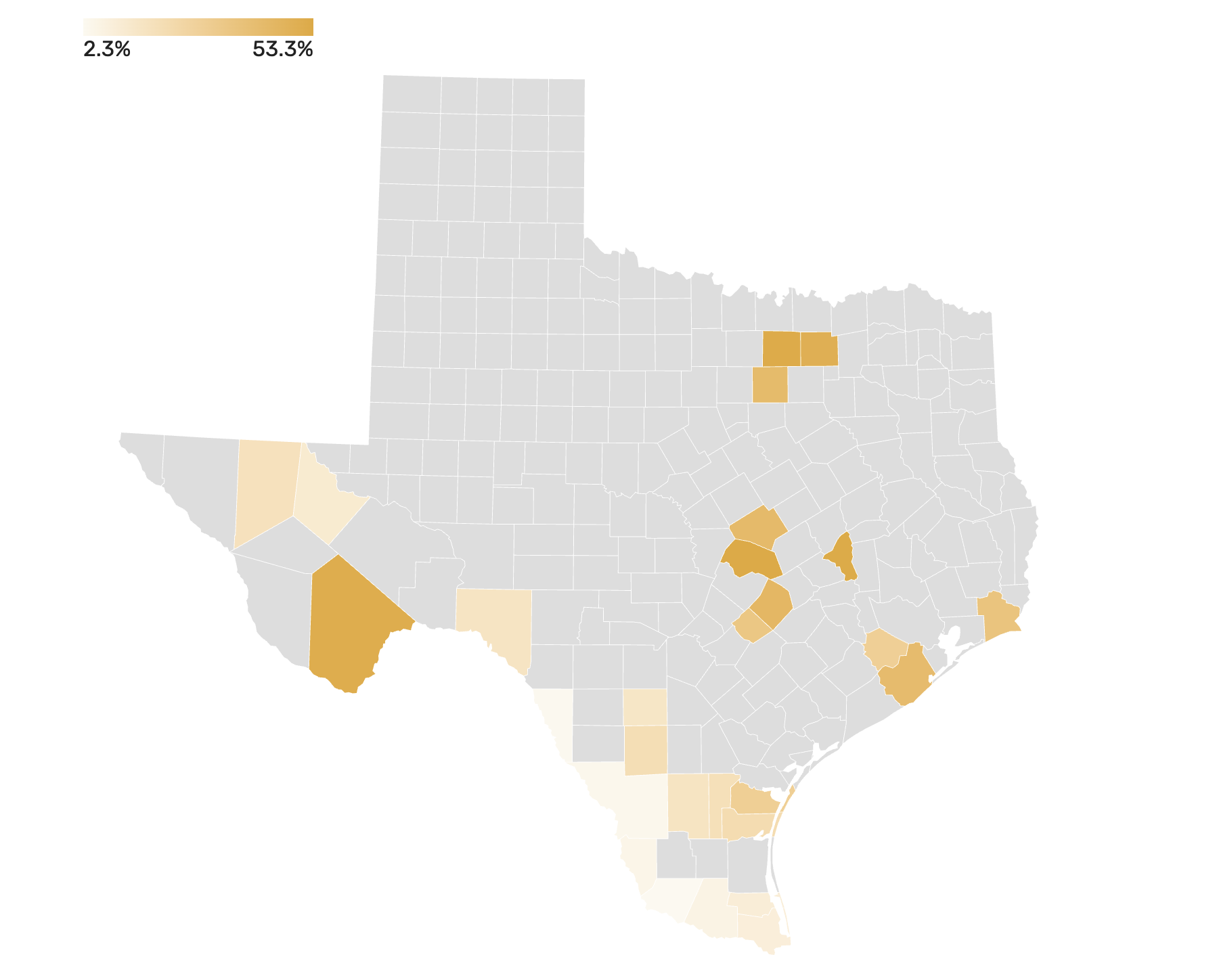
James Talarico won Texas's first Democratic U.S. Senate seat since 1988 by flipping 28 counties that voted for Donald Trump in 2024. The headline number is striking, but the composition of those counties tells a more durable story than any single election result. Two Austin-area counties — Williamson and Bastrop — rank among the wealthiest and whitest on the flip list, and both are fast-growing suburbs whose voter profiles have been shifting for a decade.
Extraction Map
Williamson County, once described as "reliably red," delivered 59% for Talarico after giving Kamala Harris just 48% two years earlier — an 11-point swing. Bastrop County moved even more dramatically: Talarico took 54% compared with Harris's 40%, a 14-point lurch. Both counties rank in the top six among flipped counties for median household income (above $80,000) and white population share. Williamson has the highest percentage of white residents of any county on the list. The wealth dimension matters. Among the 28 flipped counties, only nine had median household incomes above $80,000. Williamson ranked fourth and Bastrop sixth. This is not a story about economically distressed voters punishing incumbents — it's affluent suburbanites choosing Democratic representation, a pattern that accelerated during the Trump era nationwide but had been slower to materialize in Texas. The Hispanic dimension is equally important. Nineteen of the 28 flipped counties have Hispanic populations above 41% — the statewide share. Bastrop and Williamson, however, are notable precisely because they are outliers on the other end: whiter, wealthier, and suburban. They represent a different mechanism of realignment — educated suburban professionals moving away from the Republican brand — rather than the demographic-weight story playing out in majority-Hispanic counties. Five of the 28 flipped counties are suburbs of larger metropolitan areas. Medium-metro counties (like Brazos and Webb) flipped more frequently than either large or small ones, suggesting the suburban ring around Texas's major cities is now genuinely contested ground. Tarrant County — Fort Worth's home base and a longtime Republican stronghold — also backed Talarico, signaling the erosion isn't confined to Austin's orbit. The structural question is whether this realignment sticks or whether it's a one-cycle protest vote driven by candidate-specific dynamics. Williamson County's decade-long drift suggests structural change: population growth importing new voters, educational attainment correlating with partisan shift, and suburban identity decoupling from Republican identity. If medium-metro suburban counties continue trending this way, Texas's electoral math changes permanently — not because the state's demographics demand it, but because the suburbs chose it. The 2026 Texas results are not a fluke or a wave. They are the visible surface of a realignment that has been building since at least 2018, accelerated by population growth in suburban counties whose residents look more like Williamson than like the rural Texas base the GOP has relied on for decades.
Worth reading?
RECOMMENDED
Score
64
/100
Mildly generative — competitive two-party politics in previously uncontested suburban counties expands democratic accountability and forces both parties to compete for voters who were previously taken for granted.
What Is GRIN?
GRIN stands for Generativity, Resilience, Innovation efficiency, and Novelty openness. These four dimensions capture the essential characteristics of any memetic intelligence — whether a nation, a corporation, a religion, or a movement.
About GRINGenerativity
3/5
Resilience
3/5
Efficiency
4/5
Novelty
2/5
Extractive
1/5
Inverted
Does this create new capability or just redistribute existing value?
Moderate generative signal. Genuine two-party competition in previously safe GOP suburbs forces policy responsiveness to a broader electorate. Not yet structural — one election doesn't prove durability.
Verified Facts (14)
Democrats won Texas's first Democratic U.S. Senate seat since 1988
First Democratic governorship in more than three decades
Talarico won 28 counties that Trump previously carried in 2024
In Bastrop County, Talarico received 54% of the vote, compared with 40% for Kamala Harris in 2024
In Williamson County, Talarico received 59%, up from 48% for Harris
Among the 28 counties that flipped, Williamson ranked fourth and Bastrop ranked sixth in median household income
Nine counties on the list with a median household income above $80,000
Williamson County has the highest percentage of white residents among flipped counties
Bastrop County ranks sixth in percentage of white residents among flipped counties
19 of the 28 flipped counties have Hispanic populations above 41%
41% is the total share of Hispanic residents across Texas
Five suburban counties of larger metropolitan areas flipped
Tarrant County — home to Fort Worth — backed Talarico
Williamson County once considered 'reliably red'
More latest news
Read all